A key supplier files for insolvency on a Friday. Procurement hears about it from the plant on Monday. The supplier passed onboarding two years ago, and nobody checked it again. The sanctions screen, the financial review and the ESG survey sat in three different tools, and none of them had an owner.
Supplier risk management software keeps those checks on one record and watches each supplier after the contract is signed. We ranked the 10 best supplier risk management software tools on five weighted criteria. Every fact comes from vendor product, pricing and help pages read on November 3, 2026. Our scoring rules are public.
What Is the Best Supplier Risk Management Software in 2026?
SAP Ariba Supplier Risk is the best supplier risk management software for most procurement teams in 2026, scoring 8.3 out of 10. It is the only tool here with a published price, from USD 490 per user a month. Moody’s (7.7) leads on entity data, and apexanalytix (7.5) on fraud and supplier data.
| # | Tool | Type | Best for | Score |
|---|---|---|---|---|
| 1 | SAP Ariba Supplier Risk | Risk module in the SAP suite | SAP buyers who want risk on the supplier record, at a listed price | 8.3 |
| 2 | Moody’s Supplier Risk | Entity data and risk scores | Ownership, sanctions and financial data on a very large entity base | 7.7 |
| 3 | apexanalytix | Supplier risk and fraud platform | Fraud, bank change and compliance screening across a large supplier base | 7.5 |
| 4 | Exiger (1EXIGER.AI) | Due diligence and supply chain risk | Deep checks and supplier mapping beyond tier 1 | 7.4 |
| 5 | D&B Supplier Intelligence | Entity data and screening | Sanctions, UBO and supplier health with a free trial | 7.3 |
| 6 | Certa | Onboarding and TPRM workflow | Risk checks built into supplier onboarding | 7.2 |
| 7 | Coupa Supplier Risk & Performance | Risk module in the Coupa suite | Coupa buyers who want risk next to spend | 7.1 |
| 8 | Prewave | Disruption and ESG monitoring | Supply chain law compliance and early disruption alerts | 6.9 |
| 9 | EcoVadis | Sustainability ratings | Supplier sustainability scorecards and corrective action plans | 6.0 |
| 10 | RapidRatings | Financial health ratings | Financial health of private suppliers | 5.6 |
Our pick
SAP Ariba Supplier Risk
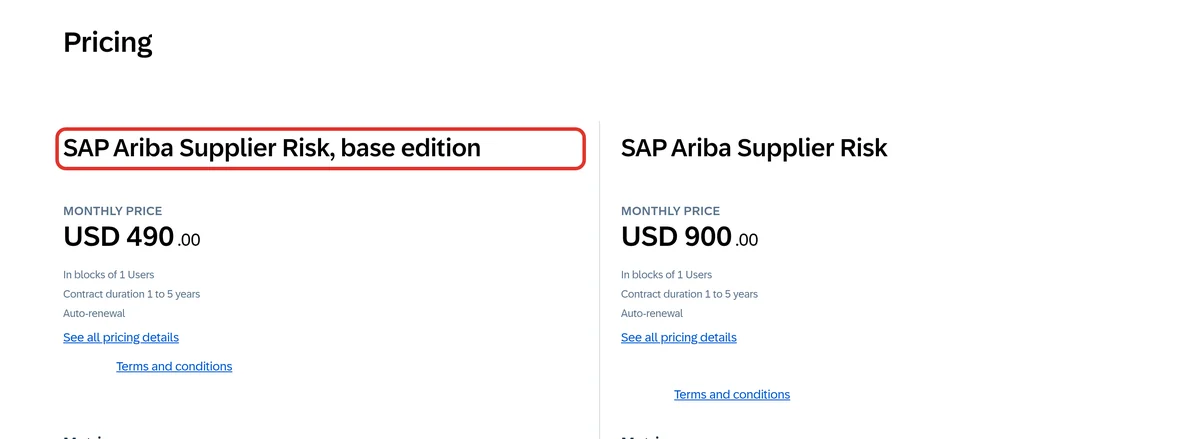
SAP Ariba Supplier Risk tracks financial, operational, environmental, social, regulatory and legal risk on each supplier. Its product page lists the base edition at USD 490 a month and the full edition at USD 900, priced per user. SAP says you can buy it without its other supplier management products.
Supplier Risk vs Vendor Cyber Risk vs Supply Chain Risk
Supplier risk management software, in procurement, checks whether a supplier is safe to pay and keep. That means financial health, sanctions, ownership, ESG and disruption. Vendor cyber risk tools rate a vendor’s security from the outside. Supply chain risk tools map suppliers several tiers deep and watch for events that stop goods moving. Our supply chain risk management software ranking scores 10 of them. Our Resilinc vs Everstream vs Interos comparison looks at three of those tools in depth.
Which one are you buying?
| Question | Supplier risk management | Vendor cyber risk | Supply chain risk mapping |
|---|---|---|---|
| Main job | Is this supplier safe to onboard, pay and renew? | Is this vendor a security or data risk? | Where could supply break, and how far down? |
| Who owns it | Procurement, with compliance and finance | IT security | Supply chain and operations |
| Typical checks | Financial health, sanctions, ownership, ESG, news | Security ratings, questionnaires, breach alerts | Sub-tier maps, site locations, event alerts |
| Tools in this guide | All 10 below | Several list cyber as one domain among many | Exiger, Prewave and Coupa reach beyond tier 1 |
This guide covers the procurement meaning. If the risk tool has to sit inside a wider supplier platform, start with our procurement software guide. Our supplier management software guide explains where risk fits in the supplier record, and our best supplier management software ranking scores 12 platforms.
Do You Need Supplier Risk Management Software Yet?
You need supplier risk management software when you cannot say, today, which suppliers were checked and when. A spreadsheet and a yearly review can work for a few dozen suppliers. Once sanctions lists, ownership changes and supply laws change faster than the review cycle, the spreadsheet is out of date before it is shared.
- Stay on a spreadsheet if one person owns every supplier and none of them is critical to production.
- Start with data, not a platform, if you mainly need financial health or sanctions results. D&B offers a 30-day free trial in the US and Canada.
- Buy a platform if you onboard suppliers every week, buy from high-risk countries, or report under supply chain laws.
How Do the 10 Supplier Risk Tools Score?
SAP Ariba Supplier Risk scores 8.3, Moody’s 7.7 and apexanalytix 7.5. Exiger (7.4), D&B (7.3), Certa (7.2) and Coupa (7.1) sit close together. Prewave scores 6.9. EcoVadis (6.0) and RapidRatings (5.6) are specialists: one rates sustainability, the other financial health.
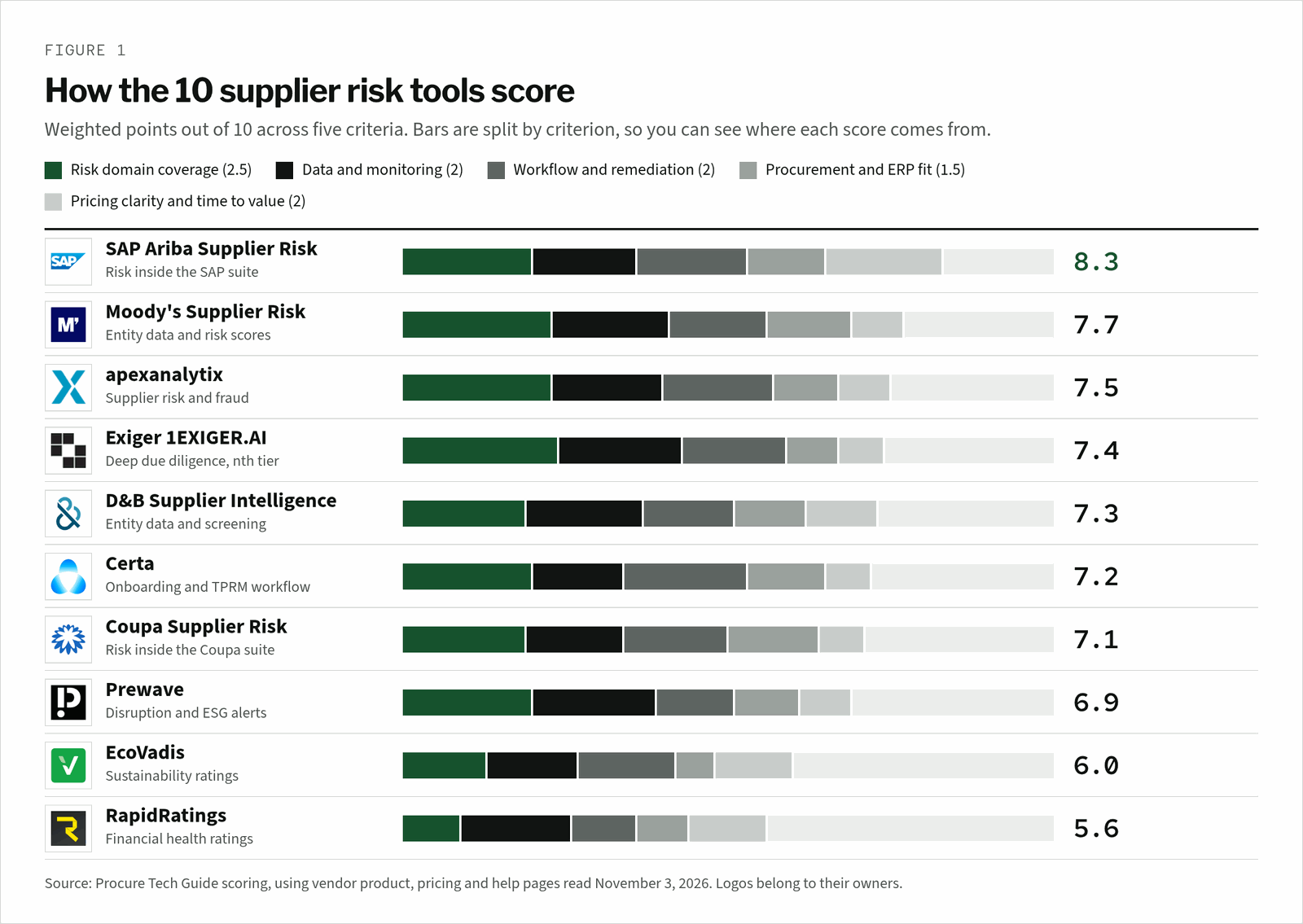
Read the bars by colour, not just the total. In supplier risk management software, coverage and price pull in different directions. Exiger, Moody’s and apexanalytix lead on risk domain coverage. SAP wins on its published price and suite fit. A tenth of a point is not a reason to choose one tool over another.
| Criterion | Weight | What earns points |
|---|---|---|
| Risk domain coverage | 2.5 | Financial, sanctions, ownership, ESG, cyber, news and beyond-tier-1 risk named on the vendor’s own pages |
| Data and monitoring | 2 | Size of the stated data base, continuous monitoring and alerts |
| Workflow and remediation | 2 | Assessments, issue tracking, corrective actions and approval routing by risk |
| Procurement and ERP fit | 1.5 | Ties to the supplier record, S2P suites and ERPs, stated connectors and APIs |
| Pricing clarity and time to value | 2 | Published prices, a free trial or a clear pricing basis |
Which Risk Domains Does Each Tool Cover?
Exiger states all eight risk domains we looked for. Moody’s and Certa state seven, and neither page named mapping beyond tier 1. apexanalytix and Coupa state six, and D&B five. Prewave is strongest on ESG, news and multi-tier visibility. RapidRatings covers financial health only, and says so.
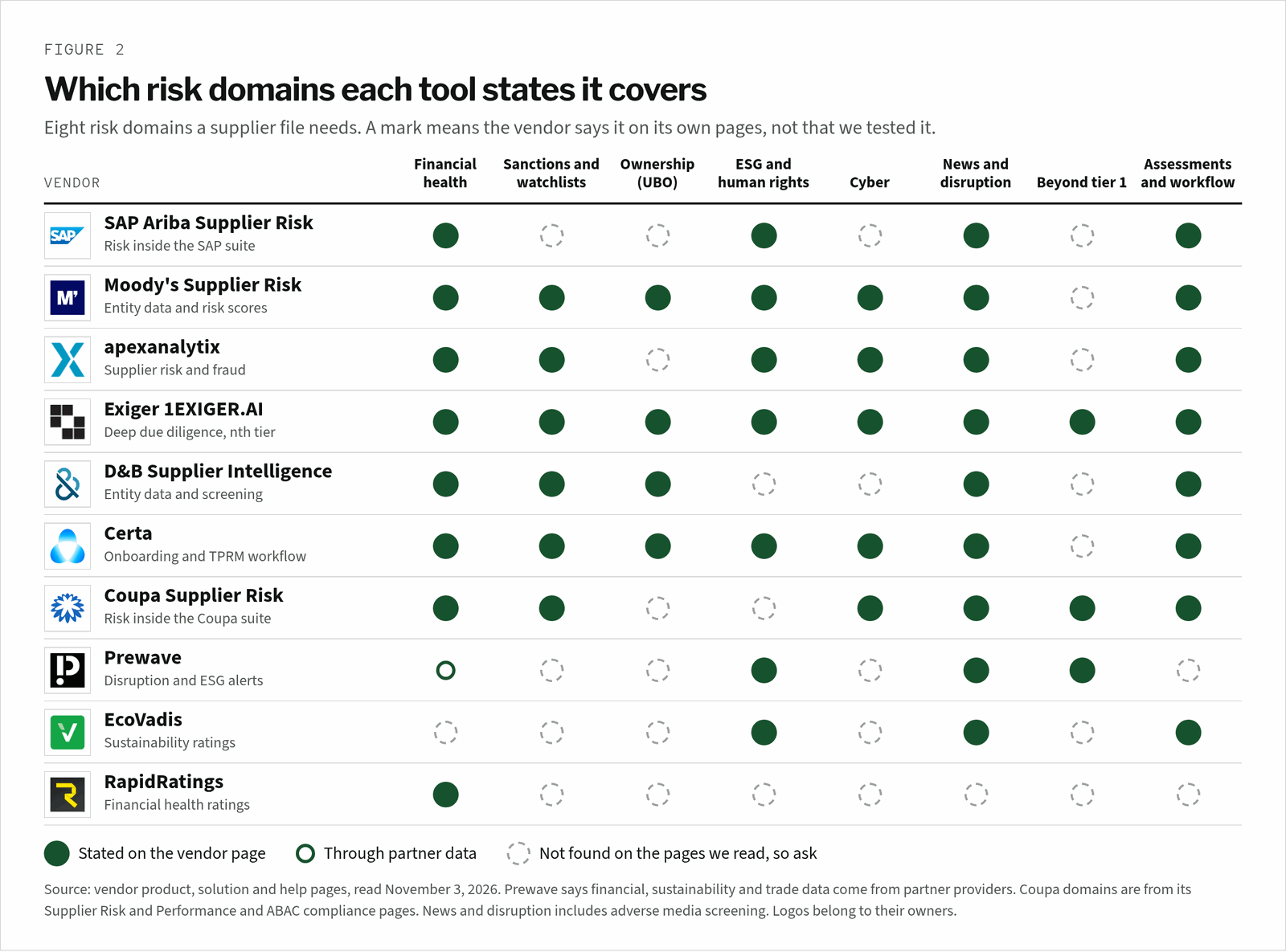
A dashed circle is a demo question for the supplier risk management tools, not a verdict. The feature may sit on a page we did not read, or in a partner add-on. Ask each vendor to show it on one of your own suppliers, and to confirm in writing whether it is included or priced separately.
What the Record Holds
A record in supplier risk management software is only useful if it answers three questions fast: who owns this supplier, what was checked, and what changed since. Ask each tool to show these fields filled in for a real supplier. A risk score with no owner and no date is a number, not a control.
Fields to see in the demo
| Field | Why it matters | Who owns it |
|---|---|---|
| Legal entity and ultimate owner | Sanctions and conflicts follow the owner, not the trading name | Compliance |
| Sanctions, PEP and watchlist result, with date | Proves the supplier was screened before it was paid | Compliance |
| Financial health score and trend | Warns before a key supplier fails | Finance or treasury |
| ESG rating or survey result | Feeds supply chain due diligence reports | Sustainability lead |
| Risk tier and next review date | Sets how often the supplier is checked again | Procurement |
| Open alerts and issues | Shows what is being fixed, by whom, by when | Category manager |
| Bank details and change history | Stops payment fraud from a changed account | AP with a second approver |
| Business owner and spend | Says who answers for the supplier inside the company | Requesting team |
If the record also has to drive purchasing, see our best procurement software ranking.
How Much Does Supplier Risk Management Software Cost?
Most supplier risk management software is sold by quote. Only SAP publishes a price. SAP Ariba Supplier Risk lists USD 490 a month for the base edition and USD 900 for the full edition, priced per user with 1 to 5 year contracts. D&B offers a 30-day free trial. EcoVadis says annual fees vary by company size. Everyone else quotes. Suppliers also pay for their own EcoVadis rating, and our EcoVadis pricing breakdown lists those fees.
| Tool | Published price or pricing basis | Source |
|---|---|---|
| SAP Ariba Supplier Risk | Base edition USD 490 a month and full edition USD 900 a month, in blocks of 1 user, priced by user per year; contract 1 to 5 years with auto-renewal | SAP product page |
| D&B Supplier Intelligence | 30-day free trial for new customers in the US and Canada, one per D-U-N-S Number; paid plans by quote | D&B free trial page |
| EcoVadis | Enterprise subscription with unlimited suppliers and users; annual fees vary by company size | EcoVadis plans and pricing |
| Moody’s, apexanalytix, Exiger, Certa | Quote based; no price on the pages we read | Vendor sites |
| Coupa, Prewave, RapidRatings | Quote based; no price on the pages we read | Vendor sites |
Some articles put a dollar figure on Coupa’s risk module. Coupa does not publish one, so treat any such number as a guess. Ask for licence, data, monitoring and implementation as separate lines. Our Coupa pricing guide shows what Coupa does disclose.
The 10 Best Supplier Risk Management Software Tools, Reviewed
Each supplier risk management software review covers what the tool checks, where its data comes from, and what we could not confirm. Every claim links to the vendor page where we read it. Screenshots show each vendor’s own page, with the relevant part outlined in red.
1. SAP Ariba Supplier Risk
SAP’s product page says the tool filters data from more than 600,000 public and private sources and tracks more than 200 risk incidents. It monitors financial, operational, environmental, social, regulatory and legal risk, and helps find where forced labor may exist in your supply chain.
It runs control assessments, issue management and action plans, and connects risk to source-to-pay. SAP’s learning course says you can subscribe without its supplier information or lifecycle products. Sanctions screening and ownership data were not named on the pages we read, so ask what is included and what comes from partners.
Strengths
- Published per-user price
- Risk sits on the SAP supplier record
- Forced labor and incident tracking built in
Watch-outs
- Sanctions and ownership data not named
- Best value only inside an SAP estate
2. Moody’s Supplier Risk
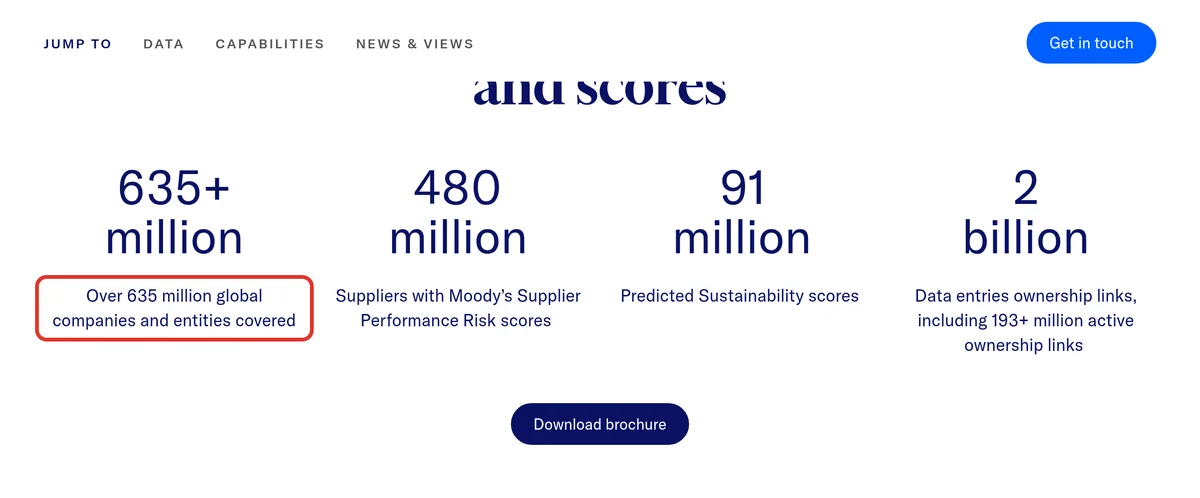
Moody’s supplier risk page says it covers over 635 million companies and entities. It frames supplier risk across financial stress, cyber threats, compliance, geopolitical developments and physical and transition risk. Supplier profiles include ownership and control intelligence.
Monitoring, alerts and workflows run in its own interface, or through data feeds, connectors, APIs and MCP integrations. Moody’s lists connectors for Coupa and for SAP Ariba and SAP S/4HANA. That suits teams that want Moody’s data inside the suite they already run.
Strengths
- Very large entity and ownership base
- Connectors for Coupa and SAP
- Cyber and geopolitical risk named
Watch-outs
- No published price
- Mapping beyond tier 1 not named on the page we read
3. apexanalytix
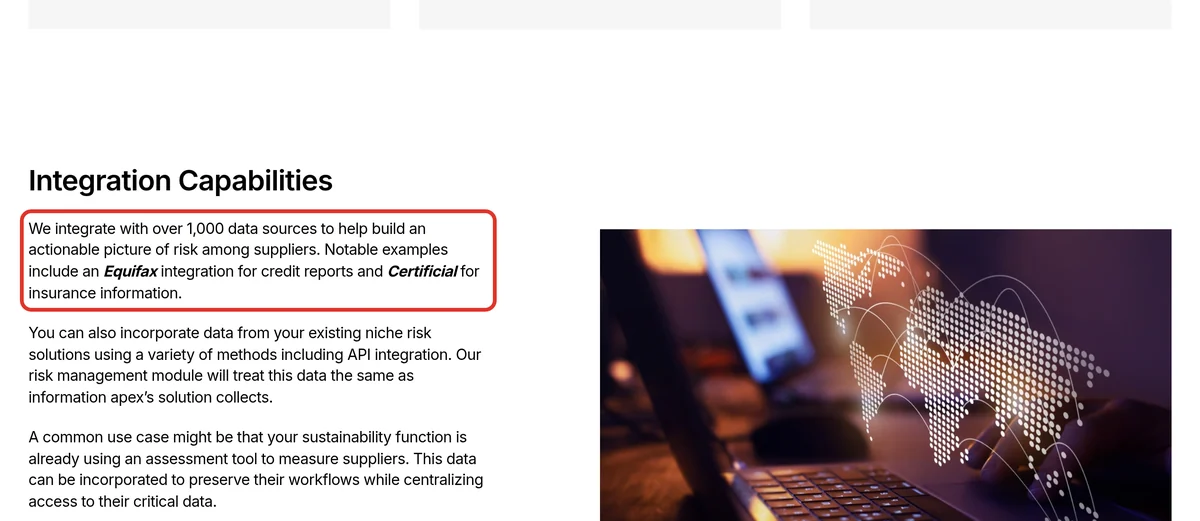
apexanalytix’s risk management module integrates with over 1,000 data sources, including Equifax for financial health and Certificial for insurance. It screens against 100+ prohibited entity lists and 200+ PEP lists, and scans supplier identity and transaction data for fraud and bank account changes.
Its database of 280 million suppliers can pre-populate profiles at onboarding. One dashboard maps regulatory, fraud, cyber and other risk across the supply base. Its platform page says apexanalytix is a Leader in the 2026 Gartner Magic Quadrant for Supplier Risk Management Solutions.
Strengths
- Strong fraud and payment controls
- Large stated compliance list coverage
- Pre-filled supplier profiles
Watch-outs
- No published price
- Ownership data not named on the page we read
4. Exiger (1EXIGER.AI)
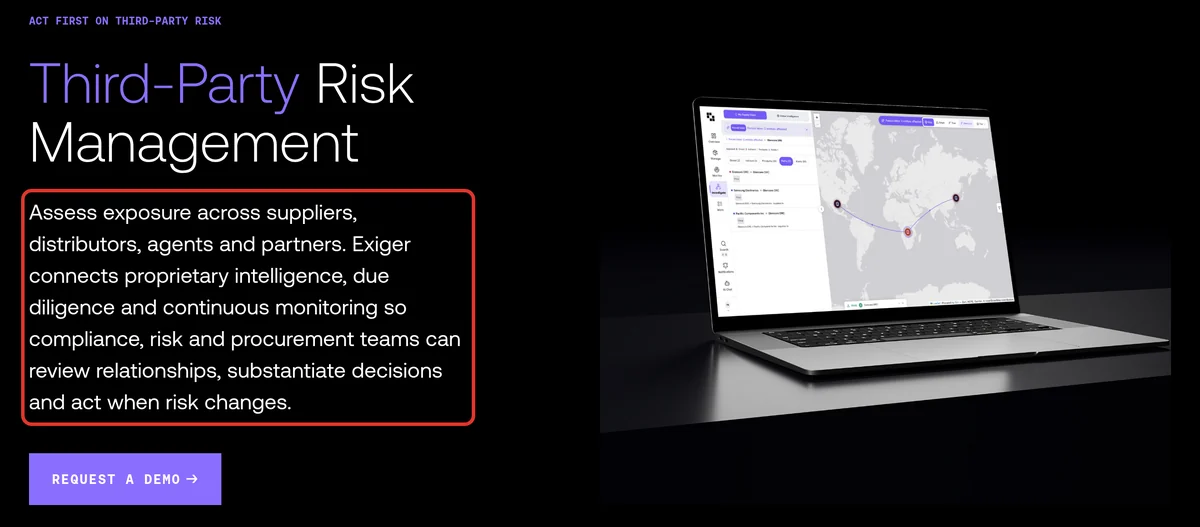
Exiger’s third-party risk page combines sanctions, bribery and corruption, financial health, cyber exposure, ownership, operational disruption and human rights. Risk weights and thresholds are configurable. Questionnaires adjust to how critical a third party is.
When a supplier needs a deeper look, Exiger’s due diligence researchers check public records, affiliations, litigation and reputation. Its 1EXIGER.AI page cites three trillion connected data points across 200 jurisdictions, and its supply chain page covers suppliers at the nth level.
Strengths
- Widest stated risk coverage
- Human researchers for high-risk cases
- Mapping beyond tier 1
Watch-outs
- No published price
- Heavy for a small supplier base
5. D&B Supplier Intelligence
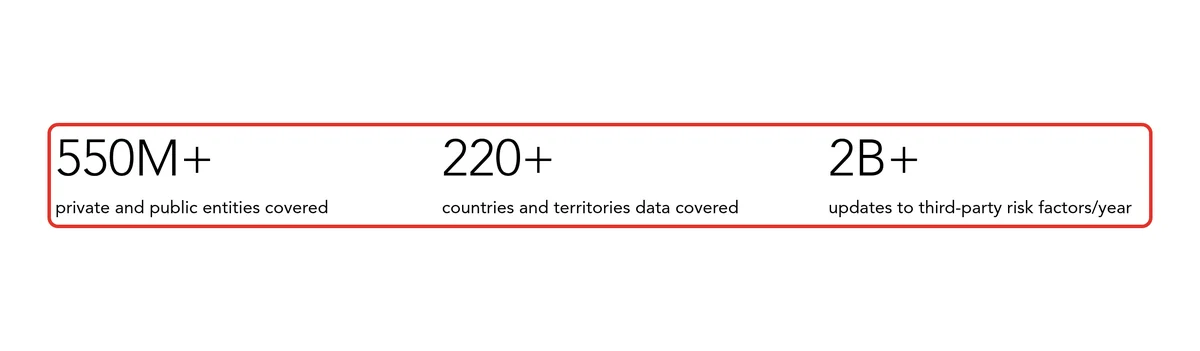
D&B’s Supplier Intelligence page says it covers 550M+ private and public entities in 220+ countries, with 2B+ updates to third-party risk factors a year. It screens against sanctions, watchlists, PEP lists and adverse media, and gives ultimate beneficial owner data with interactive ownership maps.
Predictive risk scores help segment suppliers by risk and performance. For tracking supplier KPIs after onboarding, see our supplier performance management software ranking. Custom surveys support ongoing assessments, and an MCP connector makes the data callable from other systems. The free trial runs 30 days for new customers in the US and Canada, one per D-U-N-S Number.
Strengths
- Free trial to test on your suppliers
- Strong ownership and screening data
- Predictive supplier health scores
Watch-outs
- Cyber and ESG not named on the page we read
- Trial limited to the US and Canada
6. Certa
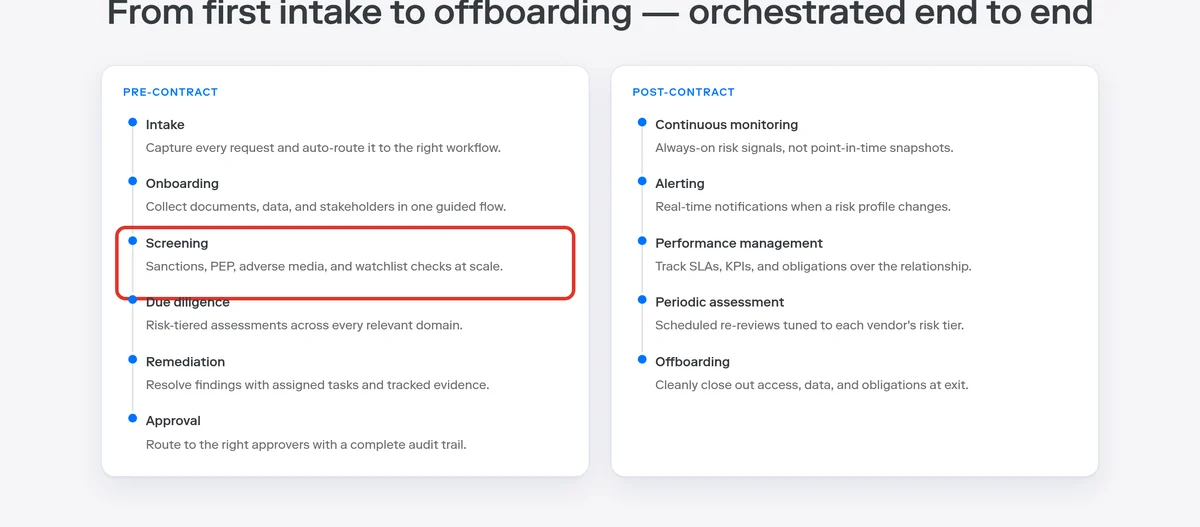
Certa’s supplier onboarding page runs sanctions, UBO and risk-domain screening automatically, and scores risk across financial, compliance and cyber. Low-risk suppliers are auto-approved, and contracts and ERP records sync when a supplier goes live.
Its third-party risk page covers sanctions, PEP, adverse media and watchlist checks, continuous monitoring, re-reviews tuned to each risk tier, and offboarding. Certa says it is a Leader in the 2026 Gartner Magic Quadrant for Third-Party Risk Management Tools, with 130+ integrations.
Strengths
- Risk checks run inside onboarding
- Re-review cadence by risk tier
- Wide integration list
Watch-outs
- No published price
- Relies on partner data for depth
7. Coupa Supplier Risk & Performance
Coupa’s supplier risk and performance page uses AI to watch outside data sources, community data and user feedback. When ratings change, it recommends actions such as putting a high-risk supplier on hold. Risk assessments cover InfoSec, anti-bribery and anti-corruption, GDPR and other domains, with real-time alerts.
Its anti-bribery and anti-corruption page covers watch lists, political exposure, state ownership and negative news, including fourth and fifth parties. Coupa’s site blocked our screenshot tool, so this review has no capture. Our Coupa vs SAP Ariba comparison covers the wider suite.
Strengths
- Risk sits next to spend and the supplier portal
- Fourth and fifth party screening
- Prescriptive actions on risky suppliers
Watch-outs
- No published price
- Best value only inside Coupa
8. Prewave
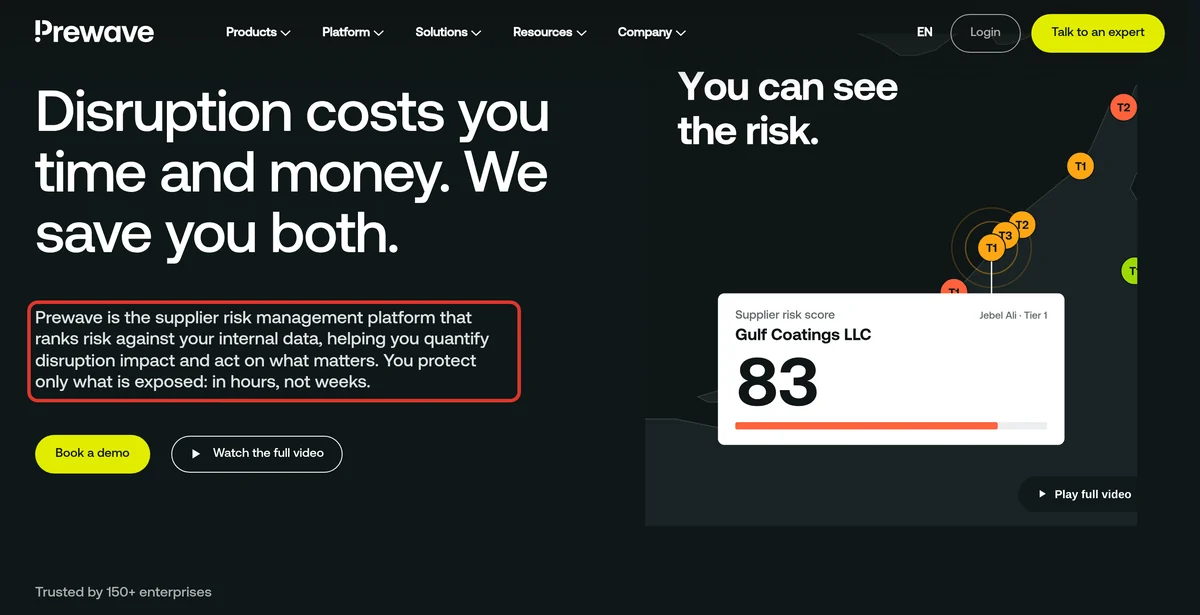
Prewave’s home page says it ranks risk against your internal data and quantifies disruption impact. It is built on 4.5M signals a day. It shows risk beyond tier 1 without supplier surveys, and uses your ERP data to show how disruption affects your business.
Prewave supports compliance with LkSG, CSDDD, EUDR and forced labour rules. It says financial, sustainability and trade data come from data partners. Prewave also says it is a Leader in the 2026 Gartner Magic Quadrant for Supplier Risk Management Solutions.
Strengths
- Strong on supply chain due diligence laws
- Disruption alerts beyond tier 1
- No supplier surveys needed for mapping
Watch-outs
- Sanctions and ownership not named
- Financial data comes from partners
9. EcoVadis
EcoVadis’s home page says it has rated 175K companies across 180+ countries and 230+ industries. Its ratings page offers analyst-validated scorecards, corrective action plans and 360 Watch news monitoring across 100,000+ sources.
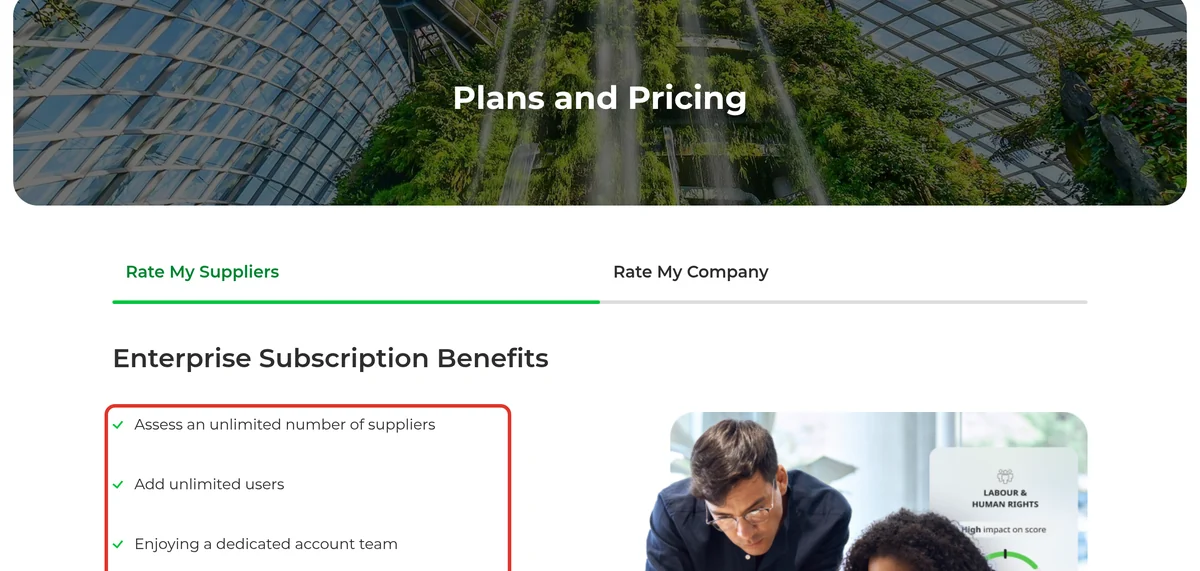
The plans and pricing page says the enterprise subscription covers an unlimited number of suppliers and unlimited users, and that annual fees vary by company size. It is a sustainability tool first. Pair it with a financial and sanctions source for full supplier risk. Our EcoVadis vs Sedex vs CDP comparison shows how its rating differs from SMETA audits and CDP disclosure. If you want a different sustainability signal, our EcoVadis alternatives ranking compares Prewave, IntegrityNext and four other options.
Strengths
- Widely recognised supplier ratings
- Unlimited suppliers on the enterprise plan
- Corrective action plans built in
Watch-outs
- No financial or sanctions checks named
- Fee figures not published
10. RapidRatings
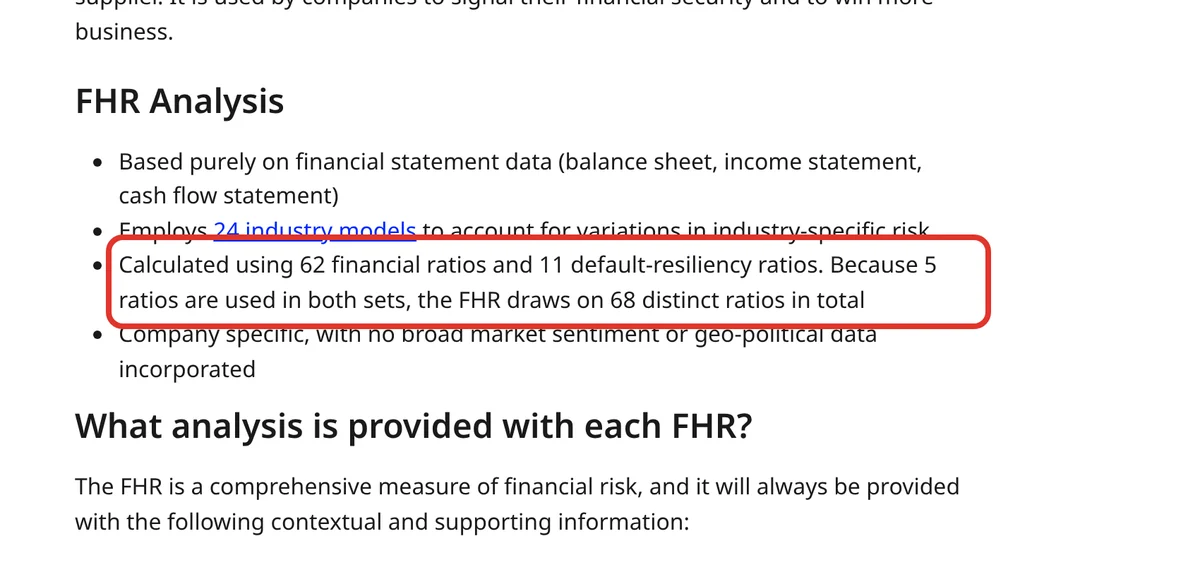
RapidRatings’ help article says the Financial Health Rating runs from 0 to 100, uses 24 industry models and draws on 68 distinct financial ratios. Its FHR page says ratings are built from financial statements sourced directly from each company.
Its supply chain risk page says the FHR detects financial distress in suppliers 12 to 24 months before it affects your business. That is the vendor’s own claim. RiskPulse gives a quick read across the whole network, and ActionPath helps manage weak suppliers.
Strengths
- Deep financial analysis for private firms
- Clear 0 to 100 scale
- Network-wide quick ratings
Watch-outs
- Financial risk only
- Suppliers must share their statements
After Signature: The First 30 Days
Run this list in every supplier risk management software demo, then again in the first month live. Use two of your own suppliers: one simple and one high risk. If a tool cannot show an item live, it becomes manual work later. Get each answer in writing, with the name of who owns it.
- Tiers: every supplier has a risk tier, and the tier sets the review date.
- Screening: sanctions, PEP and watchlist results land on the record with a date.
- Ownership: the ultimate owner is named, and a change raises an alert.
- Alerts: each alert type routes to a named person, not a shared inbox.
- Issues: a high-risk finding opens an issue with an owner and a due date.
- Hold: a supplier on hold cannot get a new PO or payment.
- ERP: the risk tier and status show on the supplier in your ERP or S2P suite.
- Report: you can export the checks for one supplier before it becomes a problem in an audit. For tracking certificates and expiry dates, see our supplier compliance management software ranking.
Red Flags in a Demo
- The demo uses sample suppliers and none of yours.
- A single risk score hides which data sources fed it.
- Sanctions or ownership data is “available” but priced later as a partner add-on.
- Alerts exist, but nobody can say who receives them or how many a week to expect.
- Coverage beyond tier 1 depends on suppliers answering surveys.
- A prediction or savings figure is quoted without saying how it was measured.
Which Supplier Risk Management Software Should You Choose?
Choose supplier risk management software by the risk that would hurt you most. SAP Ariba Supplier Risk leads at 8.3 for SAP teams and is the only listed price. Moody’s and D&B fit data-led teams. Exiger fits high-risk sectors that need checks beyond tier 1.
The verdict
- Choose SAP Ariba Supplier Risk if you run SAP and want a published price.
- Choose Moody’s if ownership and entity data matter most, inside Coupa or SAP.
- Choose apexanalytix if payment fraud and bank changes are the risks that keep you up.
- Choose Exiger if you need human due diligence and mapping beyond tier 1.
- Choose D&B if you want sanctions and UBO data and a free trial first.
- Choose Certa if risk checks must run inside supplier onboarding.
- Choose Coupa if you already run Coupa and want risk next to spend.
- Choose Prewave if LkSG, CSDDD or EUDR reporting drives the project.
- Choose EcoVadis or RapidRatings if you need one deep signal: sustainability or financial health.
More guides sit in our supplier management hub. If SAP Ariba is on your list, compare it with our SAP Ariba alternatives. For narrower jobs, see our supplier onboarding software, vendor management software and SRM software rankings.
Frequently Asked Questions
What is the best supplier risk management software?
SAP Ariba Supplier Risk is the best supplier risk management software for most procurement teams, scoring 8.3 out of 10 in our ranking. It covers financial, operational, ESG, regulatory and legal risk, and lists a price from USD 490 per user a month. Moody’s (7.7) and apexanalytix (7.5) follow.
What does supplier risk management software do?
Supplier risk management software checks whether a supplier is safe to onboard, pay and keep. It screens sanctions and watchlists, tracks financial health, ownership, ESG and news, and alerts you when something changes. Stronger tools add risk tiers, assessments, issue tracking and holds on risky suppliers.
How much does supplier risk management software cost?
Most vendors quote. SAP Ariba Supplier Risk is the exception, listing USD 490 a month for the base edition and USD 900 for the full edition, priced per user. D&B offers a 30-day free trial in the US and Canada. EcoVadis says its annual fees vary by company size.
What is the difference between supplier risk and third-party risk management?
Third-party risk management covers every outside party, including resellers, agents and IT vendors. Supplier risk management focuses on the companies you buy from. The tools overlap: Certa and Exiger sell third-party risk platforms, while SAP Ariba Supplier Risk and Prewave start from procurement and supply.
Which supplier risk tools cover risks beyond tier 1?
Exiger, Prewave and Coupa state coverage beyond tier 1 on their own pages. Exiger covers suppliers at the nth level, Prewave shows risk beyond tier 1 without supplier surveys, and Coupa screens fourth and fifth parties for bribery and corruption risk. Ask each to map one of your own suppliers.
Can I manage supplier risk in a spreadsheet?
Yes, for a small and stable supplier base with one owner. A spreadsheet cannot watch sanctions lists, ownership changes or news between reviews, though. Once you have critical suppliers in high-risk countries or report under supply chain laws, you need monitoring that runs every day.