Buying procurement software in 2026 comes down to one trade-off: a source-to-pay suite that runs sourcing, contracts and payables in one place, or a lighter purchasing tool that sits on top of the ERP you already pay for. The deciding question is how much of the buying process procurement needs to own.
This guide ranks 10 tools on six weighted criteria, using only what each vendor publishes on its own site as of October 25, 2026. Enterprise suites, ERP modules and mid-market purchase-to-pay tools share one table, so you can see where each one fits before you book a demo. For a wider field of 15 platforms split by company size, including Basware, Ramp and Zoho, see our ranking of the best procurement software. For narrower shortlists, see our rankings of procure-to-pay software and AI procurement software.
Which procurement software should you shortlist in 2026?
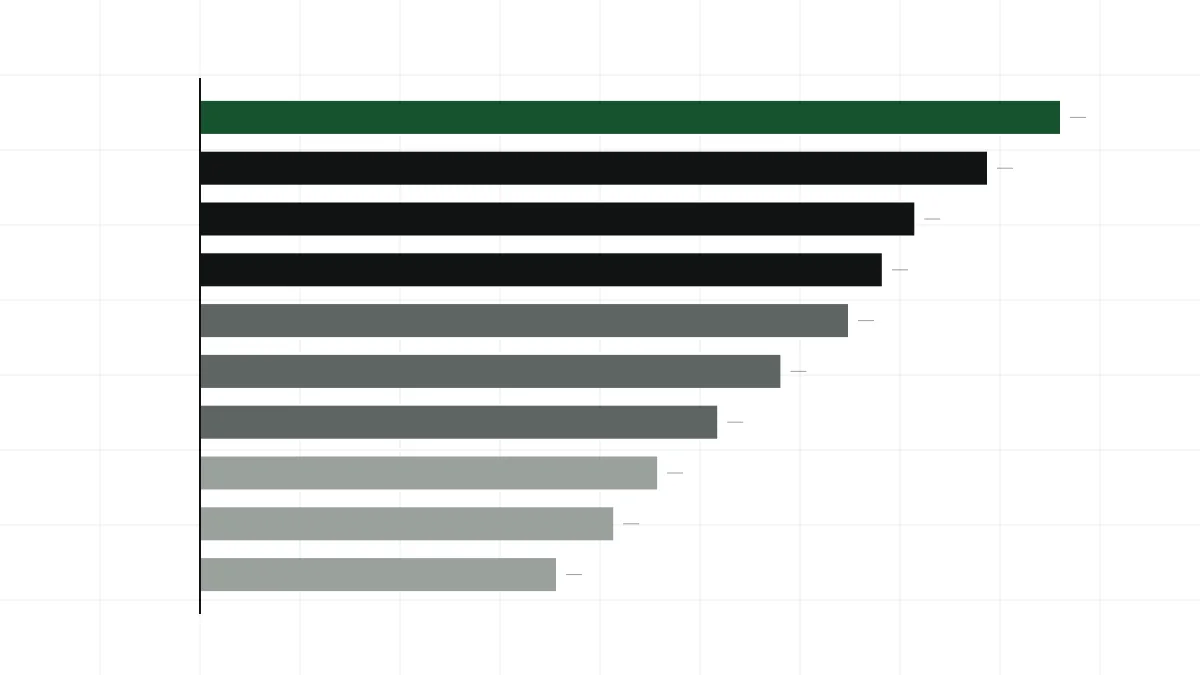
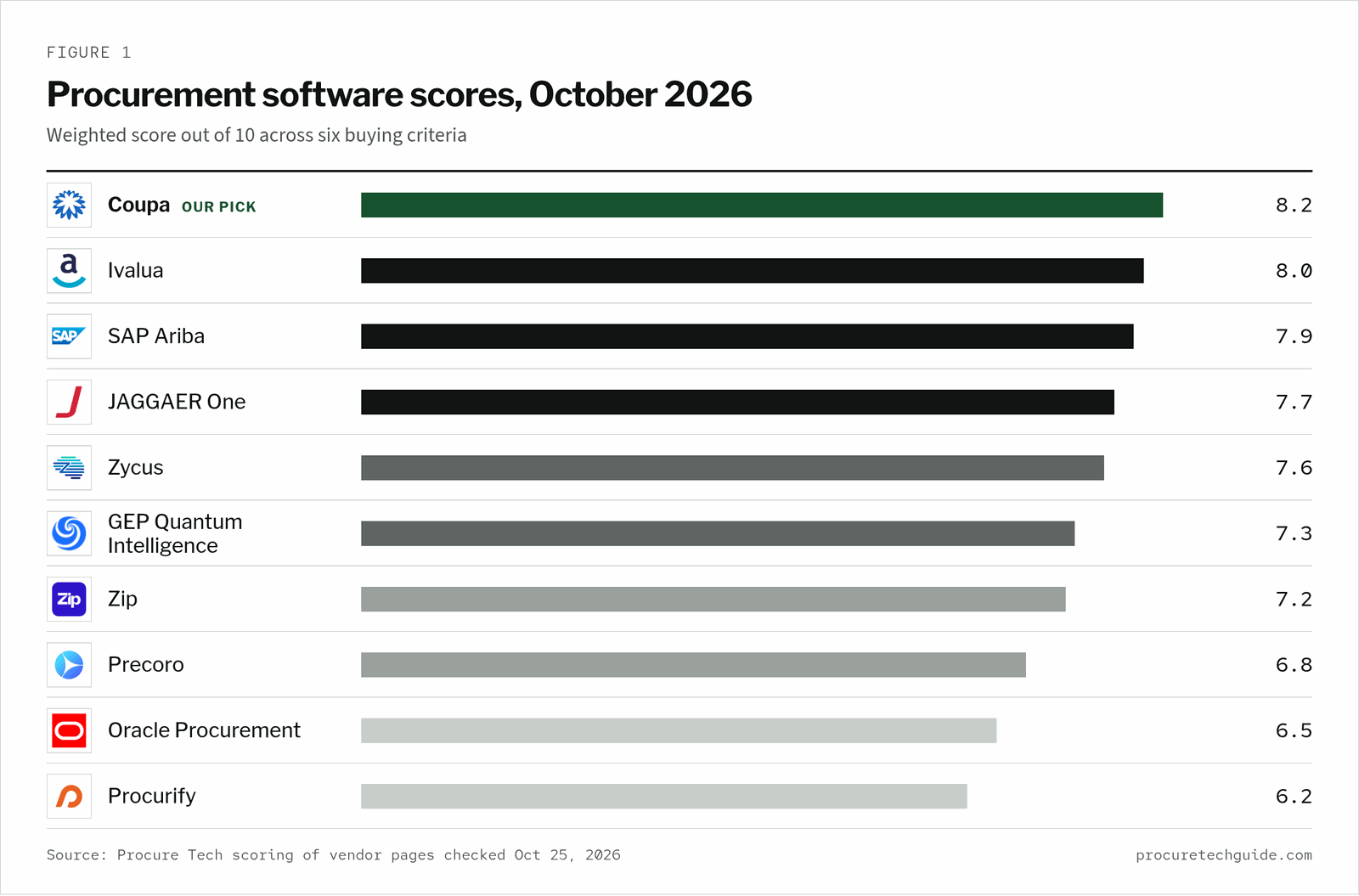
Coupa is our pick for most enterprise buyers, scoring 8.2 out of 10 on module breadth, network size and analyst standing. Ivalua (8.0) and SAP Ariba (7.9) follow closely, with Ivalua stronger for multi-ERP estates and Ariba for SAP shops. Mid-market teams should start with Precoro, the only vendor here that publishes its prices. If the choice is down to the top suites, our Coupa vs SAP Ariba comparison covers modules, ERP fit and cost to run.
| Rank | Tool | Best for | Pricing from | Our score |
|---|---|---|---|---|
| 1 | Coupa | Large enterprises that want one suite from sourcing to payment | Quote based | 8.2 |
| 2 | Ivalua | Direct and indirect spend across several ERPs | Quote based | 8.0 |
| 3 | SAP Ariba | Companies already running SAP ERP | Quote based | 7.9 |
| 4 | JAGGAER One | Manufacturing, higher education and public sector | Quote based | 7.7 |
| 5 | Zycus | Agent-run sourcing and tail spend negotiation | Quote based | 7.6 |
| 6 | GEP Quantum Intelligence | Software plus managed procurement services | Quote based | 7.3 |
| 7 | Zip | An intake layer on top of an existing ERP or suite | Quote based | 7.2 |
| 8 | Precoro | Mid-sized companies that want published pricing | $499 per month, billed annually | 6.8 |
| 9 | Oracle Procurement | Existing Oracle Fusion Cloud ERP customers | Quote based | 6.5 |
| 10 | Procurify | Mid-market teams on NetSuite, QuickBooks or Sage Intacct | Quote based | 6.2 |
Our pick
Coupa
For a company that wants sourcing, contracts, purchasing, invoicing and spend analysis in one suite, Coupa has the widest documented module list on our shortlist and a network of 10M+ buyers and suppliers, per its platform page.
Do you need a suite, an ERP module or a point tool?
Pick a suite when sourcing, contracts and supplier risk sit with the team that also runs purchasing. Pick your ERP’s module when buying is simple and mostly catalog based. Pick a point tool such as Zip, Precoro or Procurify when the pain is intake, approvals and purchase orders, and your ERP already handles payables well. Our intake-to-procure software guide explains how that front-door layer works. Our head-to-heads cover the common suite shortlists: Ivalua vs Coupa vs JAGGAER, GEP SMART vs Zycus vs Ivalua and Coupa vs Oracle Procurement vs Workday.
| Option | Choose it when | Tools in this guide | The line item to watch |
|---|---|---|---|
| Source-to-pay suite | Procurement owns sourcing, contracts and supplier risk across many categories | Coupa, Ivalua, SAP Ariba, JAGGAER One, Zycus, GEP Quantum Intelligence | Implementation partner fees and supplier onboarding |
| ERP procurement module | One ERP runs the business and most buying is catalog or repeat orders | Oracle Procurement, SAP Ariba for SAP S/4HANA customers | Licence cost for occasional requesters |
| Point tool for intake and P2P | Requests arrive by email or chat and finance wants a PO before every invoice | Zip, Precoro, Procurify | Add-on products such as AP, contracts and cards |
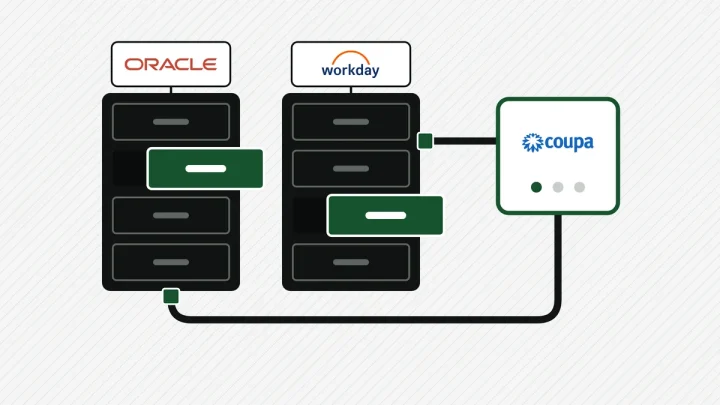
In practice, many companies run two layers. Zip lists integrations with SAP Ariba, Coupa and Ivalua alongside SAP S/4HANA, Oracle Fusion, Workday and NetSuite on its integrations page, so it often sits in front of a suite instead of replacing one. Our best procurement orchestration platforms ranking compares the layers that work this way. Our intake orchestration hub covers that layer in more depth. If you already run Coupa or SAP Ariba, our Coupa pricing breakdown and SAP Ariba alternatives guide cover cost and switching.
How did we score each tool?
Each tool gets a 1 to 5 rating on six criteria, multiplied by a weight and converted to a score out of 10. Module coverage carries the most weight at 25%, followed by ERP integration at 20%. Every rating rests on the vendor’s own pages, checked on October 25, 2026, and no vendor paid for placement.
| Criterion | Weight | What earns a 5 |
|---|---|---|
| Module coverage | 25% | Sourcing, contracts, supplier management, intake, purchasing and invoicing are all documented |
| ERP and finance integration | 20% | Named connectors for several ERPs, multi-ERP support and included integration tooling |
| Supplier network | 15% | A published network in the millions, plus a supplier portal and onboarding |
| Implementation effort | 15% | Go-live in weeks with vendor-led setup and little IT work |
| Pricing transparency | 10% | Published prices with the billing unit |
| Analyst and peer standing | 15% | Leader in the 2026 Gartner Magic Quadrant for Source-to-Pay Suites, or strong peer review ratings |
| Tool | Modules | ERP | Network | Setup | Pricing | Analyst | Score |
|---|---|---|---|---|---|---|---|
| Coupa | 5 | 4 | 5 | 3 | 1 | 5 | 8.2 |
| Ivalua | 5 | 5 | 3 | 3 | 1 | 5 | 8.0 |
| SAP Ariba | 5 | 4 | 5 | 2 | 1 | 5 | 7.9 |
| JAGGAER One | 5 | 5 | 5 | 2 | 1 | 3 | 7.7 |
| Zycus | 5 | 4 | 3 | 3 | 1 | 5 | 7.6 |
| GEP Quantum Intelligence | 5 | 4 | 3 | 2 | 1 | 5 | 7.3 |
| Zip | 4 | 5 | 2 | 4 | 1 | 4 | 7.2 |
| Precoro | 3 | 4 | 1 | 5 | 5 | 3 | 6.8 |
| Oracle Procurement | 4 | 4 | 2 | 4 | 1 | 3 | 6.5 |
| Procurify | 3 | 4 | 1 | 5 | 2 | 3 | 6.2 |
How we chose
We reviewed product, pricing, integration and security pages for 10 vendors and did not run hands-on trials. Analyst placements are reported as each vendor states them, because the Gartner report sits behind a licence. JAGGAER, for example, drops to a 3 on standing because it lists a Visionary placement.
Which tools cover each stage of source-to-pay?
Six of the 10 tools document every stage from sourcing to invoice on their own pages, and JAGGAER One covers all of them except a named intake module. Zip, Precoro and Procurify start at the request and the purchase order, with sourcing and contracts light, tied to a higher plan or sold as add-ons.
| Tool | Sourcing | Contracts | Supplier mgmt | Intake | Purchase orders | Invoice and AP |
|---|---|---|---|---|---|---|
| Coupa | Yes | Yes | Yes | Yes | Yes | Yes |
| Ivalua | Yes | Yes | Yes | Yes | Yes | Yes |
| SAP Ariba | Yes | Yes | Yes | Yes | Yes | Yes |
| JAGGAER One | Yes | Yes | Yes | Not listed | Yes | Yes |
| Zycus | Yes | Yes | Yes | Yes | Yes | Yes |
| GEP Quantum Intelligence | Yes | Yes | Yes | Yes | Yes | Yes |
| Oracle Procurement | Yes | Yes | Yes | Guided buying | Yes | Yes |
| Zip | RFx only | Yes | Risk only | Yes | Yes | Yes |
| Precoro | RFPs on Automation plan | Repository | Portal on Automation plan | Automation plan | Yes | Yes |
| Procurify | No | Add-on | Vendor records | Yes | Yes | AP product |
Sourcing depth matters most for buyers with direct materials or large indirect categories. If that is you, read our source-to-pay hub; if purchase control is the main goal, the procure-to-pay hub is the better starting point. Buyers who already know they need a full suite can compare ten of them in our ranking of the best source-to-pay suites.
How do the 10 procurement software tools compare?
The cards below follow the ranking. Each lists who the tool suits, the published starting price or the fact that it is quote based, one standout fact from the vendor’s own site and the watch-outs a buyer should raise in the first demo. Every fact was checked on October 25, 2026.
1. Coupa
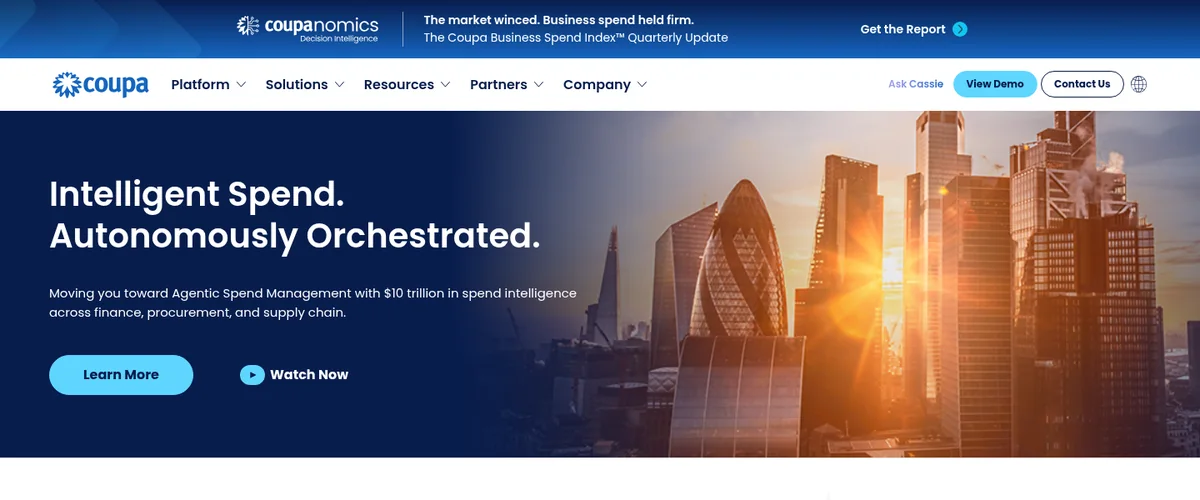
Coupa has the broadest module list on our shortlist, covering sourcing, contracts, supplier risk, intake, procurement, inventory, invoicing, expense and treasury, per its platform page. Gartner named Coupa a Leader in the 2026 Magic Quadrant for Source-to-Pay Suites for the third year running, according to the Coupa site. Coupa also says 55% of the Fortune 500 work with it. If Coupa is already in place and falling short, our Coupa alternatives guide sorts the options by reason for leaving.
Strengths
- Widest documented module coverage, including treasury and supply chain
- SOC 1, SOC 2, ISO 27001:2022, ISO 42001 and FedRAMP Moderate on its compliance page
- Large buyer and supplier network for onboarding
Watch-outs
- No published pricing
- Suite breadth means a longer rollout than a point tool
- Mid-market teams may pay for modules they never switch on
2. Ivalua
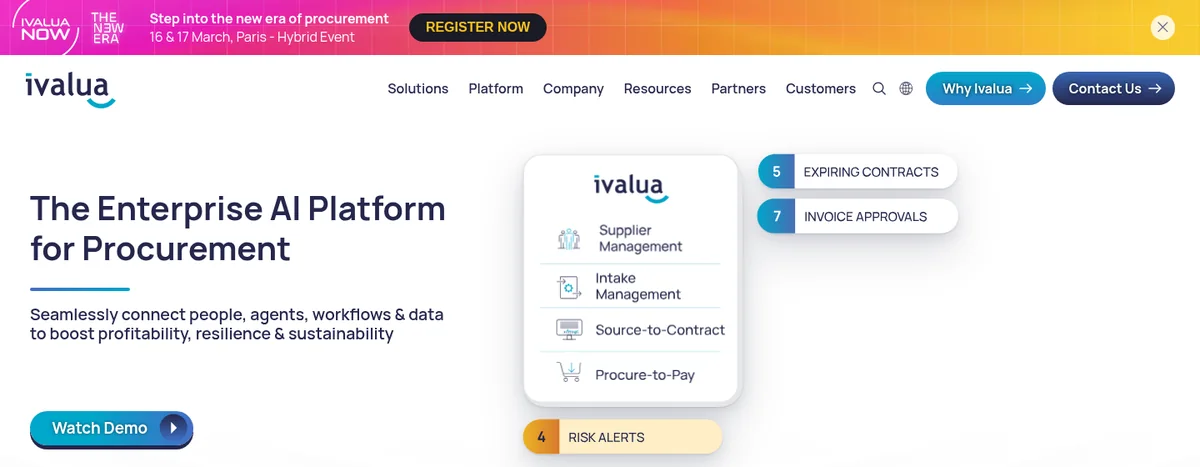
Ivalua runs intake, sourcing, contracts, supplier management, spend analysis and direct materials sourcing on one data model, per its source-to-pay page. Its multi-ERP page says integration tooling is part of the platform with no third-party middleware, and cites a $20B manufacturer that connected 4 ERPs and 166 integration points in 6 months. Ivalua reports a Leader placement in the 2026 Gartner Magic Quadrant, which it says evaluated 13 vendors.
Strengths
- Strong multi-ERP and SAP integration story
- Direct materials and supplier collaboration on the same platform
- ISO 27001, SOC 1, SOC 2 Type II and TISAX on its security page
Watch-outs
- No published pricing
- Configuration depth calls for a named platform owner after go-live
- No published supplier network size
3. SAP Ariba
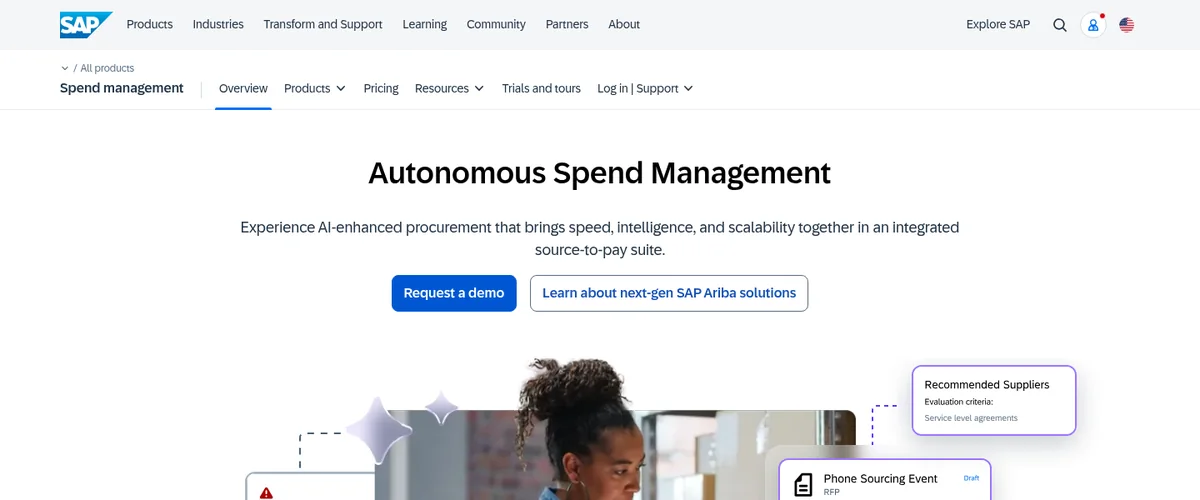
SAP Ariba Buying and Invoicing covers guided buying, catalogs, invoice management and network collaboration, and SAP says it supports federated processes across multiple ERPs on its procure-to-pay page. Sourcing, contracts and supplier management come as a separate package on the spend management page. Suppliers trade through SAP Business Network, which SAP calls the world’s largest business network.
Strengths
- Closest fit for SAP S/4HANA estates
- Supplier portal, local e-invoicing formats and early payment options on the network page
- Nine supplier management agents, per SAP
Watch-outs
- No published pricing
- Buying and sourcing are separate packages, so check what the quote includes
- Ask how small suppliers are onboarded to the network
4. JAGGAER One
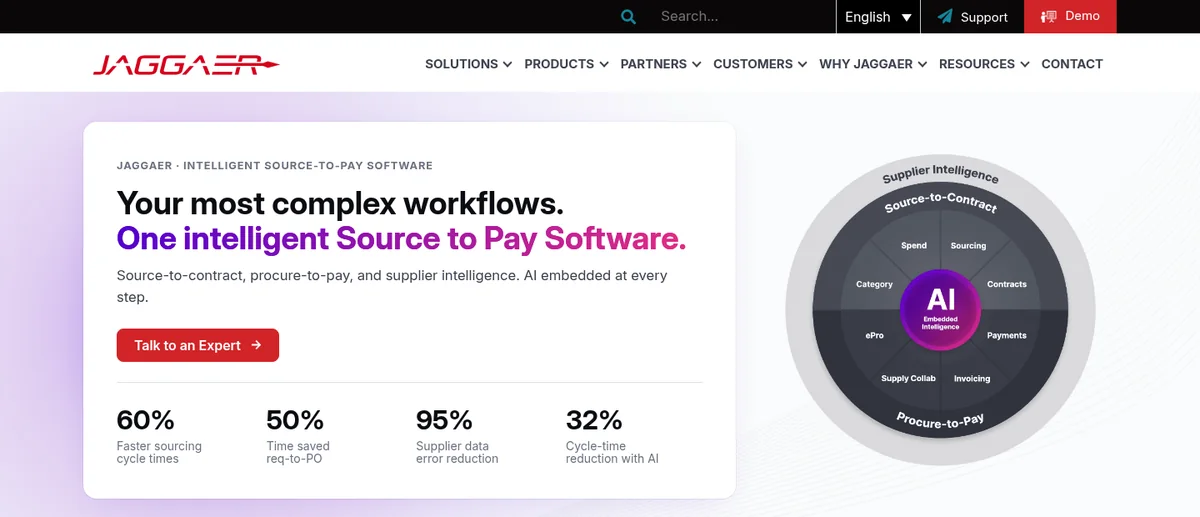
JAGGAER One puts source-to-contract, procure-to-pay and supplier intelligence on one data layer, with configurations for BOM-driven direct sourcing, cooperative purchasing and departmental punchout buying, per its source-to-pay page. The same page lists 13M+ suppliers in its network, and the JAGGAER home page says 1,400+ enterprises use it. JAGGAER estimates 12 to 16 weeks for one sourcing module and 6 to 9 months for a full source-to-pay program.
Strengths
- Managed connectors to SAP, Oracle, Workday, Infor, NetSuite, Banner and PeopleSoft
- Published implementation timelines
- ISO 27001, 27017 and 27018 on its security page
Watch-outs
- Listed as a Visionary, below Leader, in the 2026 Gartner S2P Magic Quadrant
- No published pricing
- No named intake module on the pages we checked
5. Zycus
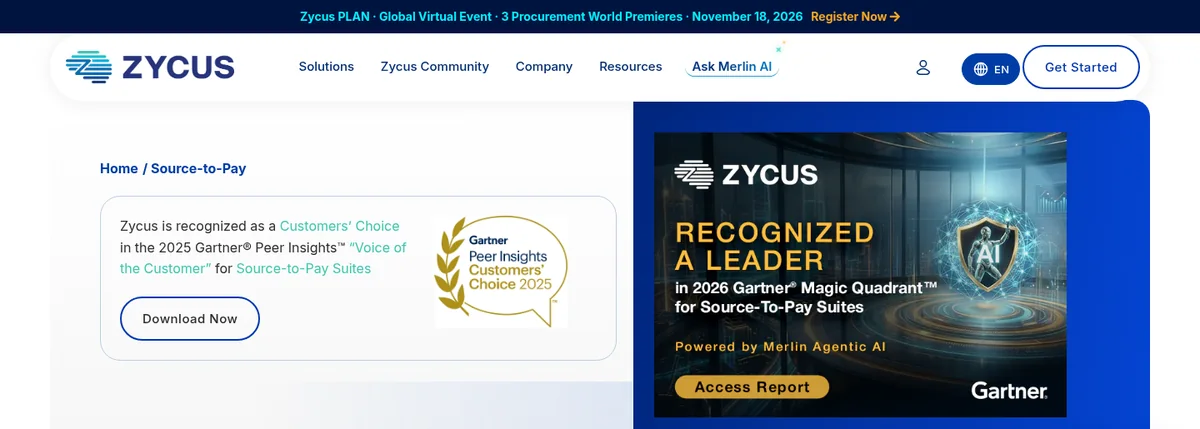
Zycus offers spend analysis, strategic sourcing, contract management, intake inside Microsoft Teams, supplier management and AP automation in one suite, per its source-to-pay page. Its Merlin agents run sourcing events and negotiate tail spend, backed by what Zycus describes as 32+ patents and $1Tr+ in spend processed on the Merlin page. Zycus lists itself as a Leader in the 2026 Gartner Magic Quadrant for Source-to-Pay Suites.
Strengths
- Agent flows already running with customers, per Zycus
- Intake where employees already work, in Microsoft Teams
- Large API surface for custom integration
Watch-outs
- No published pricing
- No published supplier network size
- Test the 95% straight-through processing claim against your own invoice mix
6. GEP Quantum Intelligence
GEP is folding GEP SMART and GEP NEXXE into one AI-native platform, GEP Quantum Intelligence, which covers source-to-pay and supply chain, per its client update. GEP says SMART stays fully supported with no forced migration timeline and no change to existing pricing or contracts. The platform launched in 2023, and GEP reports a Leader placement in the 2026 Gartner S2P Magic Quadrant.
Strengths
- Sourcing, contract, risk and supplier agents on one platform
- Managed services available from the same vendor
- SOC 1 Type II, SOC 2 Type II, ISO 27001 and ISO 42001 on its trust page
Watch-outs
- Product names are changing, so confirm which platform your contract covers
- No published pricing
- No published supplier network size
7. Zip
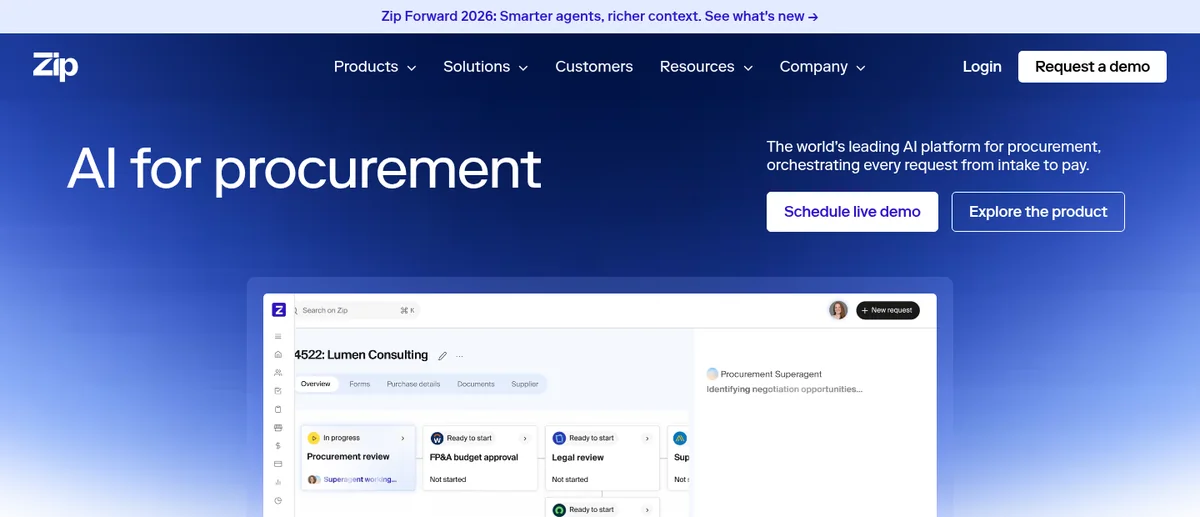
Zip gives employees one front door for every purchase request, then routes it through approval workflows with PO and invoice automation, contracts and third-party risk on the same platform, per its platform overview. It lists 100+ integrations and its own App Studio integration platform. Named customers on the Zip home page include OpenAI, Snowflake and T-Mobile.
Strengths
- Pre-built integration templates with AI-guided setup
- SOC 1 Type 2, SOC 2 Type 2 and ISO 27001:2022 on its trust page
- Works alongside a suite as well as on its own
Watch-outs
- No published pricing
- Sourcing is limited to RFx
- No supplier network of its own
8. Precoro
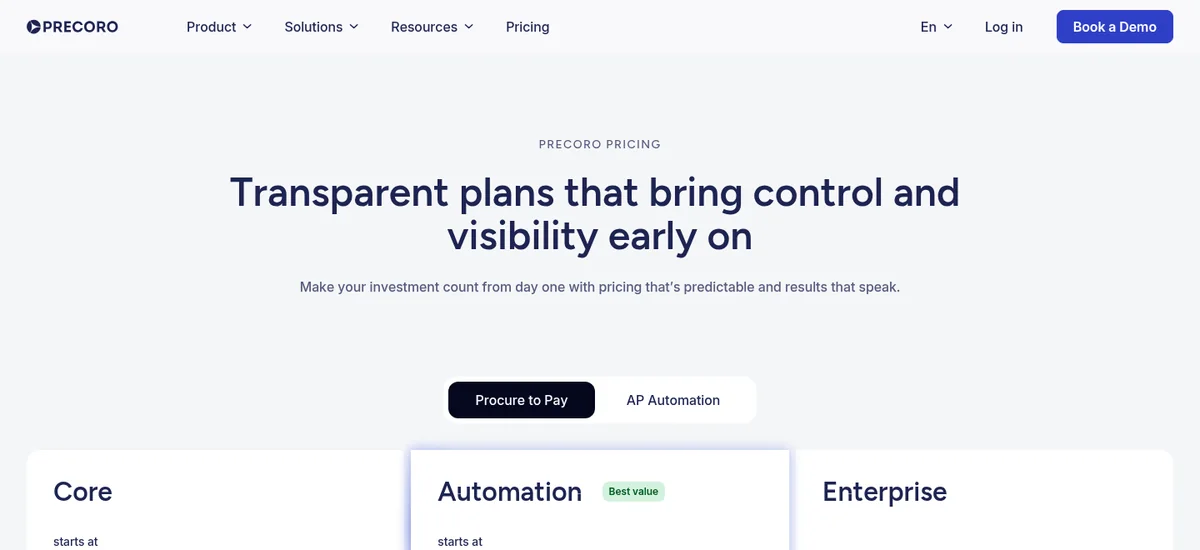
Precoro is the only tool here with public prices: Core starts at $499 a month billed annually, Automation is $999 and Enterprise is custom, per its pricing page. Core covers requests, POs, receipts, invoices, 2- and 3-way match and QuickBooks Online or Xero sync, while Automation adds intake, a supplier portal, RFPs, API access and SSO. ERP connections sit on the Enterprise plan or come as an add-on.
Strengths
- Transparent, tiered pricing
- Fast rollout with vendor-led onboarding
- SOC 2 Type II, GDPR, CCPA and HIPAA on its trust page
Watch-outs
- Sourcing is limited to RFPs
- Contracts are a repository
- Multiple entities and concierge setup cost extra
9. Oracle Procurement
Oracle Fusion Cloud Procurement covers guided buying, sourcing, contracts, supplier management and invoice automation, and Oracle calls it a connected, continuously updated source-to-pay suite on its procurement page. It earns its place for Oracle customers, whose supplier, item and invoice data already sit in Oracle Fusion Cloud ERP. Outside Oracle estates the case is weaker, which is why it ranks ninth.
Strengths
- Native fit with Oracle Fusion Cloud ERP and SCM
- Built-in AI agents for policy and requisitions
- Contract authoring with e-signatures
Watch-outs
- No published pricing
- The page does not state its own 2026 Magic Quadrant placement
- Little reason to pick it without Oracle ERP
10. Procurify
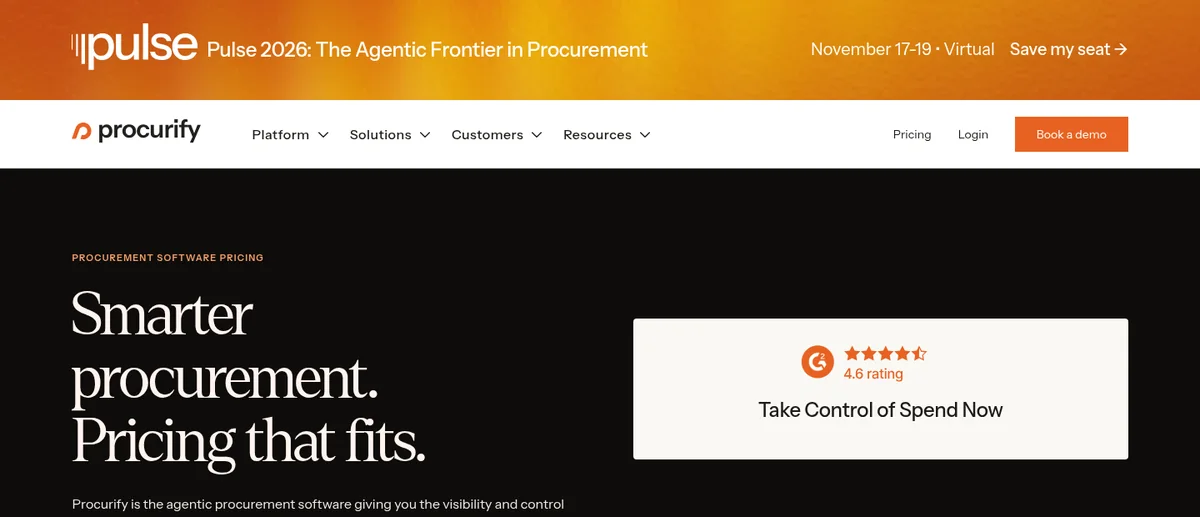
Procurify starts every customer on Purchasing, which includes requests, POs, catalogs, approvals, budgets and accounting sync, then sells AP and Expense and Card as products with Guided Intake and Contracts as add-ons, per its pricing page. It holds 4.6 on G2 and 4.5 on Capterra and was a G2 Leader for mid-market procure-to-pay in Fall 2026, per the Procurify home page. There is no sourcing module.
Strengths
- Clear packaging logic even without list prices
- Dedicated implementation team with no engineering resources required
- SOC 1 Type 2 and SOC 2 Type 2 on its security page
Watch-outs
- Quote based despite a pricing page
- No sourcing or supplier risk
- Contracts only as an add-on
What does procurement software cost in 2026?
Nine of the 10 vendors are quote based, so a list price is rarely the number to compare. Precoro is the exception, with its Core plan priced per month and billed annually. For everyone else the bill is built from modules, paid users, ERP connectors and setup services, and the line item to watch is usually integration work.
| Cost driver | How vendors price it | Where we saw it |
|---|---|---|
| Modules | A base product plus add-on products | Procurify sells AP and Expense and Card on top of Purchasing |
| Users | Paid power users, free requesters | Procurify prices by Pro users and includes unlimited Basic users |
| Integrations | Included tooling or a paid add-on | Ivalua says connectivity is part of the platform; Precoro sells ERP integration as an add-on |
| Setup | Vendor-led onboarding, sometimes paid | Precoro lists Concierge setup as an add-on |
| Entities | A fee for running several companies | Precoro lists Multiple companies as an add-on |
Ask each vendor to price the same scenario: requesters, approvers and AP users, the ERP you run and the number of legal entities. Quotes from a suite and a point tool only become comparable on that basis.
When is your ERP’s own procurement module enough?
Your ERP module is enough when one ERP runs the business, most purchases come from catalogs or repeat suppliers, and procurement does not run competitive sourcing events. Oracle Procurement for Oracle customers and SAP Ariba for SAP S/4HANA customers fit that case. Add a suite or an intake layer once requests, contracts or suppliers start living in email.
- You run more than one ERP after an acquisition
- Sourcing events still run in spreadsheets
- Requests reach procurement through email or chat
- Contract renewals are tracked by hand
- Spend reports are built manually each quarter, a gap our spend analytics hub covers
Two or more of these signals usually justify a dedicated layer. For a single-entity company on one ERP, extending the module is the cheaper decision.
How long does procurement software take to implement?
Mid-market tools go live in weeks and suites take months. Precoro quotes a 2 to 8 week go-live on its pricing page, while JAGGAER puts a full source-to-pay program at 6 to 9 months. The number of ERP instances, integration points and suppliers to onboard sets the real timeline more than the software does.
Ask every vendor for a reference customer with the same ERP and a similar number of entities. If contracts are part of scope, check our CLM software hub and our contract lifecycle management software guide before deciding whether the suite’s contract module is enough.
Which procurement software fits your situation?
Match the tool to the ERP you run and the scope procurement owns. Suites win when sourcing and supplier risk matter, ERP modules win for single-ERP catalog buying, and intake tools win when the pain is requests and approvals. The verdict below maps each common situation to the tool we would shortlist first.
The verdict
- Choose Coupa if you want the broadest single suite and a large supplier network.
- Choose Ivalua if you run several ERPs or buy direct materials.
- Choose SAP Ariba if SAP S/4HANA is your system of record.
- Choose JAGGAER One if you buy for manufacturing, higher education or the public sector.
- Choose Zycus if agent-run sourcing and tail spend negotiation are priorities.
- Choose GEP Quantum Intelligence if you want software and managed services together.
- Choose Zip if you need one intake layer in front of an existing ERP or suite.
- Choose Precoro if you want published pricing and a go-live within weeks.
- Choose Oracle Procurement if Oracle Fusion Cloud ERP already runs finance.
- Choose Procurify if you are a mid-market team on NetSuite, QuickBooks, Sage Intacct or Business Central.
Frequently asked questions
What is procurement software?
Procurement software manages how a company buys, from the first purchase request to the supplier payment. Suites such as Coupa or SAP Ariba add sourcing, contracts and supplier risk, while purchase-to-pay tools such as Precoro and Procurify focus on requests, approvals, purchase orders and invoice matching that sync to your accounting system.
What is the difference between source-to-pay and procure-to-pay software?
Procure-to-pay starts at the purchase request and ends at the supplier payment, covering approvals, purchase orders, receipts and invoices. Source-to-pay adds the upstream work of spend analysis, sourcing events, contract management and supplier management. Our supplier management software guide covers that module across SRM, onboarding and supplier risk, and our best supplier management software ranking scores 12 platforms. For the relationship layer alone, see our SRM software ranking. Pick procure-to-pay if purchase control is the problem, and source-to-pay if procurement also negotiates with suppliers. Our source-to-pay vs procure-to-pay guide maps each stage in detail.
How much does procurement software cost?
Most vendors are quote based. Precoro is the only tool in our ranking with published plans, starting with a monthly Core plan billed annually. Elsewhere the price depends on modules, paid users, ERP integrations and implementation services, so ask every vendor to price the same scenario before you compare quotes side by side.
How long does it take to implement procurement software?
Plan on weeks for a mid-market purchase-to-pay tool and several months for a full suite, based on the timelines vendors publish. The number of ERP instances, integration points and suppliers to onboard drives the schedule, so ask for a reference customer with a similar setup before you sign a contract.
Which procurement software is best for mid-sized companies?
Precoro is our first pick for mid-sized companies because it publishes its pricing and covers requests, purchase orders, invoices and matching on its entry plan. Procurify suits teams on NetSuite, QuickBooks, Sage Intacct or Business Central, and Zip fits fast-growing companies that need one intake front door across departments.
Do I need procurement software if my ERP has a purchasing module?
Not always. If you run one ERP, buy mostly from catalogs and do not run sourcing events, the ERP module may be enough for years. Dedicated procurement software earns its cost when you run several ERPs, manage contracts and supplier risk, or field purchase requests through email and chat.
Which vendors were Leaders in the 2026 Gartner Magic Quadrant for Source-to-Pay Suites?
Coupa, SAP, Ivalua, GEP and Zycus each state on their own websites that Gartner named them a Leader in the 2026 Magic Quadrant for Source-to-Pay Suites, dated January 21, 2026. JAGGAER lists itself as a Visionary. We cite vendor statements because the full report requires a Gartner licence.