
The deciding question with tail spend management software is which part of the tail you want to fix: the price, the paperwork or the policy. Tail spend is the long run of small, one-off purchases that no category manager owns, and each tool here attacks it from a different end.
We ranked 8 tail spend management software tools on five weighted criteria: tail coverage (30), control at the point of request (25), fit with your P2P or ERP (20), time to value (15) and pricing clarity (10). Facts come from vendor home, product, pricing and integration pages read on October 30, 2026, and our scoring rules are public.
What is the best tail spend management software in 2026?
Pactum is the best tail spend management software for most enterprise teams in 2026, scoring 8.4 out of 10 for taking tactical buys from intake to a negotiated purchase order. Amazon Business (8.2) suits catalog buying with published plans, and Fairmarkit (8.1) suits teams that want every small buy competed.
| # | Tool | Approach | Best for | Score |
|---|---|---|---|---|
| 1 | Pactum | AI agents from intake to negotiated PO | Coupa or SAP Ariba teams with a long tactical queue | 8.4 |
| 2 | Amazon Business | Business marketplace with buying policies | Catalog goods such as office, IT and MRO supplies | 8.2 |
| 3 | Fairmarkit | Autonomous sourcing for tactical spend | Competing every small buy inside your ERP or P2P | 8.1 |
| 4 | Candex | Master vendor that invoices and pays for you | One-off suppliers you never want to set up | 8.0 |
| 5 | Simfoni Vitesse | Managed master-vendor service | Finance teams drowning in small invoices | 7.6 |
| 6 | Keelvar | Autonomous sourcing agents | Repeat tactical events with set rules | 7.5 |
| 7 | Globality | Autonomous sourcing platform | Services and indirect buys that need a full event | 7.4 |
| 8 | Order.co | Purchasing platform for supplies | Multi-location teams buying the same supplies | 6.6 |
Our pick
Pactum
Pactum is the only vendor here whose pricing page publishes how plans are sized, by annual revenue band, and whose integrations page gives a go-live of two to four weeks. Its digital workers take a tactical request from intake to a negotiated purchase order inside Coupa, SAP Ariba or Pactum itself.
Which kind of tail spend tool do you need?
Most teams need one of three kinds of tail spend tool: a sourcing tool that competes small buys (Pactum, Fairmarkit, Keelvar, Globality), a master vendor that takes over supplier setup and payment (Candex, Simfoni Vitesse), or a marketplace with buying rules (Amazon Business, Order.co). Your biggest tail problem decides which.
Match the tool to the leak
| Your tail problem | Lean toward | The question to ask |
|---|---|---|
| Small buys are placed on the first quote | Pactum, Fairmarkit, Keelvar | Which requests go to competition by default |
| Every new supplier needs weeks of setup | Candex, Simfoni Vitesse | Who carries tax, sanctions and payment duties |
| AP is buried in small invoices | Simfoni Vitesse, Candex | Whether you pay one invoice or many |
| Staff buy supplies wherever they like | Amazon Business, Order.co | Which policies block or steer a purchase |
| Services buys skip procurement entirely | Globality, Pactum | How intake routes a request to the right path |
| Your suite already has a spot-buy module | Your suite first | What the module leaves unmanaged |
In practice, many teams pair two of these: a sourcing tool for price and a master vendor for the suppliers nobody wants to onboard.
How do tail spend tools handle the tail?
Tail spend tools split cleanly by approach. Pactum, Fairmarkit and Globality show intake, automated spot quotes and AI negotiation on their own pages. Candex and Simfoni Vitesse onboard and pay suppliers on your behalf, while Amazon Business and Order.co steer buyers with catalog rules. Only Amazon Business publishes a list price.
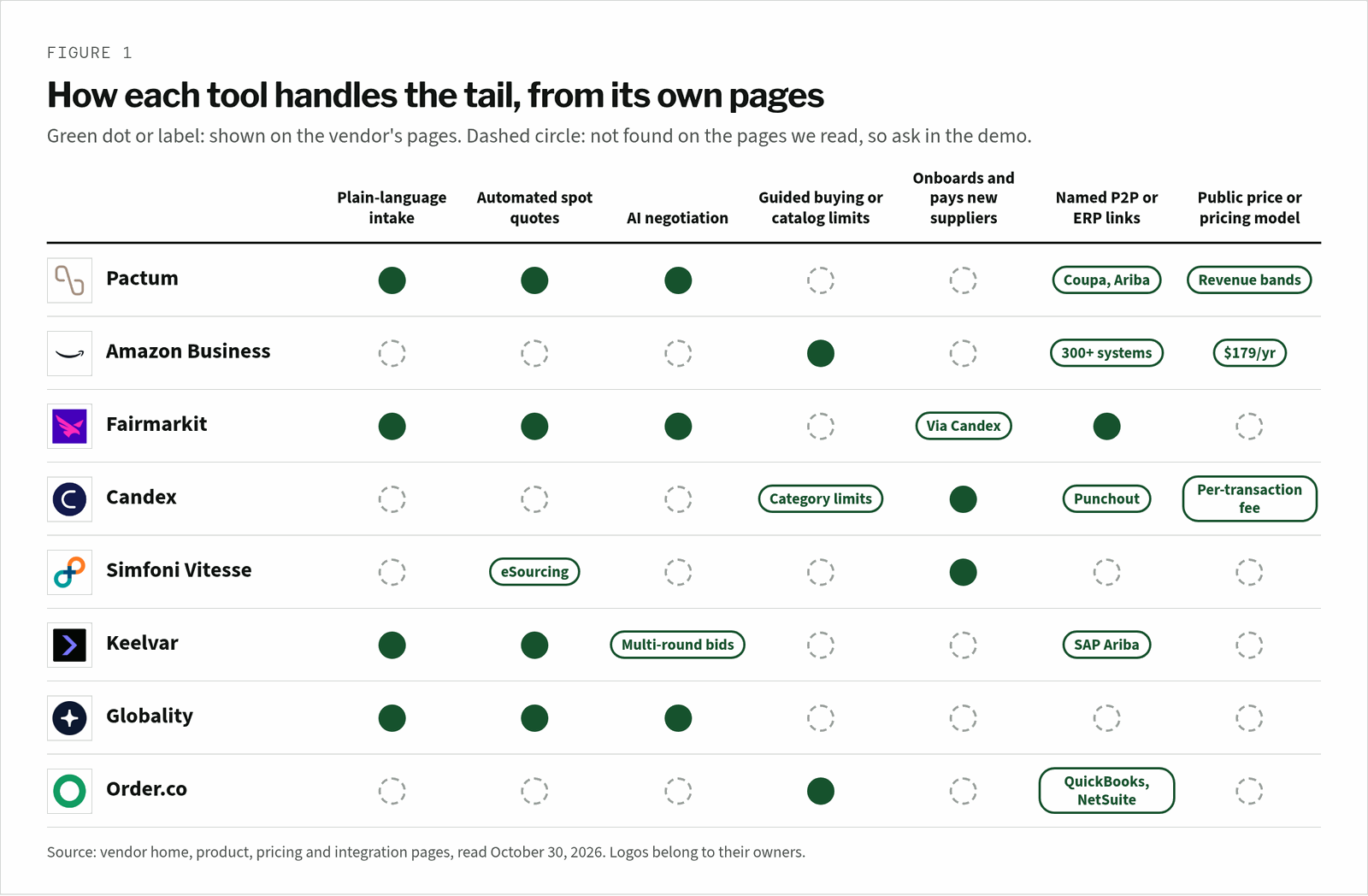
A dashed circle is a demo question, not a verdict. Fairmarkit, for example, reaches supplier onboarding and payment through its Candex integration, so ask each vendor which partner covers the gap.
How did we score tail spend management software?
Each tool earns weighted points out of 10 across five criteria, with tail coverage worth the most at 3 points. Simfoni Vitesse scores highest on coverage at 2.7 because it vets, onboards, pays and classifies. Pactum wins overall by pairing strong coverage and control with published plan bands and a stated go-live.
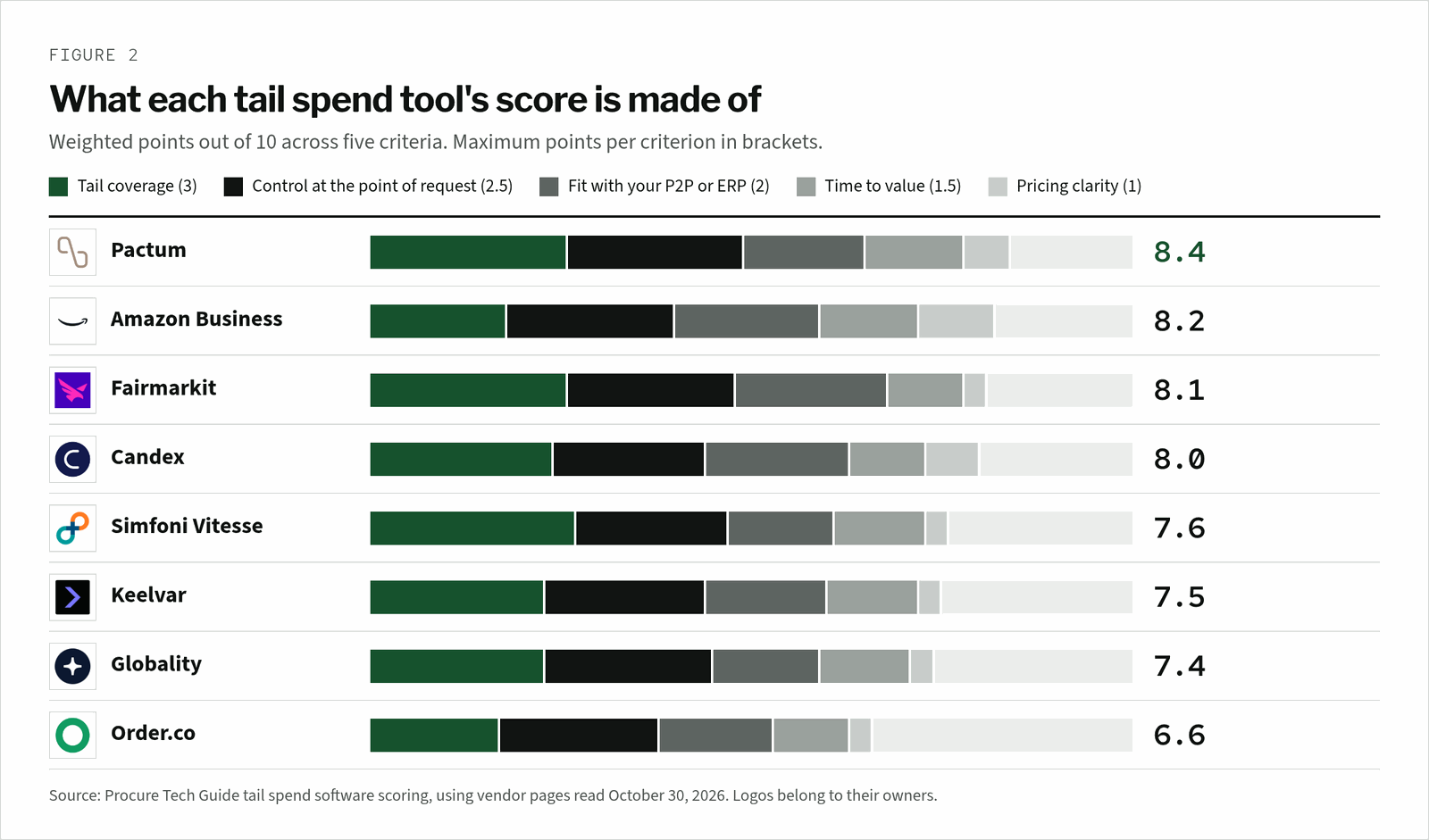
Pricing clarity is worth only 1 point, by design. Most tools here are quote based, so the score mainly rewards vendors that explain how the bill is built.
What does tail spend management software cost?
Only Amazon Business publishes list prices among these tools, with Prime Business plans from $179 a year for up to 5 users to $10,099 a year for unlimited users. Candex charges a transaction fee on each engagement, Pactum sizes plans by revenue band, and the other five are quote based.
| Tool | How the bill is built | Published price | Source |
|---|---|---|---|
| Amazon Business | Annual Prime Business plan by user count | Essentials $179/year (up to 5 users), Small $499/year (up to 20), Medium $1,299/year (up to 200), Enterprise $10,099/year (unlimited) | Prime Business plans |
| Candex | Transaction fee, shown on each engagement | No fee published; managed deployments and custom integrations may cost extra | Candex pricing |
| Pactum | Plan sized by annual company revenue | Bands: Growth under $1B, Enterprise $1B to $10B, Large Enterprise $10B to $20B, Strategic Enterprise $20B+ | Pactum pricing |
| Fairmarkit, Keelvar, Globality | Quote based | No public price | Vendor demo request |
| Simfoni Vitesse, Order.co | Quote based | No public price | Vendor demo request |
The line item to watch is the per-transaction fee on a master vendor. It replaces supplier setup cost, so compare it with what one new vendor record costs your AP team today.
The best tail spend management software, reviewed one by one
Each review covers who the tool suits, how it is priced, one standout fact and the watch-outs we found. The screenshot shows each vendor’s home page as a buyer first sees it. Tools appear in score order, from Pactum at 8.4 to Order.co at 6.6.
1. Pactum
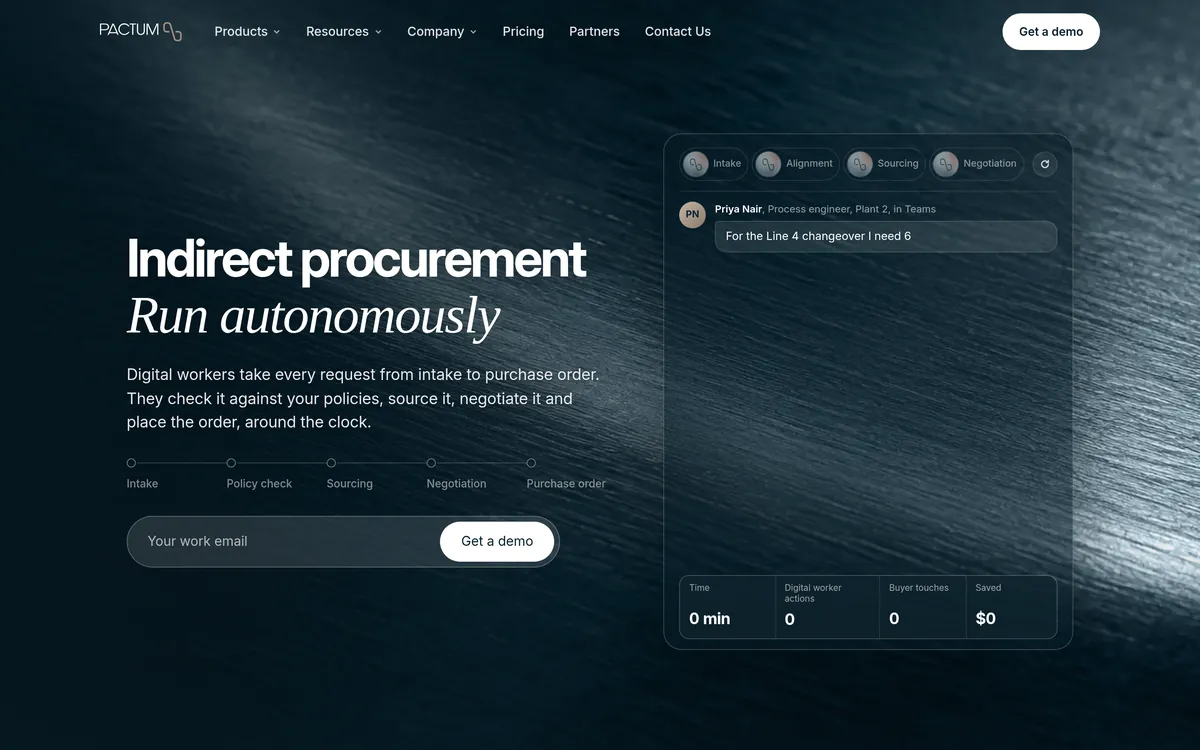
Pactum’s home page says its digital workers take every request from intake to purchase order, checking it against policy, sourcing it, negotiating it and placing the order. Its Tactical Sourcing Agent invites alternative suppliers, then negotiates price, payment terms, delivery and lead time, and the buyer makes the final selection.
Its integrations page lists Coupa and SAP Ariba, a Pactum API, and a no-integration mode where tactical sourcing runs in Pactum alone. Setup is self-service and most teams are live in two to four weeks, by Pactum’s own account, and every customer starts with a pilot on its own requests.
Strengths
- Intake to negotiated PO in one flow
- Runs inside Coupa or SAP Ariba
- Stated go-live of two to four weeks
Watch-outs
- No list price, only revenue bands
- Deepest coverage is on Coupa
2. Amazon Business
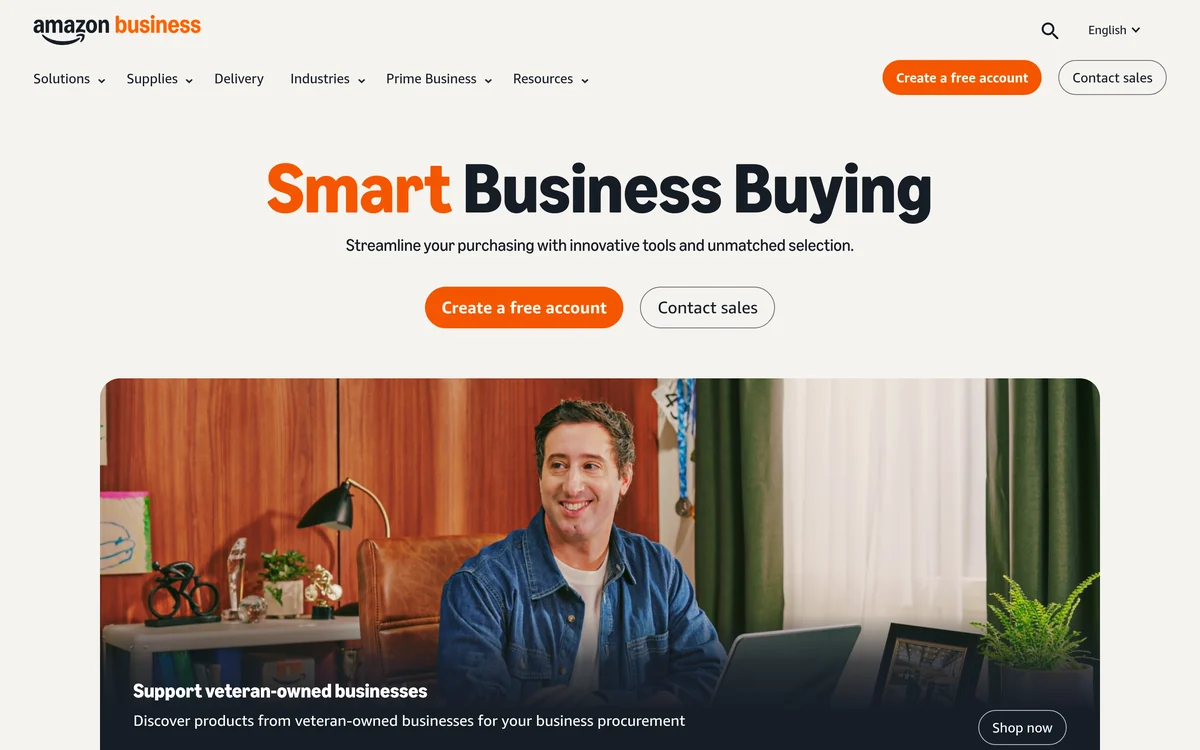
Amazon Business’s Guided Buying page lets admins prefer, restrict or block specific products and sellers, and set approvers who get 7 days to review an order. Its Prime Business plans run from Essentials at $179 a year for up to 5 users to Enterprise at $10,099 a year for unlimited users.
Its systems integration page cites integrations with more than 300 e-procurement, expense management, identity and e-sourcing systems, including punchout, punch-in and hosted catalogs. That fit is strong for goods but stops at what sellers list, so services and custom buys still need another route.
Strengths
- Published plans from $179 a year
- Punchout from your e-procurement tool
- Approvals and guided buying
Watch-outs
- Covers catalog goods, not services
- Some buying policies need a Prime Business plan
3. Fairmarkit
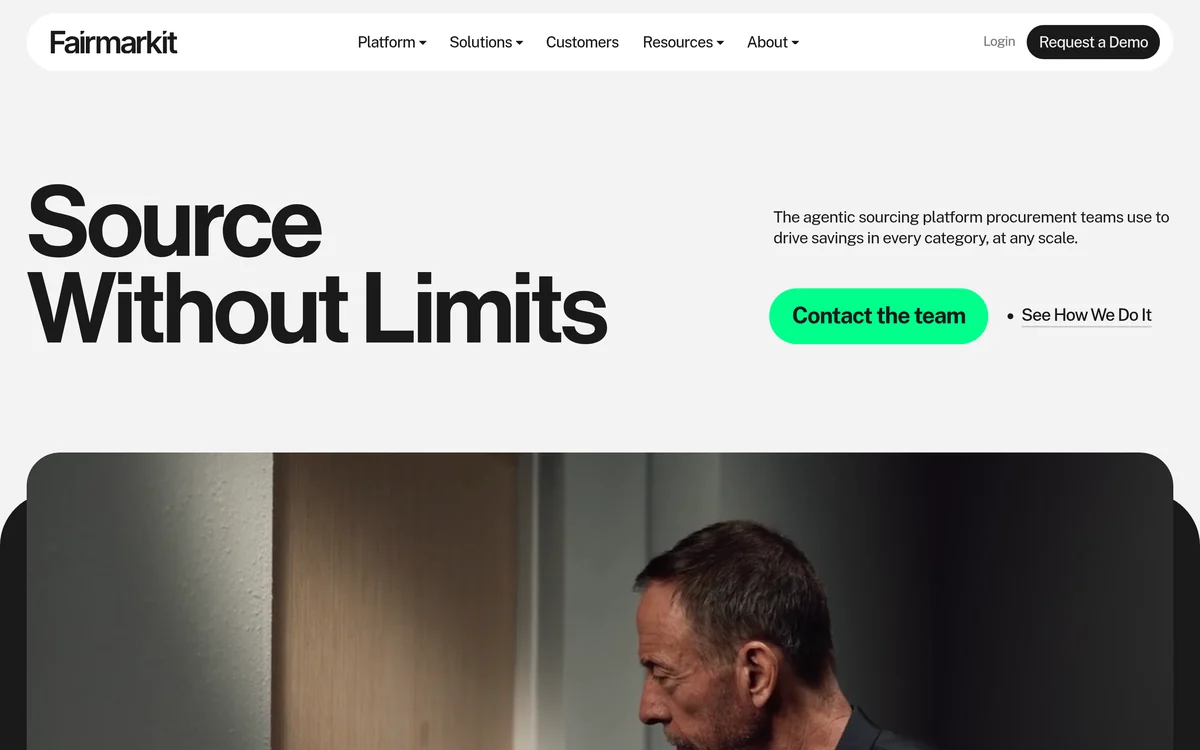
Fairmarkit’s tactical sourcing page pairs a governed intake front door with RFx templates and automation rules that turn tail spend into set-and-forget events. Its RFx execution page adds live auctions and automatic negotiation across multiple suppliers.
Its integrations page names SAP S/4HANA, SAP ECC, SAP Ariba, Coupa, Oracle, ServiceNow and Zip, each able to pass a purchase request to Fairmarkit for bids and write the result back. Amazon Business quotes and Candex supplier onboarding plug in as partners.
Strengths
- Named connectors for major suites and ERPs
- Automation rules for repeat tail events
- Candex partner for one-off suppliers
Watch-outs
- No public price
- No stated go-live on the pages we read
4. Candex
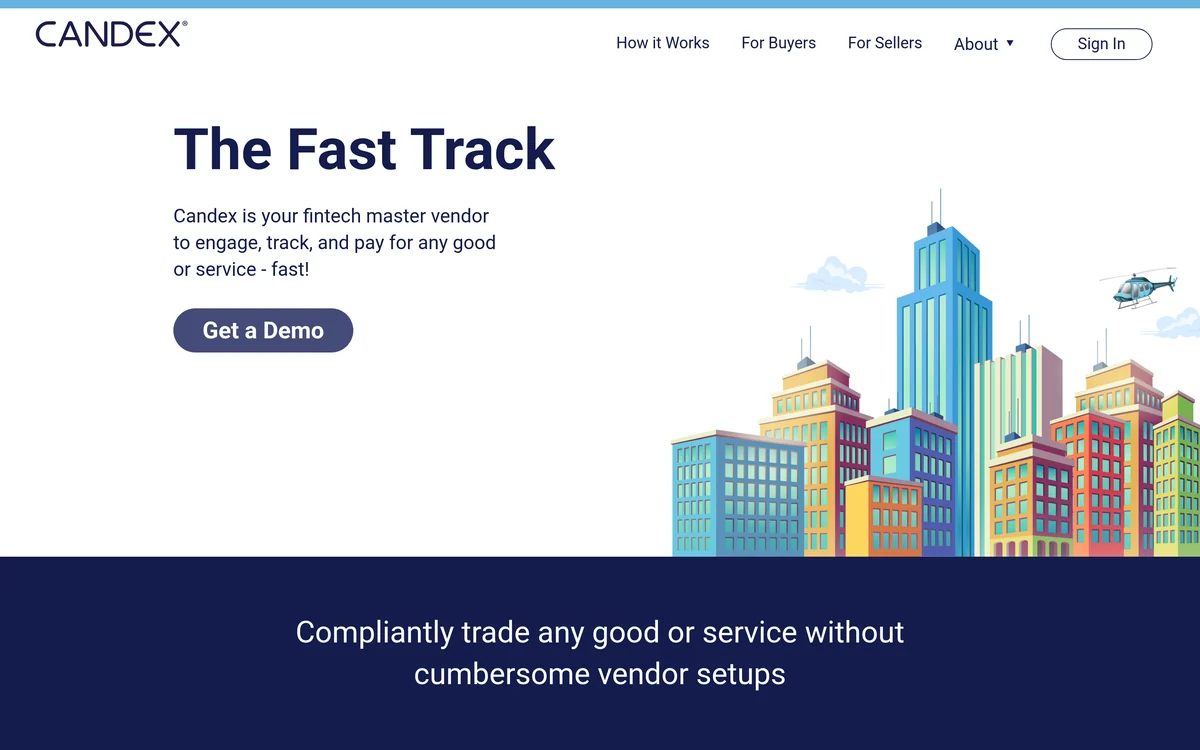
Candex’s how it works page sets it up as the trading partner for both sides: the seller invoices Candex, Candex invoices you after compliance checks, and you pay Candex. Its buyers page says it punches out from Ariba, Coupa, Oracle, SAP, Workday and other purchasing tools, and scans every vendor against major sanction lists.
The same page says Candex takes on 1099 and VAT filings for purchases through it. Its pricing page describes transaction fees similar to credit cards, visible on each engagement, with unlimited users, categories and countries.
Strengths
- No supplier setup for one-off buys
- Punchout from major P2P tools
- Pricing model stated plainly
Watch-outs
- No sourcing or price competition
- Fee level is not published
5. Simfoni Vitesse
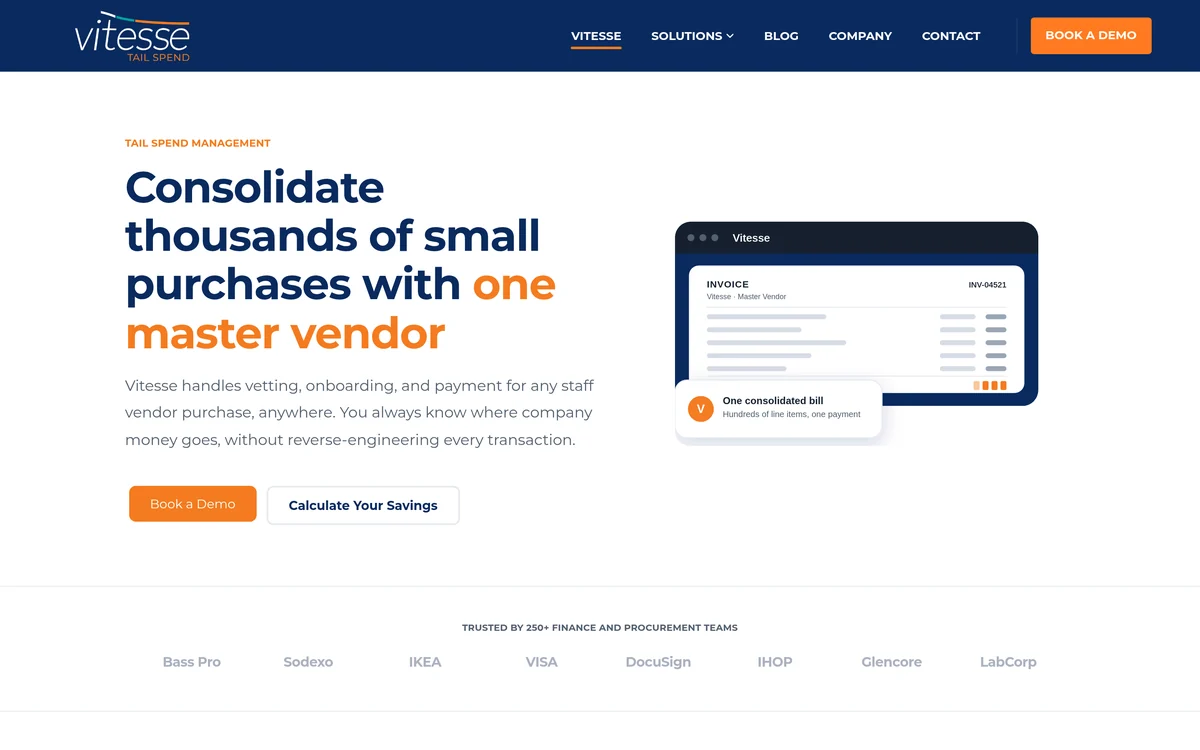
Simfoni’s Vitesse page describes a master-vendor service that vets, onboards and pays any staff vendor purchase, so finance makes a single payment to Vitesse. It auto-classifies each transaction across 200+ procurement categories and screens for sanctions before payment.
The same page says most suppliers are active within 1 to 3 business days. Simfoni also sells spend analytics and eSourcing, which helps when part of the tail should move into a proper sourcing event.
Strengths
- Single consolidated invoice
- Supplier onboarding in days
- Spend analytics and eSourcing in the same family
Watch-outs
- No public price
- No named P2P integrations on the pages we read
6. Keelvar
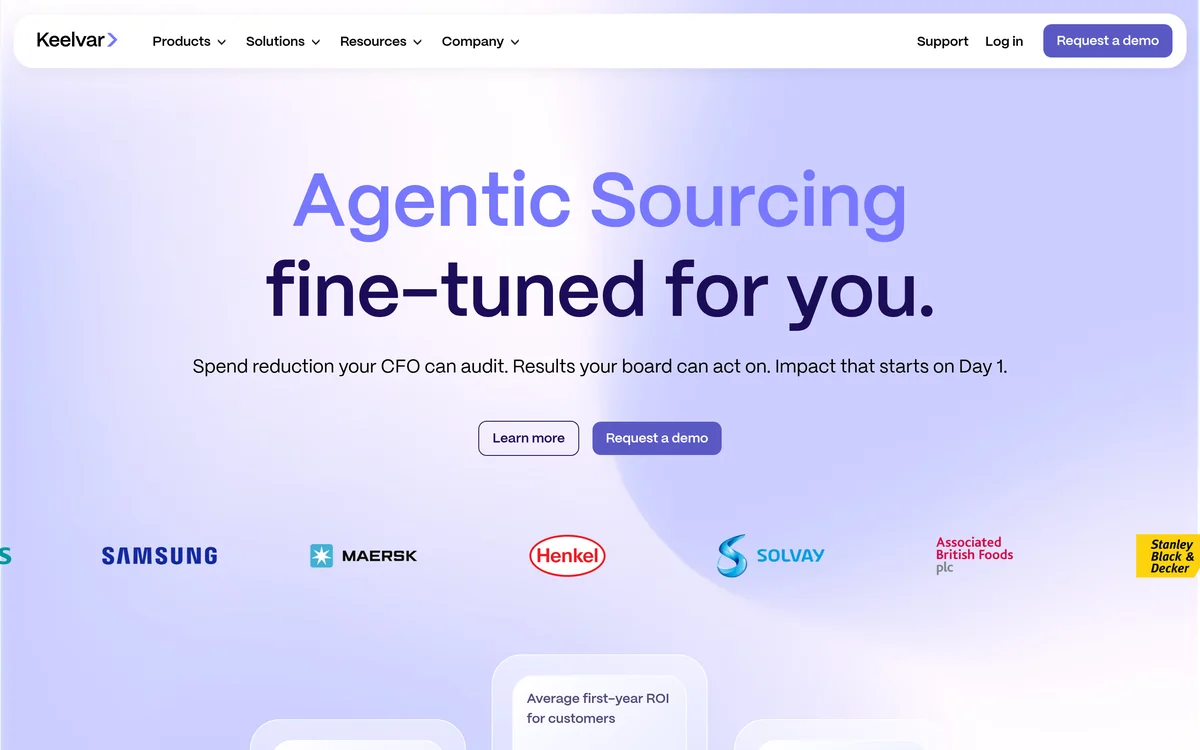
Keelvar’s autonomous sourcing page says agents run intake, supplier selection, event creation, bidding and award for tactical and tail events. End users describe the need in plain language, and the agent recommends an award automatically for straightforward spend or holds it for approval.
Its SAP Ariba integration page explains that events can start in SAP Ariba and return award data to SAP Ariba Contracting. Its home page says deployment takes days, by Keelvar’s own account. Our Keelvar vs Fairmarkit comparison covers how the two compare on complex sourcing events.
Strengths
- Category agents that follow your rules
- Multi-round bidding run for you
- SAP Ariba integration
Watch-outs
- No public price
- Built around sourcing events, not payment
7. Globality
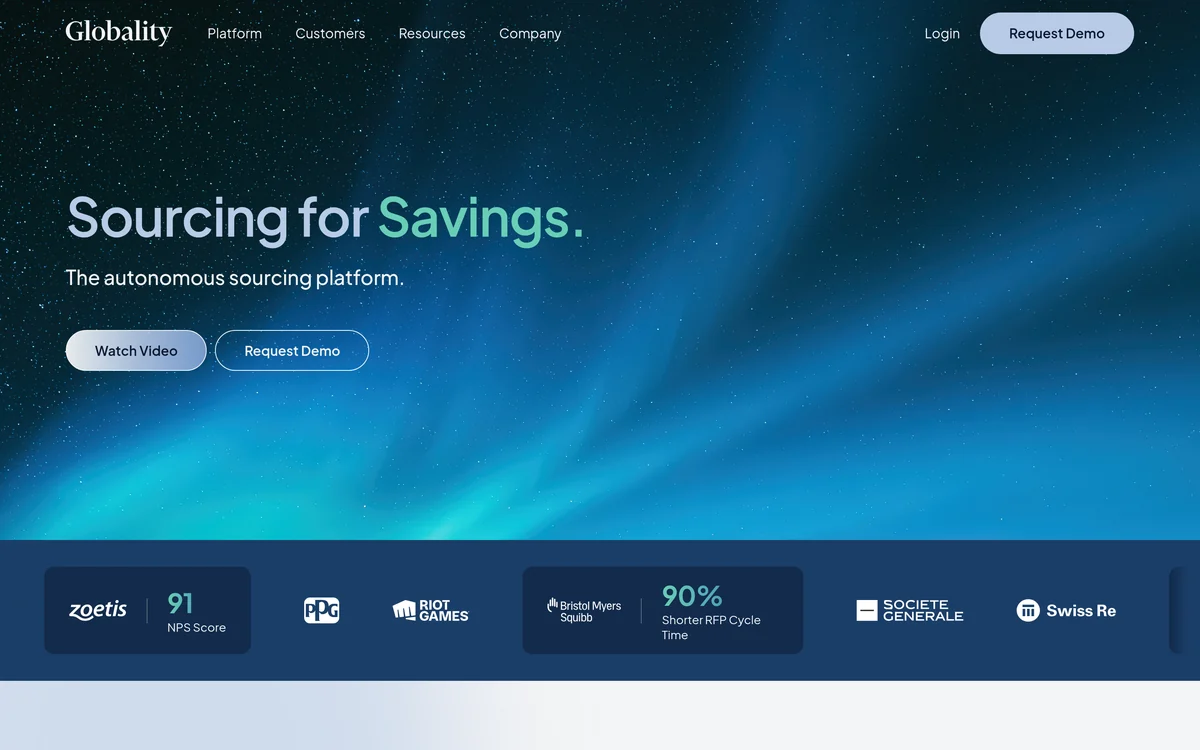
Globality’s Flexible Intake page accepts requests as text, PDF, Word or Excel, applies policy and benchmarks the submitted price against market rates. When it finds a better option, it can launch a sourcing event from the original request.
Its platform page offers an autonomous mode, where Glo negotiates with suppliers, and a collaborative mode for sensitive events. The same page says 80% of customers launch within 4 weeks, by Globality’s own account.
Strengths
- Should-cost check at intake
- Two autonomy modes by event
- Handles services as well as goods
Watch-outs
- No public price
- No named P2P connectors on the pages we read
8. Order.co
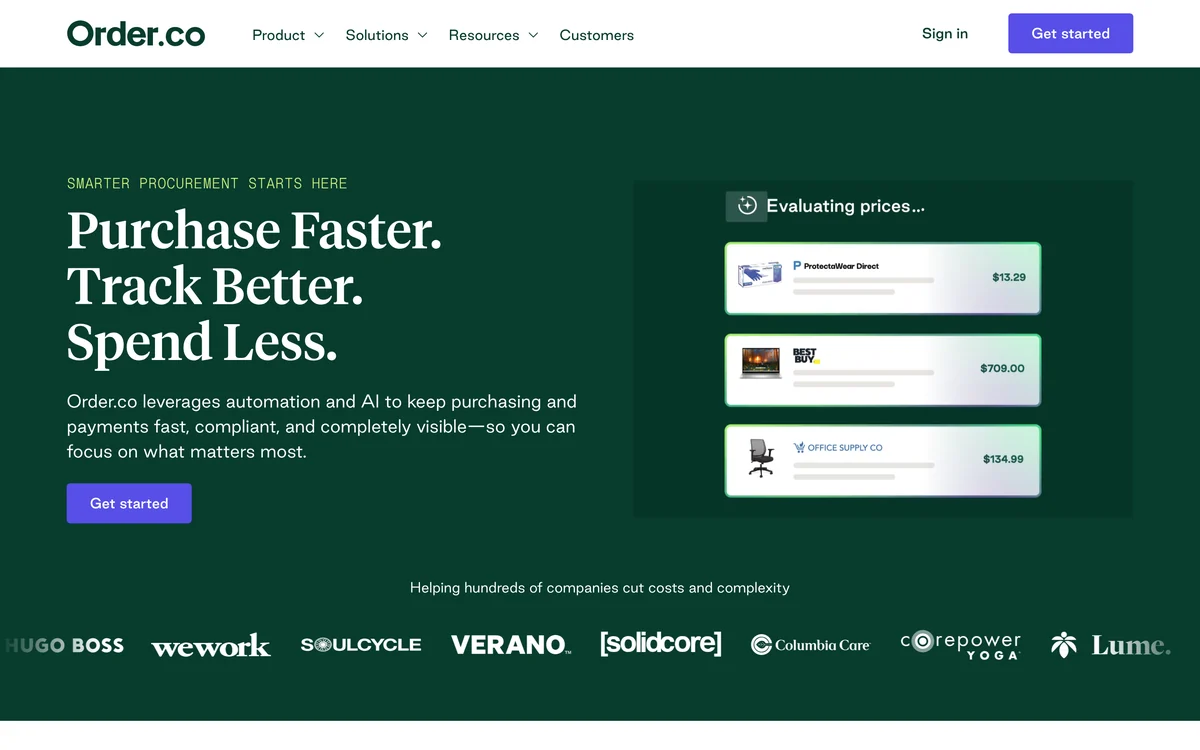
Order.co’s home page covers SKU-level pre-approvals, AI catalog management and requisitions converted into POs. It issues vendor-locked virtual cards that track spend and enforce budgets, and tracks orders from any vendor in one place.
Its accounting integrations page lists QuickBooks Online, NetSuite and Sage Intacct. It suits recurring supplies better than one-off services, and we found no public price.
Strengths
- SKU-level pre-approvals
- Budgets enforced at the card
- QuickBooks Online, NetSuite and Sage Intacct sync
Watch-outs
- No public price
- Built for supplies, not services
When your ERP’s own module is enough
Your suite or ERP module is enough for tail spend when it already offers catalogs, punchout and spot quotes, and most small buys come from a short list of known suppliers. A separate tail tool earns its cost once one-off suppliers, uncompeted quotes or invoice volume start to outweigh the spend itself.
- Buyers accept the first quote on small requests because nobody has time to compete them
- New suppliers wait weeks for setup for a single purchase
- AP processes hundreds of small invoices from vendors used once
- P-card and expense data show supplies bought outside any catalog
One of these signals usually justifies a tail spend tool. Several justify a fresh look at procure-to-pay software or the best procurement software as a whole.
Which tail spend management software should you choose?
To choose tail spend management software, name the biggest leak first: uncompeted prices, slow supplier setup, invoice volume or off-catalog buying. Pactum leads overall, Amazon Business suits catalog goods, Fairmarkit and Keelvar suit high-volume sourcing, and Candex or Simfoni Vitesse suit teams that want suppliers off their books.
The verdict
- Choose Pactum if you run Coupa or SAP Ariba and want tactical buys negotiated before the PO.
- Choose Amazon Business if most of your tail is catalog goods and you want a published price.
- Choose Fairmarkit if you want every small buy competed inside your current ERP or P2P.
- Choose Candex if one-off suppliers are the bottleneck and you want no vendor setup.
- Choose Simfoni Vitesse if finance wants one invoice in place of hundreds.
- Choose Keelvar or Globality if you want sourcing agents running repeat or services events.
- Choose Order.co if several sites reorder the same supplies.
Teams weighing a full suite can compare source-to-pay suites, read our Coupa alternatives or our SAP Ariba alternatives. New buyers can start with the procurement software guide, and more guides sit in our tail spend tools hub. If the tail problem starts at the request form, our ranking of the best purchase requisition software covers that step.
Frequently asked questions
What is tail spend management software?
Tail spend management software brings the long run of small, one-off purchases under control. Some tools compete those buys with automated spot quotes and negotiation, some act as a master vendor that onboards and pays suppliers for you, and some steer staff to approved catalogs with buying policies and approvals.
What counts as tail spend?
Tail spend is the low-value, high-volume end of company spend: one-off purchases, small suppliers used once and buys outside any contract. It is usually a small share of total spend but a large share of suppliers and invoices, which is why it costs more to process than its value suggests.
How much does tail spend management software cost?
Amazon Business is the only tool here with published list prices, from $179 a year for up to 5 users to $10,099 a year for unlimited users. Candex charges a per-transaction fee, Pactum sizes plans by revenue band, and Fairmarkit, Keelvar, Globality, Simfoni Vitesse and Order.co are quote based.
What is a master vendor for tail spend?
A master vendor sits between you and many small suppliers. You raise one PO and pay one invoice to the master vendor, which vets, onboards and pays each supplier and handles tax paperwork. Candex and Simfoni Vitesse both work this way, according to their own pages.
Does tail spend software work with Coupa and SAP Ariba?
Yes, several tools here connect to both. Pactum and Fairmarkit list Coupa and SAP Ariba integrations, Candex punches out from both, and Amazon Business integrates with more than 300 e-procurement and related systems. Keelvar names an SAP Ariba integration. Confirm which workflows each connector covers before you buy.
How long does it take to set up tail spend software?
Vendor timelines vary. Pactum says most teams are live in two to four weeks, Globality says 80% of customers launch within 4 weeks, and Keelvar says deployment takes days. Simfoni Vitesse puts supplier onboarding at 1 to 3 business days. Ask each vendor for the timeline in writing.