A supplier rebate goes unclaimed because the clause sat in an amendment nobody linked to the master agreement. Sirion vs Ironclad is a choice between two AI contract platforms that both promise to catch that. They get there from opposite ends of the contract.
We scored both on the five weighted criteria we use for every contract platform: after-signature tracking (3 points), procurement fit (2.5), authoring and review (2), time to value (1.5) and pricing clarity (1). Facts come from each vendor’s product, agent, integration, pricing and press pages, plus Vendr, read on November 1, 2026. Our scoring rules are public, and related guides sit in the contract management hub.
Sirion vs Ironclad: which should you pick?
Pick Sirion if supplier performance after signature is the problem: obligations, service levels and invoices checked against contract terms. It scores 8.3 out of 10. Pick Ironclad, at 8.2, if the queue before signature is the problem: vendor paper review, intake and Coupa requisitions. Neither publishes a price.
| Sirion | Ironclad | |
|---|---|---|
| Built around | Contract data and post-signature performance | Workflow, review and a conversational front door |
| AI layer | agentOS: 8 pre-built agents plus agents you describe in plain language | Ironclad Agent routing to 9 named agents, one in early access |
| Best for | Supplier contracts where performance and invoices must be checked | Procurement teams reviewing a lot of vendor paper, often in Coupa |
| Named S2P links | SAP Ariba accelerator | Coupa requisition sync, SAP Ariba and S/4HANA |
| Public price | No | No; Vendr median $40,492 a year |
| Our score | 8.3 | 8.2 |
Our pick
Sirion for supplier performance, Ironclad for review speed
Sirion leads by one tenth because it checks invoices and service levels against the contract, per its Manage page. Ironclad leads on authoring and review and on time to value. If your pain sits before signature, the order flips.
What does AI-native mean for Sirion and Ironclad?
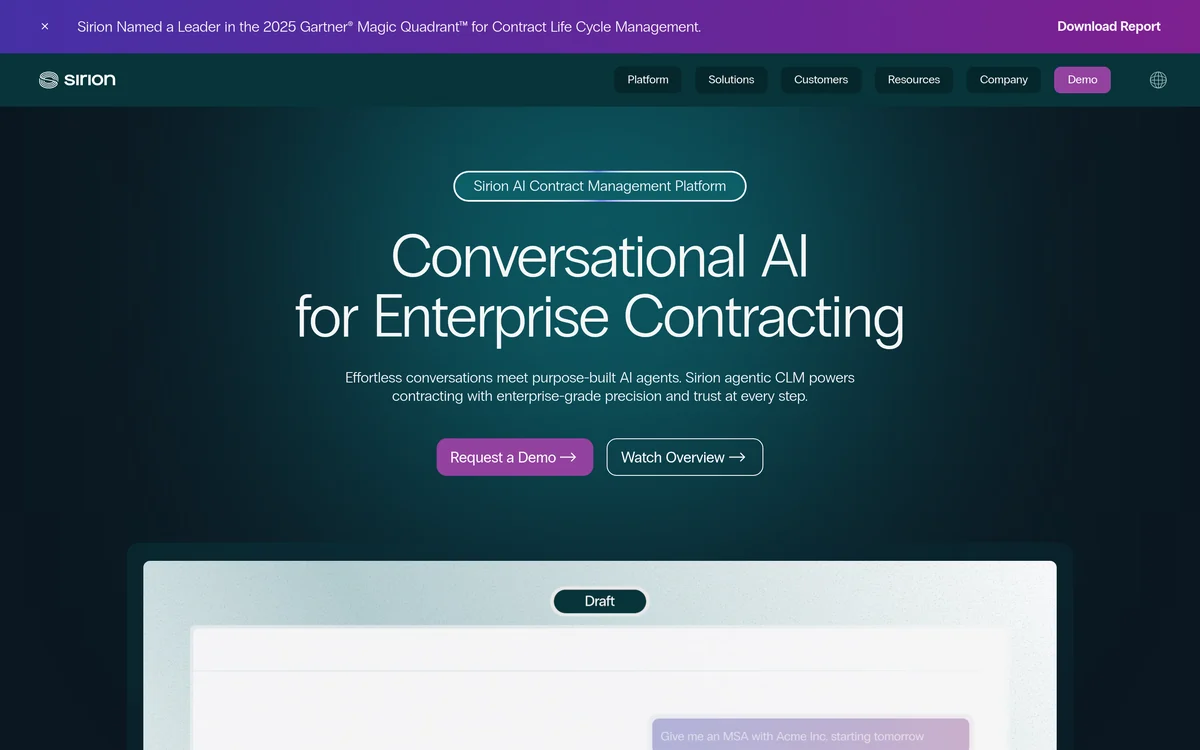
Both use the label, and it means different things. Sirion calls itself an AI-native CLM leader in its February 2026 press release. Its AI starts from extracted contract data. Ironclad calls itself the AI contracting company, and its AI starts from the workflow and the history of past negotiations.
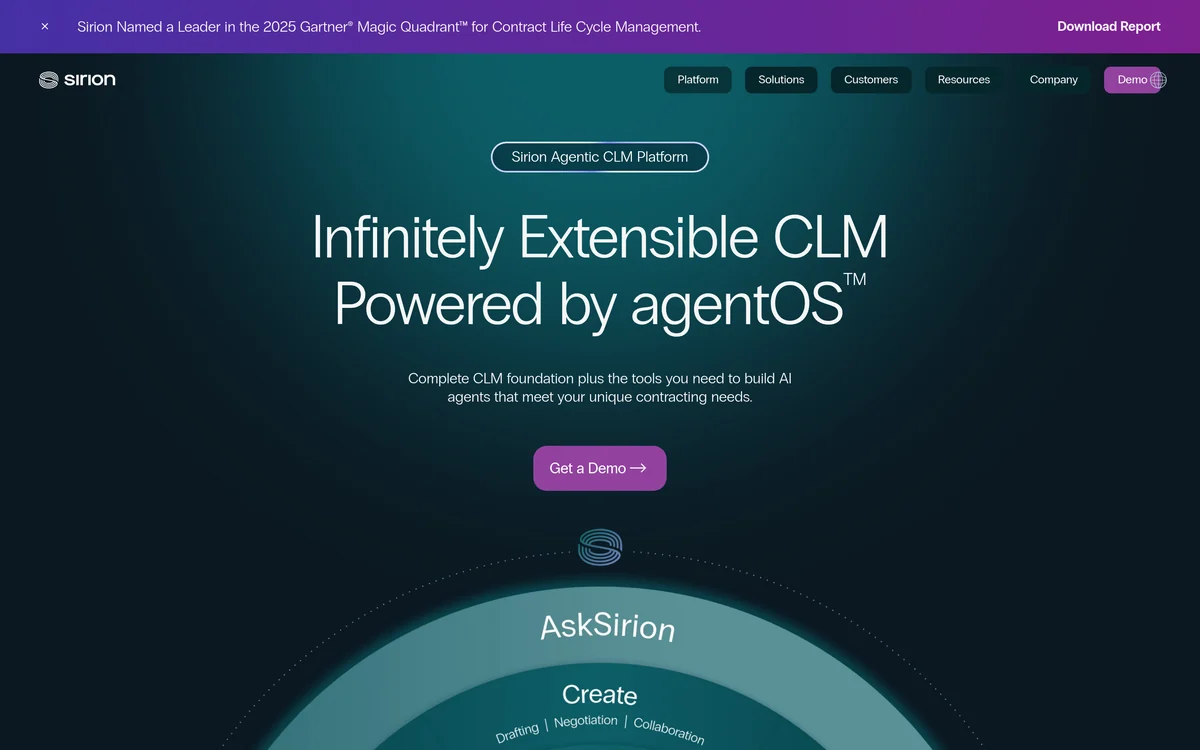
Sirion’s agentOS page says its AI combines 10+ large language models with 1,200+ proprietary small language models, and picks a model per task. Ironclad’s Ironclad Agent post describes a Contract Knowledge Graph that maps every clause, obligation, relationship and negotiated decision across your portfolio.
Which agent does which job?
Sirion names 8 pre-built agents, and Ironclad names 9 behind its Ironclad Agent front door. They overlap on search, clause review, redlining and playbooks. Sirion alone names agents for drafting and invoice checks. Ironclad alone names agents for intake, renewals, contract families and workflow building.
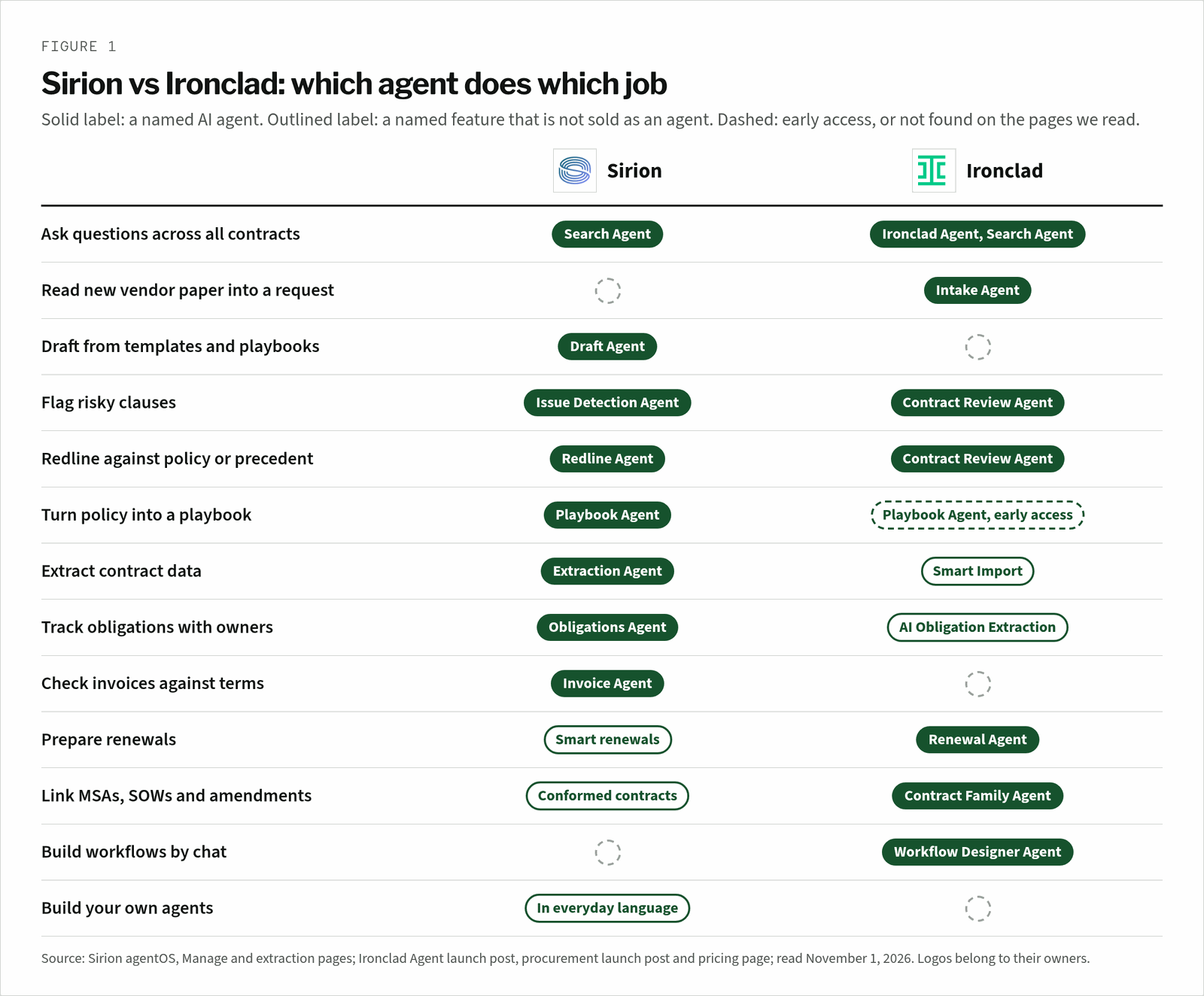
Two differences matter most. Sirion lets customers build new agents by describing the task, the data and when to escalate in everyday language. Ironclad’s launch post lists its Playbook Agent as early access and says the agent remembers each user’s preferences across sessions.
What the record holds
An agent is only as good as the record it reads. Sirion and Ironclad both extract data from signed contracts, but they count it differently. Ask both vendors to show these fields on one of your own supplier contracts, with the owner and source of each.
| Field | Sirion | Ironclad | Who owns it |
|---|---|---|---|
| Metadata fields extracted | 1,200+ ready-made fields, per its extraction page | Not counted on the pages we read | Contract owner |
| Clause categories | 200+ ready-made categories | Not counted on the pages we read | Legal |
| Obligation types | Tracked by the Obligations Agent; no count published | 37 ready-made types, per its procurement launch post | Named obligation owner |
| Custom fields or types | New metadata models without code | Self-service builder for custom obligation types | Admin |
| Tables, rate cards, service levels | Named on the extraction page | Not named on the pages we read | Procurement |
| Amendments | Reconciled into one conformed contract | Grouped by the Contract Family Agent | Legal |
| Human review | Reviewers check extracted data against the source | Obligations verified under admin review policy | Contract owner |
Where does Sirion pull ahead?
Sirion pulls ahead after signature. Its Manage page validates performance against service level agreements and audits invoices against purchase orders, contract terms and data from ERP and IT service systems. It matches payments and penalties to invoice line items. That is the job Ironclad does not name.
Sirion also runs shared governance with the supplier: one view of performance, governance meetings, issues and disputes. The same page claims an 8 to 12% cut in spend leakage and 80% fewer post-signature disputes. These are Sirion’s own figures, and the page does not say how they were measured, so ask for the method in writing.
Where does Ironclad pull ahead?
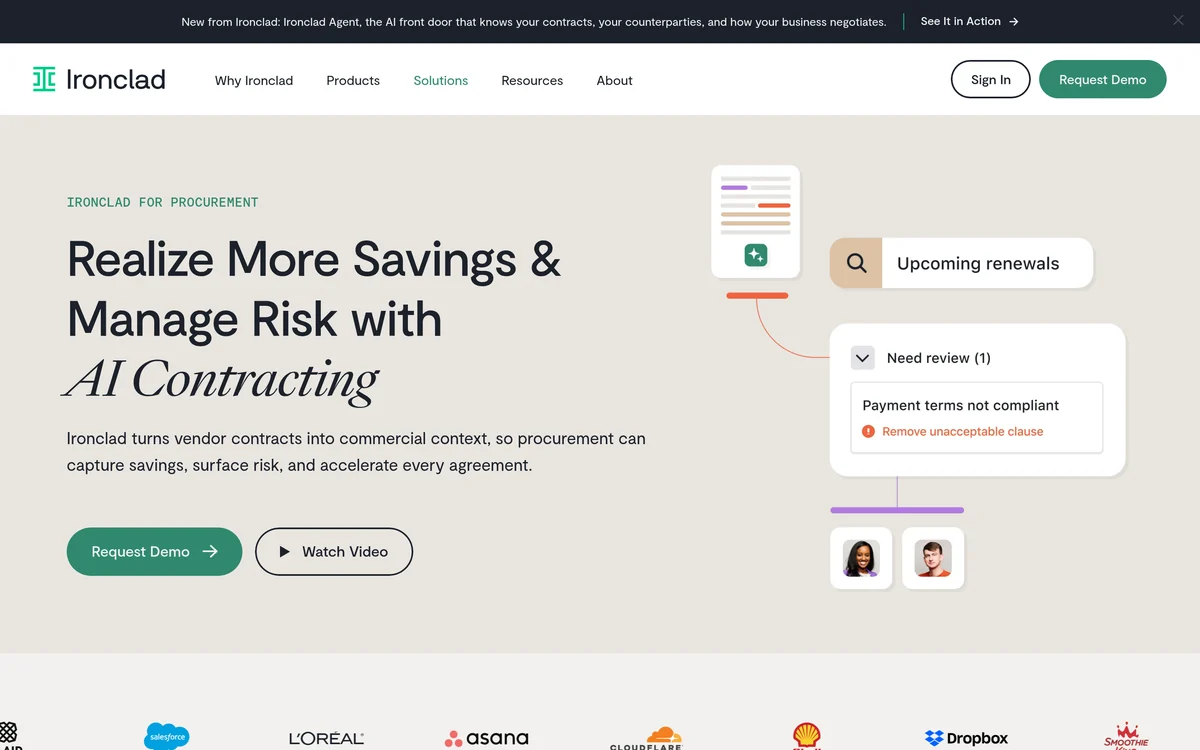
Ironclad pulls ahead before signature. Its procurement page says the Intake Agent reads incoming vendor paper and fills the launch form. The Contract Review Agent applies legal-approved positions and fallback language. In Ironclad’s own example, it flags a 4% uplift cap that matches past supplier precedent but beats the 3% playbook position.
Its August 5, 2026 procurement release closed much of the after-signature gap. It added AI Obligation Extraction for rebates, discounts, credits and termination rights, plus the Contract Family Agent. The Workflow Designer Agent lets admins describe a routing rule in plain words and get workflow logic back.
How do they connect to SAP Ariba, Coupa and Salesforce?
Sirion has the more documented SAP Ariba flow, and Ironclad has the only documented Coupa flow of the two. Ironclad also names Salesforce on its pricing page. Sirion names CRM and sell-side connectors without listing them in text we could read. Confirm each connector in writing, with the direction of sync.
| System | Sirion | Ironclad |
|---|---|---|
| SAP Ariba | Pre-built accelerator: awarded sourcing events create contract requests, signed contracts raise a PR in Ariba, approved POs sync back. Sirion Ariba page | Enhanced SAP Ariba and S/4HANA link; contract workflows start from requisitions and terms surface at PO level. Ironclad launch post and Ariba setup guide |
| Coupa | Not on Sirion’s own pages we read; Workato lists a Coupa and Sirion connector pair. Workato listing | Requisition Sync: neither the requisition nor the contract completes until both teams approve. Ironclad Coupa guide |
| Salesforce | Sell-side and CRM connectors named as categories; ask for the Salesforce scope | AppExchange-approved integration for launching contracts inside Salesforce. Ironclad pricing page |
| Other systems | APIs and no-code tools for apps without a connector. Sirion integrations | API plus named integrations such as Box and HelloSign |
How do Sirion and Ironclad score?
Sirion scores 8.3 and Ironclad 8.2 out of 10. Sirion wins after-signature tracking and procurement fit by two tenths each. Ironclad wins authoring and review and time to value by a tenth or two. Both score 0.4 of 1 on pricing clarity, because neither publishes a price.
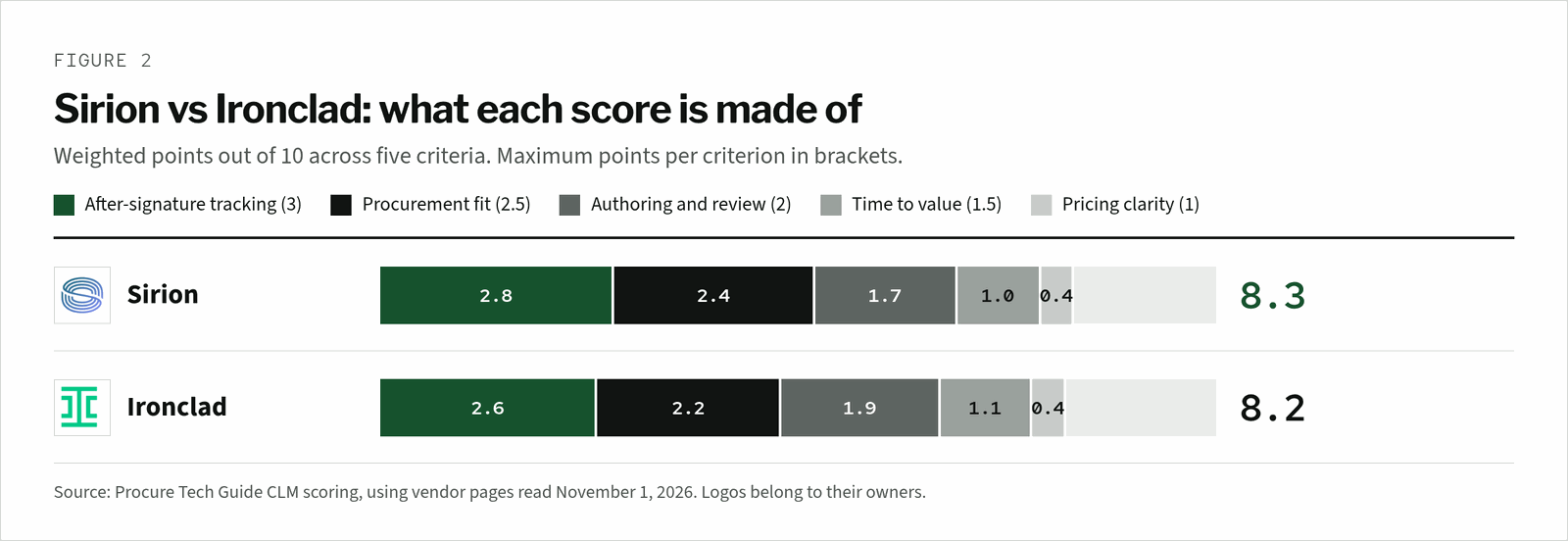
| Criterion | Max points | Sirion | Ironclad | Why |
|---|---|---|---|---|
| After-signature tracking | 3 | 2.8 | 2.6 | Sirion checks invoices and service levels; Ironclad tracks 37 obligation types |
| Procurement fit | 2.5 | 2.4 | 2.2 | Sirion’s Ariba accelerator and supplier governance; Ironclad’s Coupa sync |
| Authoring and review | 2 | 1.7 | 1.9 | Ironclad reviews against playbook and precedent |
| Time to value | 1.5 | 1.0 | 1.1 | Ironclad offers self-led, legal engineer or partner deployment |
| Pricing clarity | 1 | 0.4 | 0.4 | No list price from either |
| Total | 10 | 8.3 | 8.2 |
How much do Sirion and Ironclad cost?
Neither publishes a price. Ironclad’s pricing page says quotes depend on products, users, workflows and growth. Vendr shows a median of $40,492 a year for Ironclad across 372 purchases. We found no Vendr page for Sirion, but its AWS Marketplace listing shows $150,000 for 12 months for 100 users. Our Icertis pricing guide sets that against Icertis list pricing. Our Ironclad pricing guide breaks down its plans and cost drivers.
| Sirion | Ironclad | |
|---|---|---|
| Published price | None | None |
| What drives the quote | Not stated on the pages we read | Products, users, workflows, growth, deployment partner, add-ons |
| Public benchmark | None found | Vendr median $40,492 a year; range $15,000 to $106,988 across 372 purchases |
| Integrations | Pre-built SAP accelerator; ask whether it costs extra | Some included and some add-ons, per the pricing FAQ |
| Source | Sirion site | Vendr Ironclad page |
Ask both for a three-year quote that names every agent, connector and services day. AI features are where quotes drift. Get the price of each agent you plan to use in writing, before it becomes a problem at renewal.
Who owns Sirion and Ironclad in 2026?
Haveli Investments took a majority stake in Sirion, announced in January 2026 and completed on February 23, 2026, per Sirion’s press release. Ironclad said on February 12, 2026 that it passed $200 million in annual recurring revenue, per its announcement.
| Sirion | Ironclad | |
|---|---|---|
| Ownership news | Haveli majority investment, completed February 23, 2026 | Passed $200M ARR, February 12, 2026 |
| Scale claims | Growth above 40% a year for five years, per its January release | Jurist AI assistant grew ARR nearly six times year over year |
| Gartner CLM Magic Quadrant 2025 | Leader, fourth year in a row, per its press release | Leader, per its home page |
| Leadership | Founder Ajay Agrawal is CEO | Dan Springer is CEO |
Gartner published the Magic Quadrant for Contract Life Cycle Management on November 10, 2025. Sirion says it sits highest on Ability to Execute among 16 vendors. A new owner can change roadmaps and pricing, so ask Sirion how the Haveli deal affects your renewal terms.
Six prompts to run in both demos
Both vendors sell a chat interface, so test it the same way. Load three of your own supplier contracts, including one with an amendment. Run these six prompts in both, and keep the answers. A good answer links to the clause it came from.
- Renewal: “When can we give notice on this supplier, and who gets the alert?”
- Amendment: “Which terms did the second amendment change, and what did they replace?”
- Obligation: “List every rebate and service level in this contract, with owners.”
- Invoice: “Does last month’s invoice match the agreed rates?”
- Review: “Redline this vendor paper against our playbook and explain each change.”
- Permissions: “Show me a contract I should not have access to.” The right answer is a refusal.
After signature: the checklist
- Renewals: the notice date is extracted, a person confirms it, and the alert goes to a named owner.
- Obligations: each obligation has an owner, a due date and a link to its clause.
- Amendments: the amendment updates the record, and the original terms stay visible.
- Invoices: billed rates are checked against the contract before payment, by a person or an agent.
- S2P sync: the signed contract reaches SAP Ariba or Coupa with the right supplier and amounts.
- Audit trail: every agent action is logged with a time, a user and the permissions used.
Red flags in a demo
- The agent answers without linking to the clause it used.
- The demo runs on sample contracts, never your scanned supplier paper.
- An agent shown on stage is early access, and nobody says so.
- A connector turns out to be a third-party automation you must buy and maintain.
- An accuracy or savings figure is quoted with no method behind it.
- Nobody can say in writing who owns migration of your old contracts.
If neither fits
If contracts mostly come from sourcing events, your suite’s own contract module may be enough. See our SAP Ariba alternatives guide and the Coupa vs SAP Ariba comparison. Our contract lifecycle management software guide defines the CLM category, and our best contract management software ranking scores 12 platforms. For three-way views, see Icertis vs Ironclad vs Sirion and Agiloft vs Icertis vs Ironclad, and our AI contract management software ranking covers the AI side. For AI across the wider buying process, our AI procurement software ranking compares more vendors, and our Conga, DocuSign CLM and Agiloft comparison covers three more CLM platforms.
The verdict: Sirion or Ironclad?
Sirion scores 8.3 because it follows the contract into supplier performance and invoices. Ironclad scores 8.2 because it moves vendor paper through review faster and ties contracts to Coupa requisitions. The gap is one tenth. Choose by where your contracts fail today: after signature, or before it.
The verdict
- Choose Sirion if supplier service levels, rate cards and invoices must be checked against the contract.
- Choose Sirion if SAP Ariba runs sourcing and you want awarded events to become contract requests.
- Choose Ironclad if procurement reviews vendor paper daily and wants intake and redlines handled by agents.
- Choose Ironclad if you buy in Coupa and want requisitions held until the contract is approved.
Frequently asked questions
Is Sirion better than Ironclad?
For supplier contracts where performance matters, yes, narrowly. Sirion scores 8.3 to Ironclad’s 8.2 in our comparison, thanks to invoice audits and service level checks after signature. Ironclad is the better pick when your bottleneck is reviewing vendor paper and launching contracts from Coupa or Salesforce.
What is Sirion agentOS?
agentOS is the layer behind Sirion’s AI agents. It ships 8 pre-built agents for search, drafting, issue detection, redlining, playbooks, extraction, obligations and invoices. Customers can build new agents by describing the task in everyday language. Sirion says it combines 10+ LLMs with 1,200+ small language models.
What is Ironclad Agent?
Ironclad Agent is a single chat interface that finds contracts, answers portfolio questions and routes work to specialized agents. Ironclad made it generally available with Search, Analytics, Workflow Designer and Contract Family agents. It also remembers user preferences across sessions. The Playbook Agent is still in early access.
How much do Sirion and Ironclad cost?
Neither publishes a price. Vendr shows a median of $40,492 a year for Ironclad across 372 purchases, with deals from $15,000 to $106,988. AWS Marketplace lists Sirion at $150,000 for 12 months for 100 users. Ask both vendors for a three-year quote that names every agent, connector and services day.
Does Sirion integrate with Coupa?
Not on the Sirion pages we read. Sirion documents a pre-built SAP Ariba accelerator and APIs for other systems. Workato lists a Coupa and Sirion connector pair, which is a third-party route. Ironclad documents a Coupa Requisition Sync, so ask Sirion to show its Coupa flow in writing.
Who owns Sirion now?
Haveli Investments, an Austin technology investment firm, holds a majority stake in Sirion. The deal was announced in January 2026 and completed on February 23, 2026. Founder Ajay Agrawal remains CEO. Ironclad, led by CEO Dan Springer, said in February 2026 that it passed $200 million in annual recurring revenue.