A first-year Ironclad contract is signed with uncapped Smart Import. In year two, the order form allows 50,000 runs a quarter, and nobody noticed. Ironclad pricing is quote based, so the cost lives in the order form, the product terms and the AI credit policy. This guide reads all three.
We read Ironclad’s pricing page, its FY2026 product descriptions, its AI credit policy, its Salesforce AppExchange listing and Vendr’s Ironclad pricing page on November 1, 2026. Our editorial rules are public. For the wider category, see our contract management hub. Our contract lifecycle management software guide and best contract management software ranking compare Ironclad with other platforms, and our Icertis pricing guide covers a rival’s model.
How Much Does Ironclad Cost in 2026?
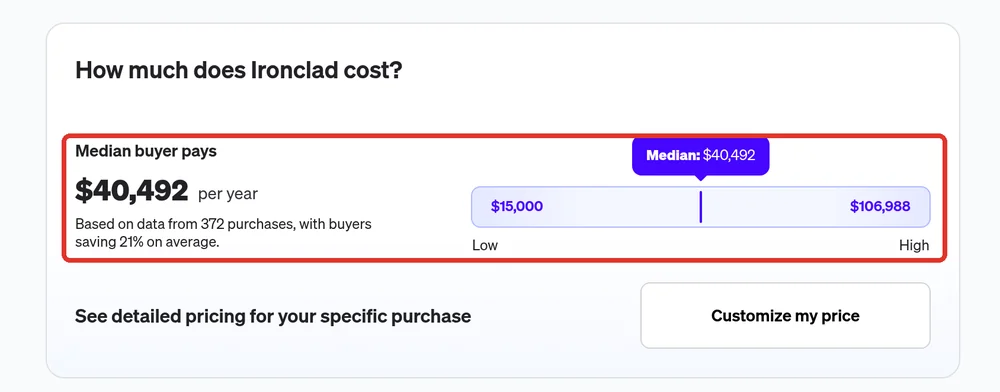
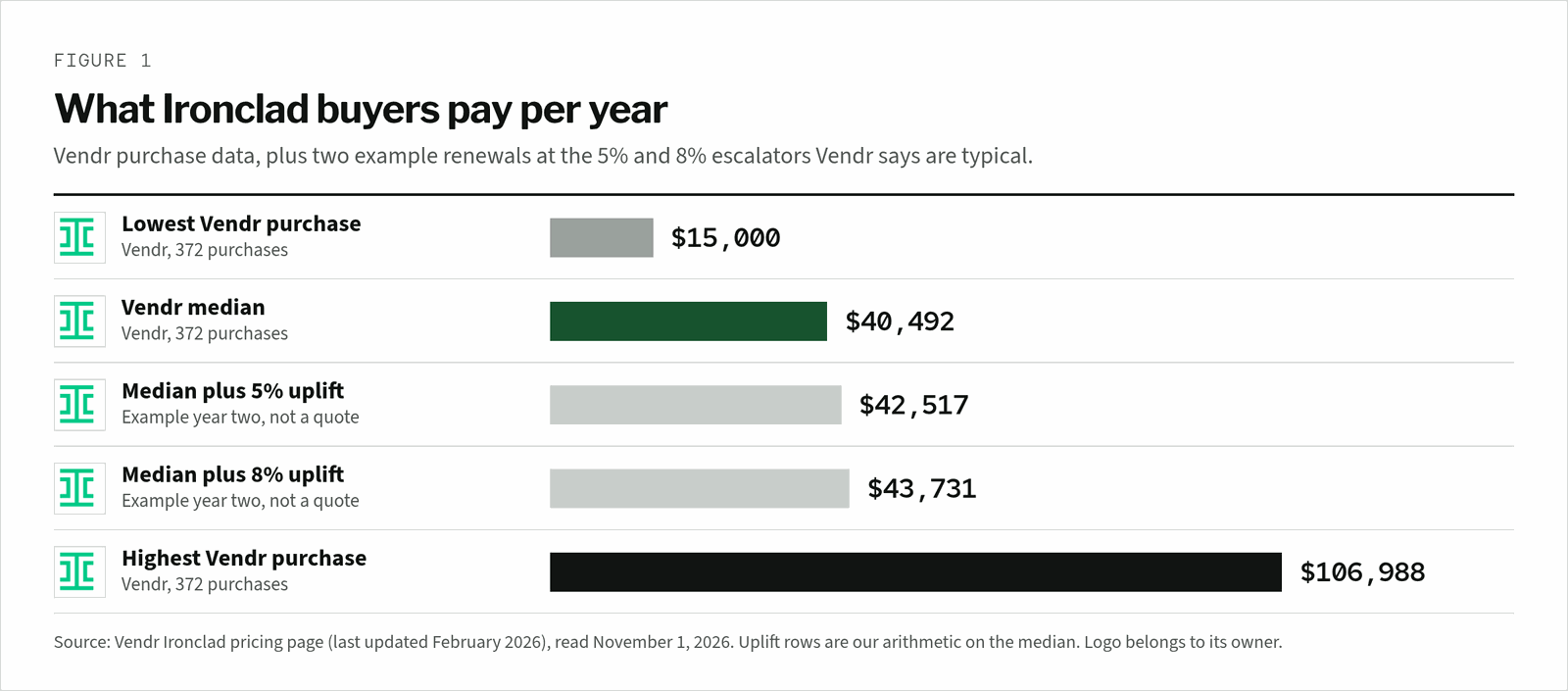
Ironclad publishes no price list. Vendr’s data on 372 Ironclad purchases shows a median of $40,492 a year, with deals from $15,000 to $106,988. The one list price we found is a Salesforce AppExchange entry starting at $200 per user per year. Budget for a five figure contract, then price the extras in writing.
| Price point | Amount | What it covers | Source |
|---|---|---|---|
| Median annual contract | $40,492 a year | 372 Ironclad purchases | Vendr |
| Lowest purchase | $15,000 a year | Same Vendr data set | Vendr |
| Highest purchase | $106,988 a year | Same Vendr data set | Vendr |
| Average savings | 21% | Against the first quote, per Vendr | Vendr |
| AppExchange entry price | From $200 per user per year | Ironclad’s Salesforce app listing; scope not stated | Salesforce AppExchange |
| Ironclad list price | Not published | The pricing page asks for a demo | Ironclad |
Budget line
Start from $40,492 a year, then price AI, seats and services
The Vendr median is the most useful anchor. Vendr’s page header counts 213 deals handled, while its price box cites 372 purchases, so treat the figures as a benchmark. Your quote moves with seat mix, AI credits, integrations and the success plan.
What Does Ironclad’s Pricing Page Say?
The Ironclad pricing page says pricing is “shaped by your products, users, workflows, and growth.” It lists three steps: pick products from CLM, an AI assistant and eSignature, pick a deployment partner, then add extras such as API access, integrations, more instances or a bigger success plan. No figures appear.
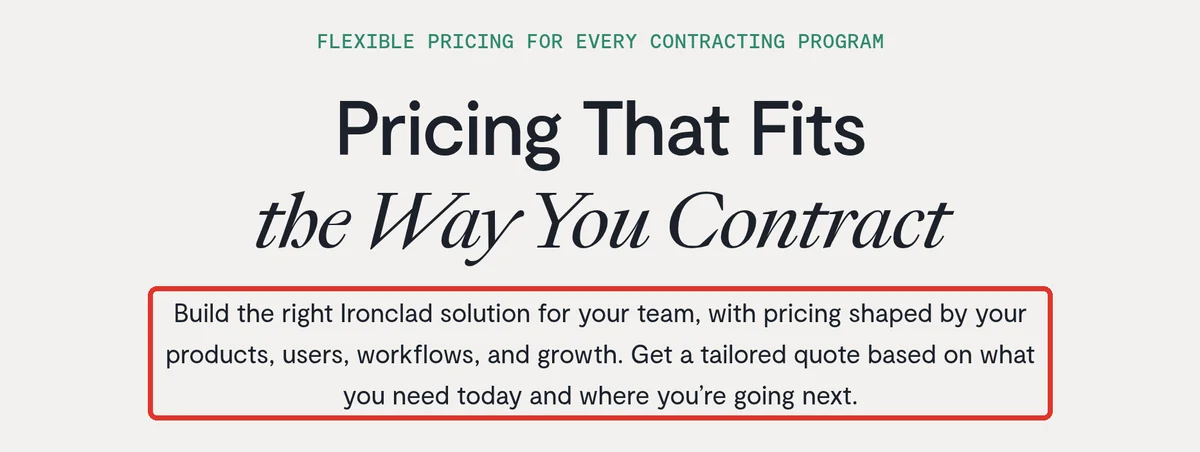
The page also says academy, community and in-app guides come free. Everything else is a line on the order form. Ironclad’s product descriptions say the order form wins when it conflicts with the agreement or the product terms. That makes the order form the system of record for your price.
What Do Ironclad Buyers Actually Pay?
Vendr’s Ironclad page reports a median of $40,492 a year from 372 purchases, a low of $15,000 and a high of $106,988. Buyers saved 21% on average. Vendr says mid-market buyers with 100 to 500 employees commonly land between $50,000 and $120,000 a year. The page was last updated February 2026.
Vendr’s bands are estimates from its own deals. It says buyers commonly receive first-year quotes of $40,000 to $80,000 with 500 to 2,000 contracts and 10 to 30 users. Large enterprises with 5,000 or more contracts commonly see quotes above $200,000 a year, by Vendr’s account.
What Drives an Ironclad Quote?
Six lines move the number: seats, products, AI credits, integrations, instances and the success plan. Ironclad names each of them in its pricing page or product descriptions. Vendr adds contract volume, which it calls the primary lever. Ask for each line as a separate price, in writing, before the first redline.
| Cost driver | What Ironclad publishes | The question to ask |
|---|---|---|
| Seats | Administrator, Standard and Requester seats, plus buy-side, sell-side and intake module users | How many of each seat type the quote assumes |
| Products | CLM, Ironclad Signature and Jurist, each named in the product descriptions | Which products the first quote bundles |
| AI credits | Credits pay for AI agents; extra credits can be bought beyond the edition’s allowance | How many credits are included, and the overage rate |
| Integrations | Coupa, SAP, NetSuite and OneTrust integrations are listed as platform entitlements | Which integration sits in your edition |
| Instances | A non-production instance is a separate entitlement; the pricing page offers extra instances | Whether a test instance is included |
| Success plan | Standard and Enterprise success plans; 24/7 phone support is a paid Enterprise upgrade | Which plan the quote assumes |
What the Order Form Holds
The order form sets the products, quantities and fees. The FY2026 product descriptions define what each seat and entitlement means. The AI credit policy sets what happens when usage runs over. Read all three together, and name an owner for each line before it becomes a problem at renewal.
| Line on the order form | What it controls | Who owns it |
|---|---|---|
| Administrator seats | Workflow Designer, groups, API access, user and integration settings | Legal operations |
| Standard seats | Editing, search, approvals and Insights reports | Legal and contract managers |
| Requester seats | Launching contract requests from forms | Business teams |
| Buy-side module users | Requests, signing and the Coupa and OneTrust integrations | Procurement |
| Jurist seats | Access to Jurist, an add-on to admin, standard and requester seats or a standalone seat | Legal |
| AI credits | Usage of Ironclad AI agents such as Archive, Intake and Renewal | Legal operations and finance |
| Platform entitlements | API access, integrations, EU data center, advanced encryption, test instance | IT and procurement |
How Is Ironclad AI Priced?
Ironclad AI comes in two layers. Embedded features such as AI Assist, AI Playbooks and Conversational Search are part of the CLM platform and fall under a fair use policy. AI agents, including the Archive, Intake and Renewal agents, consume AI credits. Credits included with an edition can be topped up.
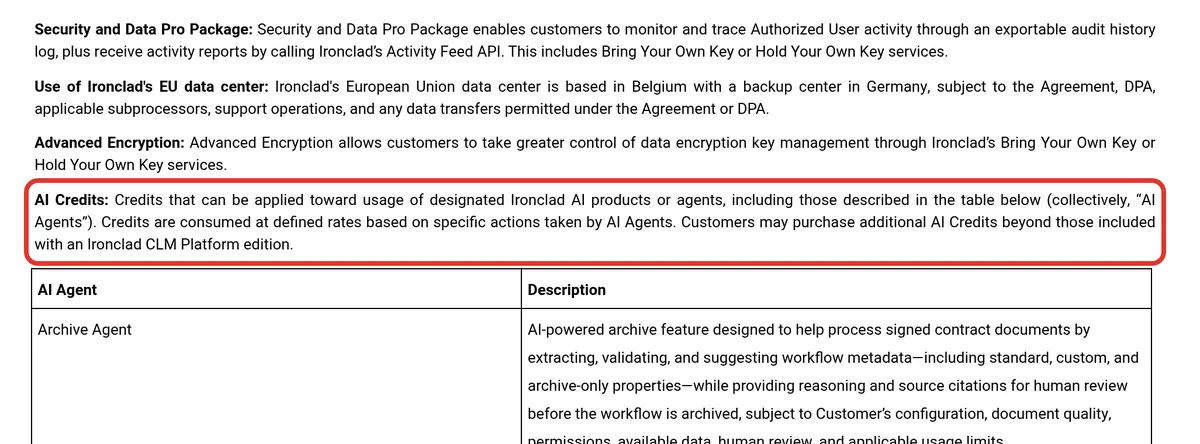
The AI Credit and Fair Use Policy, effective May 1, 2026, says usage beyond purchased credits is invoiced at Ironclad’s then-current list price for AI credits. Ironclad may also suspend agent use above your credits. Ask for that list price in writing, because the policy does not publish it.
If Ironclad finds usage outside fair use, it may throttle speed, require a higher tier or suspend affected features. It gives 30 days to fix the usage before it can invoice the excess. Vendr says AI and analytics modules commonly add 15% to 40% to the base platform cost. Our AI procurement software ranking covers agent pricing on the buying side.
What Usage Limits Are Written Into the Contract?
Five limits sit in the product descriptions unless your order form says otherwise. Smart Import is uncapped in year one, then 50,000 runs a quarter, and Extract Metadata allows 30,000 runs in 30 days. Ironclad Signature caps completed requests at 250,000 a year. Each instance allows up to 100 custom AI clauses.
| Limit | Default in the product descriptions | When it bites |
|---|---|---|
| Smart Import | Uncapped in year one, then 50,000 runs each quarter | Large legacy uploads after year one |
| Extract Metadata | 30,000 runs in a 30-day period | Re-extracting the whole repository after a schema change |
| Ironclad Signature | 250,000 completed signature requests a year | High-volume clickwrap or sales paper |
| Custom AI clauses and properties | Up to 100 of each per instance | Complex supplier paper with many custom terms |
| Legal Centers | Up to 5 | Several brands or regions publishing terms |
In practice, the year-one Smart Import allowance is the line to watch. Load the legacy repository in the first year, while imports are uncapped. Then budget Extract Metadata runs for any later schema change across the archive.
How Much Does an Ironclad Implementation Cost?
Ironclad publishes no implementation fee. Its pricing page offers three routes: lead your own deployment, use Ironclad’s legal engineers, or work with a partner. Vendr says standard implementations commonly cost $10,000 to $40,000, and complex deployments with custom integrations can pass $75,000. Ask for a fixed-fee statement of work.
Compare that with SpotDraft, whose pricing page says in-house implementation is always included with no extra fees. Jurist customers get self-implementation guides in Ironclad Academy, and standalone Jurist buyers get support aligned with the Standard Success Plan, per the product descriptions.
What Do Procurement Integrations Add to the Bill?
Procurement links are entitlements on the order form, so each one is a line to price. The Coupa integration can launch a workflow from a requisition and hold the purchase order until the contract is signed. SAP comes in two tiers, Data Foundation and Procurement Automation. NetSuite and OneTrust have their own entitlements.
| Integration | What Ironclad says it does | Question for the quote |
|---|---|---|
| Coupa | Launches a workflow from a requisition, auto-approves from Coupa approvals, holds PO generation until signature | Is it in the edition, or an add-on? |
| SAP Data Foundation | Pre-fills launch forms from SAP Ariba, pushes signed contracts to the Ariba Contract Workspace, syncs S/4HANA business partners | Which SAP tier does the quote assume? |
| SAP Procurement Automation | Everything in Data Foundation, plus workflows from requisitions and sourcing awards, and contract terms pushed into Ariba for PO matching | What is the step-up price from Data Foundation? |
| NetSuite | Pre-fills vendor data and pushes signed contracts to NetSuite records | Is the connector included? |
| OneTrust | Launches workflows from a vendor list and blocks approval until the vendor is approved | Who owns the vendor risk step? |
If your buy-side runs on Coupa or SAP Ariba, our Coupa vs SAP Ariba comparison covers the suite side, and our Coupa pricing guide shows how a suite meters its own modules.
After Signature: What Ironclad Costs at Renewal
Vendr says Ironclad renewals typically carry 5% to 8% annual escalators. On the $40,492 median, that is $42,517 to $43,731 in year two, as example figures and not a quote. Vendr also says buyers often cap increases at 3% to 5%. Get the cap in writing before signature.
- Renewals: the escalator cap and the notice window, both in the order form.
- Seats: the price of adding seats mid-term, by seat type.
- AI credits: the list price for extra credits, and whether unused credits roll over.
- Usage limits: the Smart Import allowance after year one, written down.
- Contract volume: any volume band and its overage terms, which Vendr says Ironclad may use.
- Audit trail: whether the Security and Data Pro package, which adds an exportable audit log, sits in your edition.
How Does Ironclad Pricing Compare With Alternatives?
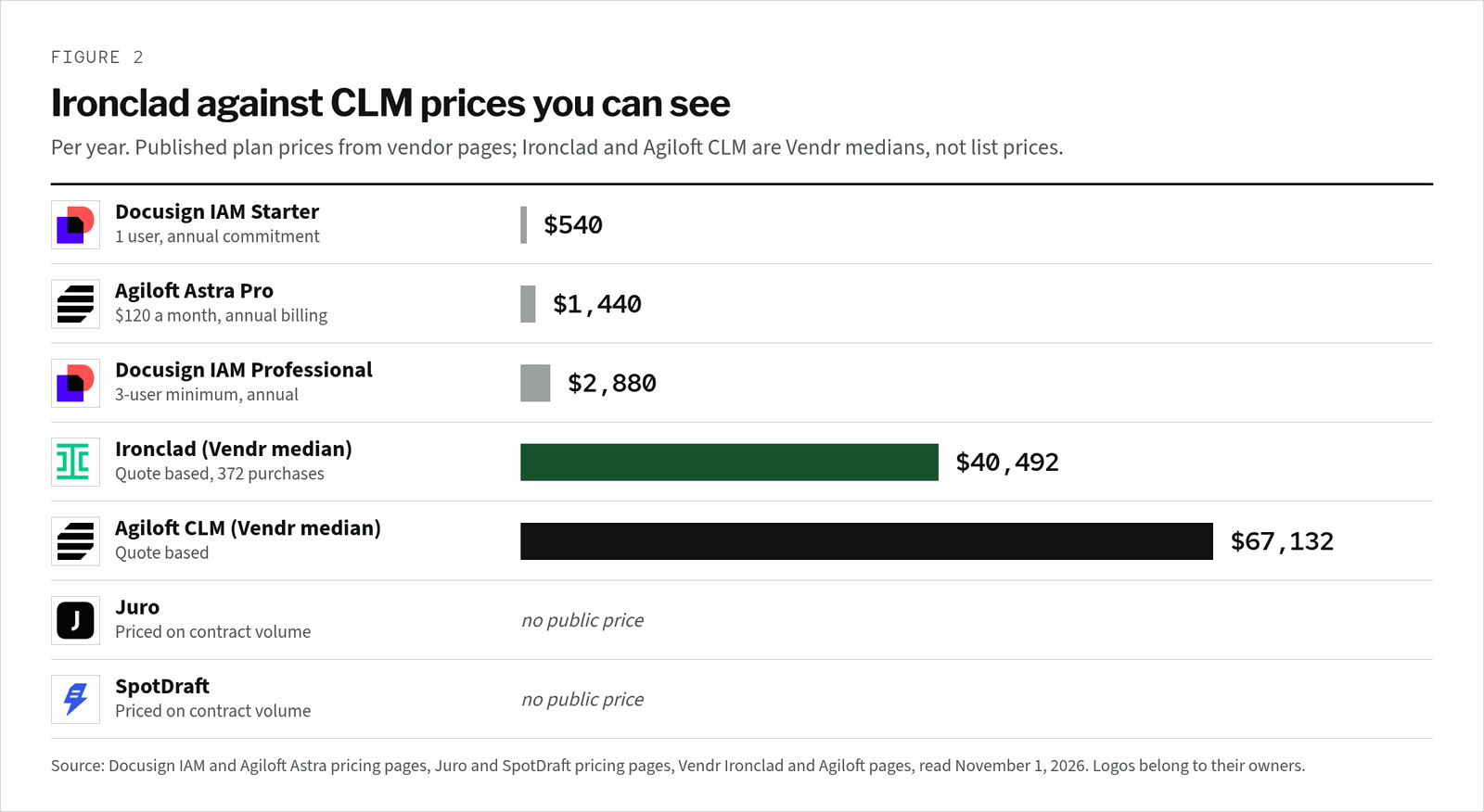
Ironclad sits in the middle of quote-based CLM. Vendr puts Agiloft’s CLM median at $67,132 a year, above Ironclad’s $40,492. Docusign IAM publishes plans from $45 per user per month on an annual commitment, and Agiloft’s Astra AI tool has a Pro plan at $120 a month. Juro and SpotDraft price on contract volume.
| Vendor | Pricing from | Best for | Watch-out |
|---|---|---|---|
| Ironclad | Quote based; Vendr median $40,492 a year (Vendr) | Workflow-heavy legal and procurement teams | AI agent usage is metered in credits |
| Agiloft CLM | Quote based; Vendr median $67,132 a year (Vendr) | No-code configuration across many contract types | Vendr shows a higher median than Ironclad |
| Agiloft Astra | Free plan; Pro $120 a month on annual billing (Astra) | AI review in Microsoft Word | A review tool, without the full CLM repository |
| Docusign IAM | Starter $45 per user per month, annual (pricing) | Teams already on Docusign eSignature | Standard and Professional need 3 users |
| Juro | Quote based on contract volume (pricing) | Unlimited users on every plan, per Juro | No public figure |
| SpotDraft | Quote based on contract volume (pricing) | Implementation included at no extra fee, per SpotDraft | No public figure |
The deciding question is who pays per seat. Ironclad prices seat types. Juro says every plan has unlimited users and prices on contract volume and integrations. If many business users need to launch contracts, ask both vendors to price the same request volume.
Red Flags in an Ironclad Pricing Call
Watch for these signals in the first pricing call. Each one points to a cost that lands after signature. Ask for the answer in writing, and keep it with the order form, so whoever owns the renewal can check what was promised.
- No credit price: the quote includes AI credits but no rate for extra credits.
- Seats as one number: the quote shows a user count without splitting admin, standard, requester and module seats.
- Integration “included”: Coupa or SAP is called included, but the order form does not list the entitlement.
- Silent year two: nothing is written about the Smart Import allowance or the renewal escalator.
- Services by the hour: implementation is priced as time and materials with no fixed scope.
Is Ironclad Worth the Price?
Ironclad pricing makes sense when contract workflows cross legal, procurement and sales, and someone owns the configuration. At a $40,492 median, it costs less than Agiloft CLM on Vendr’s data, and far more than published review tools. The value depends on how much of the order form you read before signing.
The verdict
- Budget for Ironclad if you need configurable workflows, a contract repository and procurement links such as Coupa or SAP Ariba.
- Negotiate hard on AI credit overage rates, the renewal cap and the Smart Import allowance after year one.
- Look at Juro or SpotDraft if many requesters need access and you would rather pay on contract volume.
- Start with Agiloft Astra or Docusign IAM if you mainly need AI review or a repository on published pricing.
Frequently Asked Questions
Does Ironclad publish its pricing?
No. Ironclad’s pricing page lists no plans or figures and asks for a demo. It says pricing depends on products, users, workflows and growth. The only list price we found is a Salesforce AppExchange entry for its Salesforce app, starting at $200 per user per year, and that listing does not say what it covers.
How much does Ironclad cost per year?
Vendr’s data on 372 Ironclad purchases shows a median of $40,492 a year, with deals from $15,000 to $106,988, on a page last updated February 2026. Vendr says mid-market buyers commonly pay $50,000 to $120,000 a year. Your figure moves with seats, AI credits, integrations and services.
How are Ironclad AI agents priced?
Ironclad AI agents such as the Archive, Intake and Renewal agents use AI credits. An edition includes some credits, and you can buy more. Usage beyond purchased credits is invoiced at Ironclad’s then-current list price, per its AI Credit and Fair Use Policy effective May 1, 2026. Ask for that rate in writing.
Does Ironclad charge for implementation?
Ironclad does not publish implementation fees. You can lead your own deployment, use its legal engineers or work with a partner. Vendr says standard implementations commonly cost $10,000 to $40,000, with complex deployments above $75,000. Ask for a fixed-fee statement of work before you sign the order form.
Can you get a discount on Ironclad?
Vendr reports average savings of 21% against the first quote across its Ironclad deals. It says multi-year terms of two to three years commonly bring 15% to 25% lower annual pricing. A competing quote from Agiloft, Juro or Docusign gives you a real number to negotiate against.
Is Ironclad cheaper than Agiloft?
On Vendr’s data, yes. Vendr shows a median of $40,492 a year for Ironclad and $67,132 for Agiloft CLM. Both are quote based, and both medians come from Vendr’s own deals. Agiloft also sells Astra, an AI review tool with a free plan and a Pro plan at $120 a month on annual billing.