A port closes overnight, and your team learns about it from a customer. Nobody knew a sub-tier supplier sat next to that port. Resilinc vs Everstream vs Interos is a choice about who builds that supplier map, and how each platform tells you when something breaks.
This guide is for procurement and supplier risk teams with a shortlist of three. Every fact comes from the vendors’ own product pages, FAQs, commercial terms and press releases, read on November 4, 2026. Our scoring rules are public, and related guides sit in the supplier management hub.
Resilinc vs Everstream vs Interos: Which Should You Pick?
Pick Everstream if you want alerts that analysts check before they reach you, plus weather and route forecasts. Pick Resilinc if you need a part-to-site map that your suppliers confirm. Pick Interos if you want a broad automated risk graph with cyber, financial and tariff scoring. None of the three publishes a price.
| Resilinc | Everstream | Interos | |
|---|---|---|---|
| How the map is built | AI plus supplier-validated data, down to part-site level | AI over trade data, validated by industry experts | AI maps 250 million+ companies and their links automatically |
| How alerts are checked | EventWatch AI scans 104 million+ sources | Analysts validate alerts 24/7 before they reach you | Real-time iScore changes across six risk domains |
| Standout extra | WarRooms, MCP server and a Microsoft Copilot plugin | Weather forecasts up to 14 days ahead and climate scores to 2100 | itariffs for tier 1 to 3 tariff exposure |
| Published terms | No seats, limits or price published | Onboarding of 4 to 12 weeks; 24/5 support | Base licence seats and API limits published |
| 2026 Gartner MQ, supplier risk | Says it is a Leader | Says it is a Leader, second year running | Listed as evaluated; position not public |
| Our score | 8.0 | 8.3 | 8.2 |
Our pick
Everstream for teams that cannot staff a 24/7 alert desk
Everstream says expert analysts validate every alert before it reaches you, per its FAQ. It also publishes a typical onboarding window. Choose Resilinc when part-level maps matter most, and Interos when cyber and financial scoring lead.
How Does Each Platform Find Your Sub-Tier Suppliers?
They use three different methods, and the method decides what you can trust. Resilinc combines AI with data your suppliers confirm. Everstream infers links from trade data, then has industry experts check them. Interos maps relationships automatically at very large scale, so ask each vendor to show your own supplier list mapped, not a demo.
Resilinc: supplier-validated, part-to-site maps
Resilinc maps supply chains down to the part-site level, per its multi-tier mapping page. It combines supplier declarations, ERP data and machine-learned patterns. It says it holds 15+ years of validated data and links 4M+ parts to real supplier locations.
In March 2026 it described its Intelligent Supplier Network, which blends supplier-volunteered data with trade and logistics signals, per its March 2026 release. AI agents also run supplier outreach and data collection. That makes supplier response rates a number to ask about in writing.
Everstream: inferred maps, checked by experts
Everstream says its AI queries billions of data points to find sub-tier links, per its sub-tier visibility page. Industry specialists then verify the discovered connections. You can add your own supplier knowledge to refine the map. It started inside DHL’s logistics network and trains on 15+ years of data, per its FAQ.
Interos: an automated relationship graph
Interos says it uses AI to map and monitor 250 million+ companies and billions of relationships, per its software page. Its mapping tool shows tier 2 and tier 3 suppliers and how they connect to you. The method is automated, so ask how often your own map refreshes.
How Do Their Alerts and Risk Scores Work?
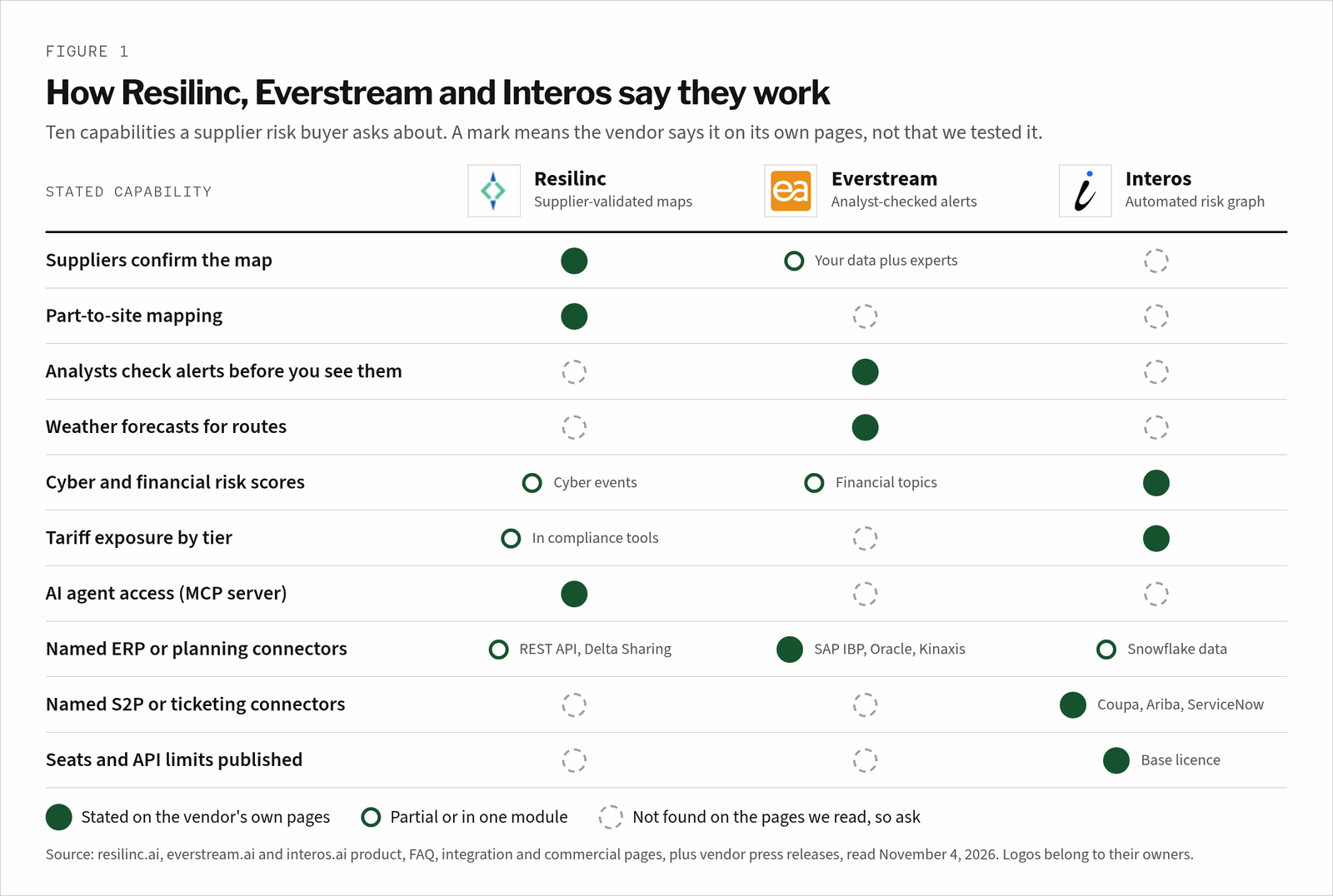
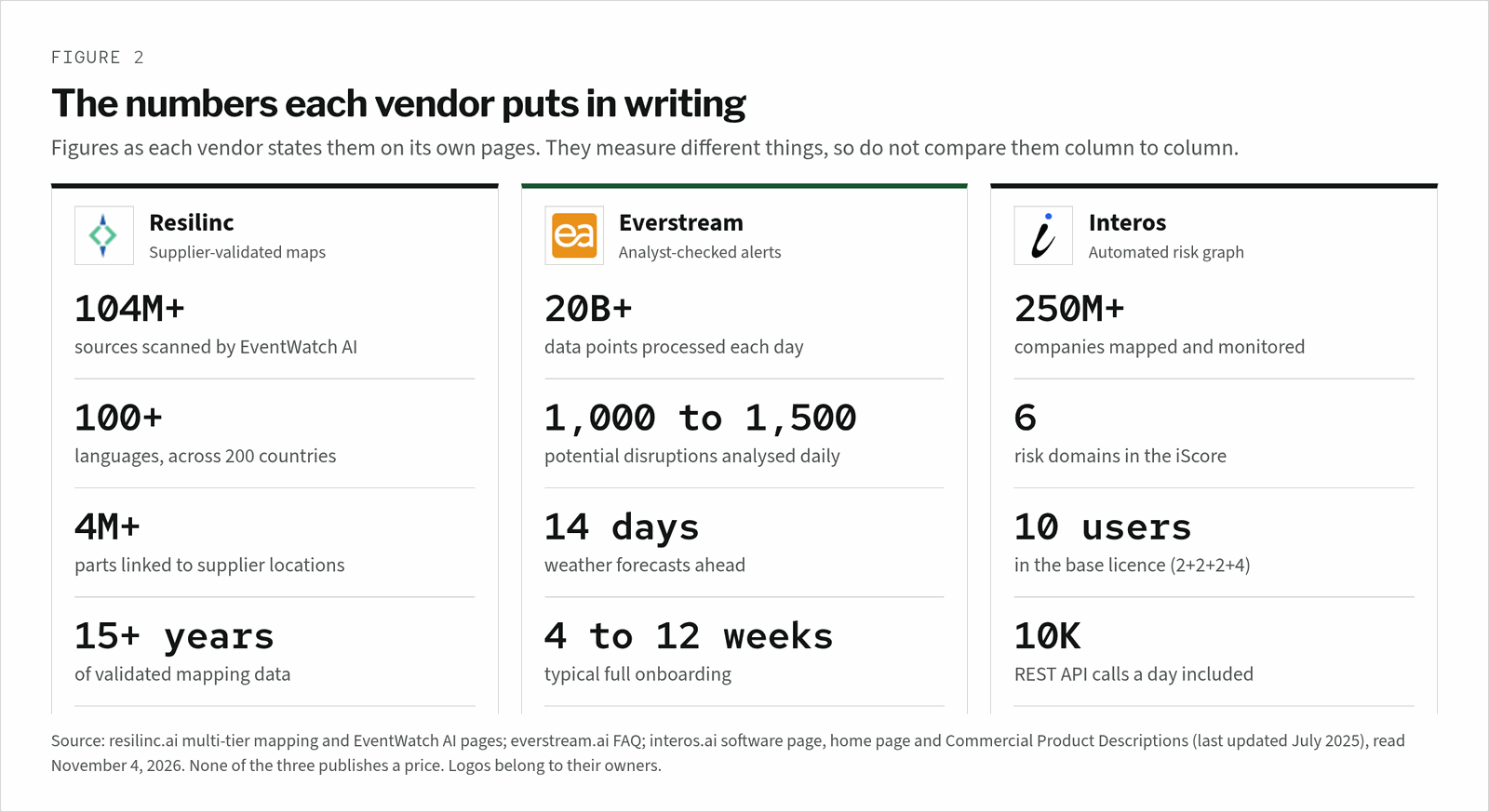
Everstream puts people in the loop, Resilinc leans on AI scanning, and Interos scores suppliers across six risk domains. Figure 1 shows what each vendor says it does. The real test is the false alarm rate on your own suppliers, so ask for alert history from a reference customer.
Resilinc’s EventWatch AI scans over 104 million sources in 100+ languages and 200 countries, per its monitoring page. It covers 50+ event types and 400 risk categories. Alerts are cross-checked against mapped sites and parts, with revenue impact. WarRooms let teams assign tasks and track resolution.
Everstream processes 20+ billion data points a day and analyses 1,000 to 1,500 potential disruptions daily, per its FAQ. Analysts and meteorologists validate alerts before they reach you. It forecasts weather disruptions up to 14 days ahead. Its climate projection scores run to the year 2100.
Interos scores suppliers with its iScore across six risk domains, per its home page. That page lists ESG, cyber, financial, restrictions, geopolitical and catastrophic risk. Its itariffs page lists operational risk instead of restrictions. Ask which six domains your contract covers.
What the Record Holds
A risk platform is only useful if each alert lands with a named owner. Decide who owns it before the first alert arrives. These are the records each vendor says it keeps, from its own pages. Fill the last column in before you sign.
| Record | Resilinc | Everstream | Interos | Who owns it |
|---|---|---|---|---|
| Supplier map | Part-to-site map with supplier-validated data | Sub-tier map from trade data, verified by experts | Tier 1 to 3 map from an automated graph | Supplier risk lead |
| Alerts | EventWatch AI alerts, ranked by exposure | Analyst-validated alerts, delivered by email, platform or API | iScore changes and Watchtower alerts | Category manager |
| Risk score | Risk scores by supplier, region and part | Supplier risk score across 40+ or 50+ topics (the FAQ states both) | iScore across six domains | Supplier risk lead |
| Response log | WarRoom tasks, archived for compliance | Ask the vendor to show it | iflow tasks synced to ServiceNow | The person who closes it |
| Your own data | Supplier, part and ERP data | Supplier lists, SAP, Oracle and Kinaxis data | Supplier data plus up to 20 custom risk models | IT and procurement |
Ask each vendor where the response log lives. A risk platform should not become a second home for supplier decisions. Push tasks into the system of record your team already uses, and keep the decision trail there.
How Do They Connect to Your ERP and Workflow Tools?
All three connect by API, but they name different tools. Everstream names SAP, Oracle and Kinaxis, while Interos names Coupa, SAP Ariba Risk and ServiceNow. Resilinc offers REST APIs, an MCP server for AI agents and Databricks Delta Sharing. Match the list to your stack before the demo.
Resilinc lists REST APIs, MCP Server and Delta Sharing on its integrations page. In October 2026 it launched a Microsoft Copilot plugin built on MCP, per its Copilot release. In September 2026 it made Resilinc Compliance for EUDR generally available, per its EUDR release.
Everstream says it has a standard SAP connector and an SAP IBP integration, plus Oracle TMS and Kinaxis links, per its FAQ. Support runs 24/5 from Europe and Asia. Critical issues get a response within two hours.
Interos lists connectors for Coupa, SAP Ariba Risk and ServiceNow in its commercial product descriptions. Bulk data access runs through Snowflake. In October 2026 it announced iflow, which turns risks into tasks in workflow tools, per its iflow post. An iflow plugin is listed on the ServiceNow Store.
How Do Resilinc, Everstream and Interos Score?
We scored each platform on five weighted criteria for a procurement buyer. Mapping depth and alert quality carry 2.5 points each. Buying transparency rewards vendors that publish seats, limits or onboarding times. Everstream leads at 8.3, Interos follows at 8.2 and Resilinc scores 8.0.
| Criterion (max points) | Resilinc | Everstream | Interos |
|---|---|---|---|
| Sub-tier mapping depth (2.5) | 2.3 | 2.0 | 2.0 |
| Alert quality and monitoring (2.5) | 2.1 | 2.4 | 1.8 |
| Risk breadth and scoring (2) | 1.6 | 1.6 | 1.8 |
| Integrations and workflow (1.5) | 1.3 | 1.2 | 1.3 |
| Buying transparency (1.5) | 0.7 | 1.1 | 1.3 |
| Total (10) | 8.0 | 8.3 | 8.2 |
Resilinc wins on mapping, because suppliers confirm the data down to the part. Everstream wins on alerts, with analysts checking each one. Interos wins on breadth and transparency, with six risk domains and published licence terms. Resilinc loses points only because it publishes no buying terms.
How Much Do Resilinc, Everstream and Interos Cost?
None of the three publishes a price, so you will need a quote in writing. Interos publishes what its base licence includes, and Everstream publishes its onboarding window. Resilinc publishes neither. Treat any price range on a comparison site with care unless it names a source.
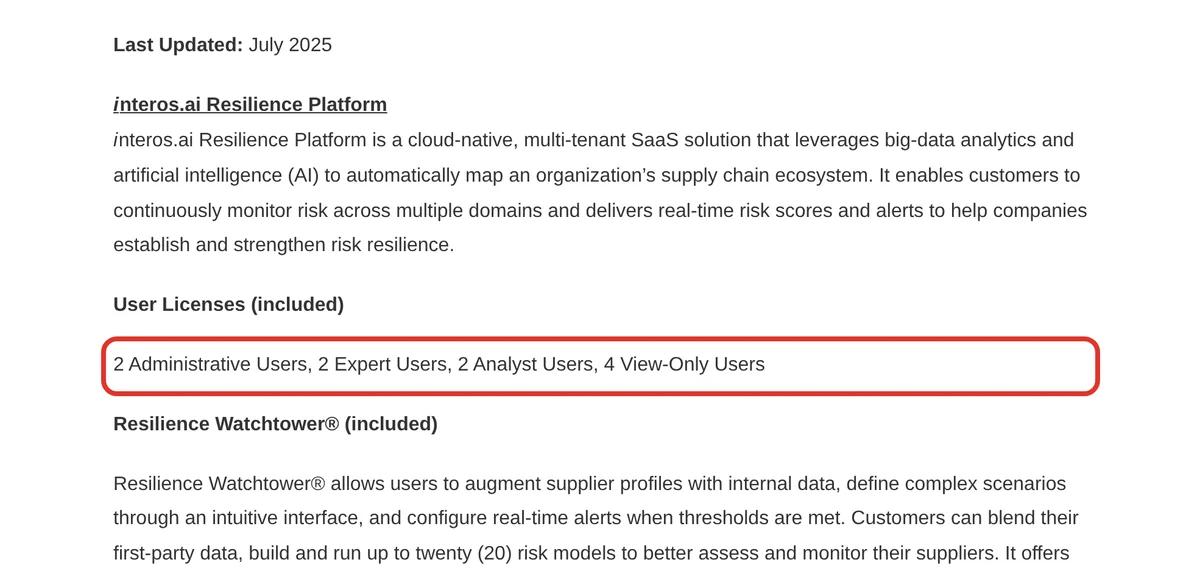
Per the Interos commercial product descriptions, the base licence includes 2 administrative, 2 expert, 2 analyst and 4 view-only users. It also includes Resilience Watchtower with up to 20 risk models, and a REST API with up to 10,000 calls a day. The terms page was last updated in July 2025. Modules such as itariffs, itracing and ireputation are listed separately.
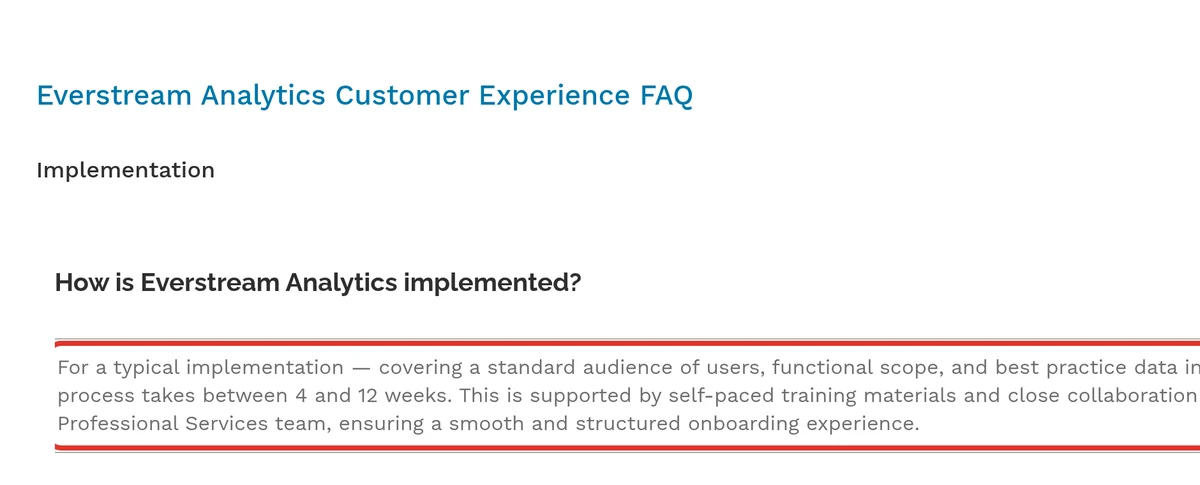
Everstream says a typical full onboarding takes 4 to 12 weeks, per its FAQ. Platform access comes within days. Resilinc says many API integrations deploy in weeks, per its integrations page. Larger rollouts are phased.
One figure travels between comparison sites: $1,400 for Resilinc. It comes from a Capterra listing that shows “$1,400 per feature, per month”. Resilinc does not publish that figure. Ask for a quote that names the modules, seats and suppliers covered.
After Signature: The Checklist
- Map coverage: the contract names how many suppliers and tiers are mapped, and by when, in writing.
- Alert routing: each alert type has a named owner and a response time, before it becomes a problem.
- Seats: the user count and roles match the licence, including view-only users for category teams.
- Modules: tariffs, compliance and ESG modules are listed by name, with their renewal dates. For supplier sustainability ratings, see our EcoVadis vs Sedex vs CDP comparison.
- API limits: the daily call limit and bulk data method are written into the order form.
- System of record: tasks flow into your ERP or ticketing tool, so the decision trail lives in one place. Our supplier management software guide covers that record.
Red Flags in a Demo
- The map is shown on a sample company, never on your own supplier list.
- Nobody can say how many of your suppliers are already mapped, or confirmed by the supplier.
- Alerts are shown without a false alarm rate or a reference customer to check it.
- The risk score names a different set of domains from the order form.
- A connector is a logo on a slide, with no named direction of sync.
- The quote has no supplier count, tier depth or module list in writing.
If None of the Three Fits
If you need to store supplier risk terms against contracts, start with our contract management software for procurement guide. If risk data should sit inside your sourcing suite, see the source-to-pay suites ranking. For AI tools that read supplier documents, read our AI procurement software list. Our supply chain risk management software ranking scores these three alongside seven other tools. For financial, sanctions and ESG checks on the suppliers you pay, see our supplier risk management software ranking.
The Verdict: Resilinc, Everstream or Interos?
Everstream scores 8.3 because analysts check its alerts and it publishes an onboarding window. Interos scores 8.2, with the broadest risk scoring and published licence terms. Resilinc scores 8.0 and has the deepest supplier-confirmed maps. Gartner evaluated all three in its 2026 Magic Quadrant for supplier risk management.
The verdict
- Choose Everstream if you want analyst-checked alerts, weather forecasts and SAP or Oracle links.
- Choose Resilinc if you need part-to-site maps that your suppliers confirm.
- Choose Interos if you need cyber, financial and tariff risk across a very large supplier base.
- Run a pilot on your own suppliers before you sign with any of the three.
Frequently Asked Questions
Is Everstream better than Resilinc?
For alerts, yes in our scoring. Everstream scores 8.3 to Resilinc’s 8.0, because analysts validate its alerts and it publishes an onboarding window. Resilinc is stronger when you need part-to-site maps confirmed by suppliers. Both say Gartner named them Leaders in its 2026 Magic Quadrant for supplier risk management.
What is the difference between Interos and Resilinc?
Interos maps 250 million+ companies automatically and scores them across six risk domains with its iScore. Resilinc builds part-to-site maps with AI and data that suppliers confirm. Interos publishes its base licence seats and API limits. Resilinc publishes no buying terms, so ask for them in writing.
How much does Resilinc cost?
Resilinc does not publish a price. A Capterra listing shows $1,400 per feature, per month, but that figure is not on the Resilinc website. Ask for a written quote that names the modules, the number of suppliers mapped, the seats and the integrations included. Then compare quotes on the same scope.
How long does Everstream take to implement?
Everstream says a typical full onboarding takes between 4 and 12 weeks. That covers a standard group of users, functional scope and data integration. It says platform access comes within days. Ask for the plan in writing, with dates for your first supplier map and your first live alerts.
What does the Interos base licence include?
The Interos commercial terms list 2 administrative, 2 expert, 2 analyst and 4 view-only users. They include Resilience Watchtower with up to 20 risk models and a REST API with up to 10,000 calls a day. Modules such as itariffs, itracing and ireputation are listed separately from the base licence.
Which is the best supply chain risk platform in 2026?
There is no single winner. In our scoring, Everstream leads at 8.3, Interos follows at 8.2 and Resilinc scores 8.0. Gartner’s 2026 Magic Quadrant evaluated all three. Pick by need: analyst-checked alerts, broad automated risk scoring or part-to-site maps that suppliers confirm.