You ask a supplier for its EcoVadis scorecard, and it sends a SMETA audit instead. Nobody on the team can say whether that counts. EcoVadis vs Sedex vs CDP is a choice between three different records, so the answer depends on the risk you need to evidence.
This guide is written for the buyer side: what each program puts on file for procurement, what it costs your suppliers and what the buyer pays. Every fact comes from the three programs’ own pricing pages, help centers and FAQs, read on November 4, 2026. Our scoring rules are public, and related guides sit in the supplier management hub.
EcoVadis vs Sedex vs CDP: Which Should You Ask Suppliers For?
Ask for EcoVadis when you want one company-level sustainability score across environment, labour, ethics and purchasing. Ask for Sedex and a SMETA audit when the risk sits at a factory or farm. Ask for CDP when you need environmental data, mainly climate, from your suppliers. You can ask for two of them.
| EcoVadis | Sedex (SMETA) | CDP | |
|---|---|---|---|
| What it measures | A company’s sustainability management system, scored 0 to 100 | Working conditions at a site, through a questionnaire and an on-site social audit | Environmental disclosure on climate, forests and water |
| Unit assessed | The legal entity | Each site: factory, farm or facility | The company |
| Output | Scorecard, percentile rank and a medal if eligible | Audit report, corrective action plan and a site risk rating | A score from D- to A |
| How long it lasts | Scorecard and medal valid 12 months | Membership valid 12 months | One score per annual cycle |
| Supplier pays (published) | From $589 to $12,249 a year in the US, by size and plan | £224 or £374 per site a year, plus the audit firm’s quote | $0 to $7,650 in 2026 for a North American company |
| Buyer pays | Quote, by company size | Quote: setup fee plus annual fee scaled by turnover | Quote, tier set by number of supplier requests |
| Our score | 8.2 | 7.6 | 7.5 |
Our pick
EcoVadis as the first program for a mixed supplier base
EcoVadis covers the most risk areas in one score and publishes every supplier price on its plans and pricing page. Add Sedex where factory labour risk is high. Add CDP where you need supplier climate data for your own reporting.
What Does Each Program Actually Measure?
They look at different things, so one does not replace another. EcoVadis rates how a company manages sustainability across its whole business. SMETA checks working conditions at one site on the day of the audit. CDP scores what a company discloses about its environmental impact each year.
EcoVadis: a company-level management score
EcoVadis scores a company from 0 to 100 across four themes: Environment, Labor and Human Rights, Ethics and Sustainable Procurement. Analysts review the questionnaire and up to 55 supporting documents, per its supporting documents article. The method draws on GRI, ISO 26000 and the UN Global Compact principles, per its assessment process article.
Medals go by percentile across all companies rated in the last 12 months. Platinum is the top 1%, Gold the top 5%, Silver the top 15% and Bronze the top 35%, per the medals and badges article. A company scoring under 30 in any theme cannot get a medal. EcoVadis says it has rated more than 150,000 companies on its ratings page.
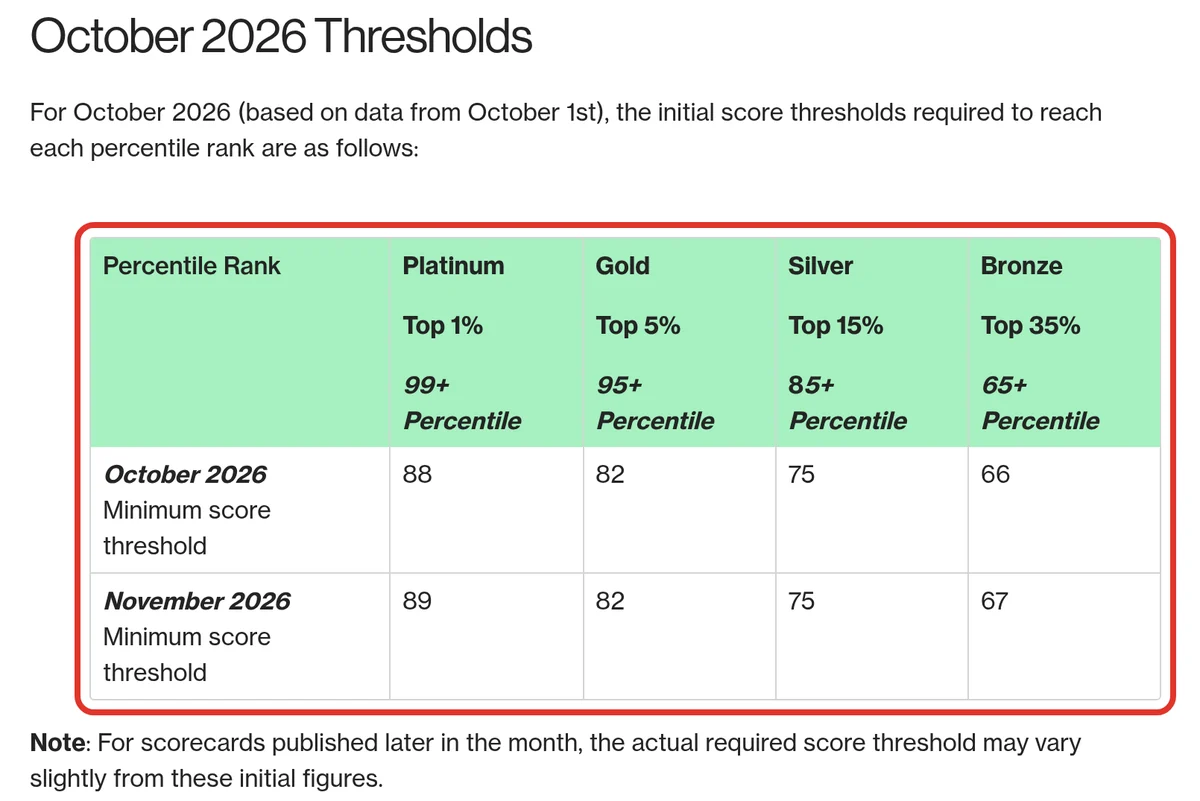
The score needed for a medal moves every month. For November 2026, the threshold article lists 89 for Platinum, 82 for Gold, 75 for Silver and 67 for Bronze. A supplier that scored Silver last year can drop to Bronze with the same score. Record the score, the medal and the publication month in the supplier file.
Sedex: site-level social audit data
Sedex is a data platform, and SMETA is the audit methodology it owns. Every SMETA audit covers labour standards and health and safety. The 4-pillar version adds environment and business ethics, and Sedex says it is used in around 70% of audits on its SMETA page.
Audits are run by Affiliate Audit Companies and measured against the ETI Base Code, ILO conventions and local law. Each audit produces a Corrective Action Plan. Sedex says it is not a certification, and it reports 67,000 SMETA audits in 2025.
Buyers see a risk rating, audit results and open corrective actions for each site, per the Sedex Platform page. Sedex names API links into SAP, Oracle, Ariba and Coupa, and says more than 115,000 supplier sites are registered. Suppliers also fill in a Self-Assessment Questionnaire (SAQ) matched to their industry, size and country.
CDP: environmental disclosure, scored
CDP runs an annual questionnaire on Climate Change, Forests and Water Security, and scores each issue. In 2026, plastics, biodiversity and ocean questions are not scored, and the SME questionnaire is scored for climate only, per its scoring help article. Scores run from D- to A across four levels: Disclosure, Awareness, Management and Leadership.
Scores are based only on data in the response, not on site visits. The 2026 scoring deadline was September 16, 2026, and CDP releases scores in the week of November 30, 2026. CDP says more than 22,000 companies disclosed in 2025 on its 2026 disclosure page.
How Do They Fit Together in a Supplier Program?
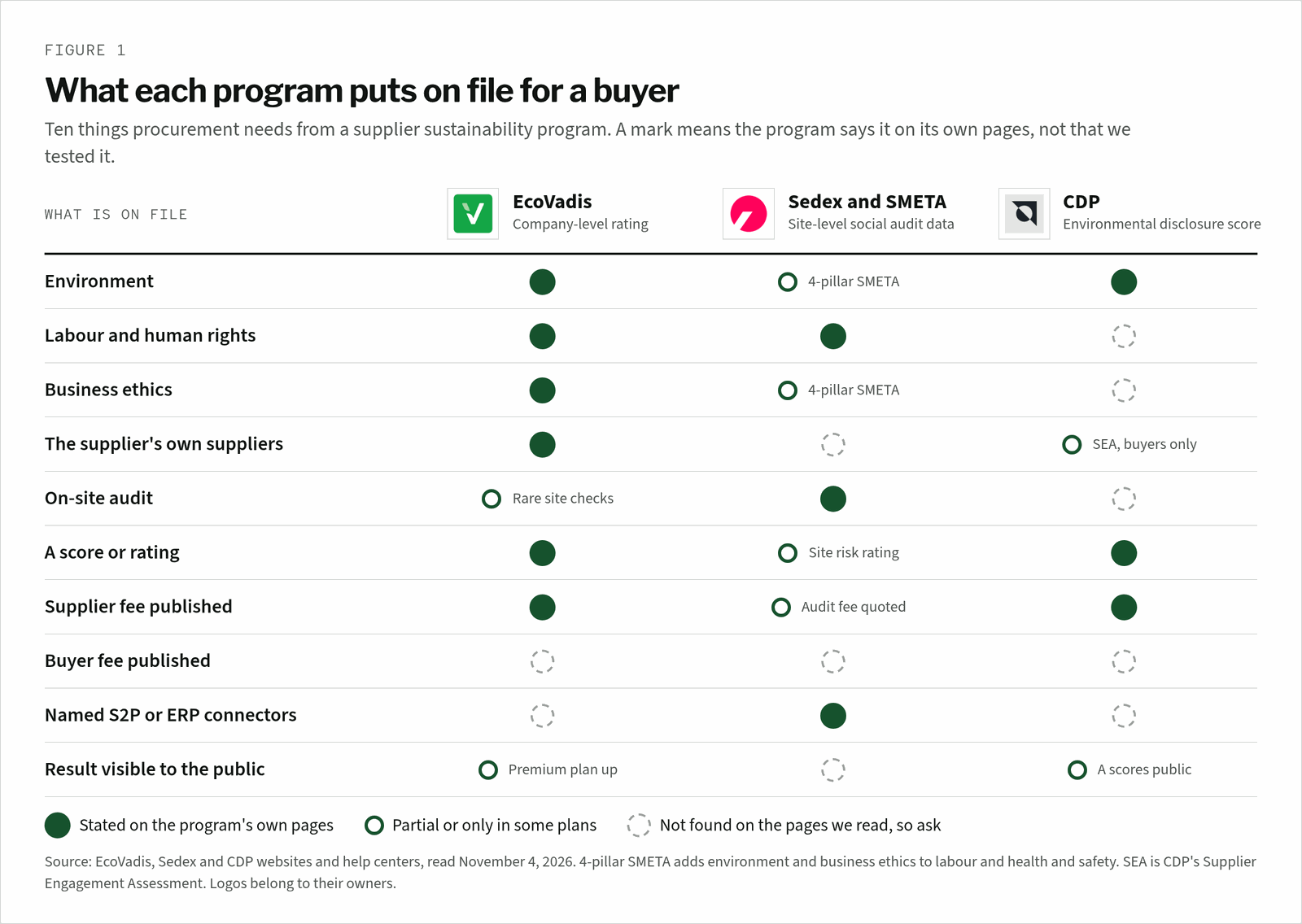
You may need two of the three, because each covers a gap in the others. Figure 1 shows what each program says it puts on file. EcoVadis scores sustainable procurement as one of its four themes, while CDP rates supplier engagement on climate in a separate assessment.
| If the risk you must evidence is | Ask for | Why |
|---|---|---|
| Forced labour or unsafe conditions at a factory or farm | SMETA audit through Sedex | It is the only one of the three with an on-site social audit and a corrective action plan |
| How well a supplier manages ESG overall | EcoVadis scorecard | One 0 to 100 score across four themes, with documents reviewed by analysts |
| Supplier emissions, climate targets and Scope 3 data | CDP response and score | The questionnaire is aligned with IFRS S2 and the TCFD recommendations |
| A supplier’s own supply chain practices | EcoVadis | Sustainable Procurement is one of its four scored themes |
| A small supplier with a tight budget | Sedex Standard or the CDP SME questionnaire | The lowest published fees of the three |
There is one useful overlap. EcoVadis says a company with a valid SMETA, RBA or BSCI audit from the last two years will generally not be picked for its own site verification, per its site verification article. Ask suppliers to upload that audit to EcoVadis, so they are not audited twice.
What the Record Holds
A rating is only useful if your team can find it, date it and act on it. Map each field to an owner before you send the first request. These are the fields each program keeps, and where they live.
| Field | EcoVadis | Sedex | CDP | Who owns it |
|---|---|---|---|---|
| Score and date | 0 to 100 score and percentile, published 6 to 8 weeks after submission | Site risk rating and audit findings | D- to A score, released the week of November 30, 2026 | Category manager |
| Evidence behind it | Questionnaire, up to 55 documents, news from 100,000+ sources | SMETA audit by an Affiliate Audit Company, plus the SAQ | The questionnaire response only | Supplier |
| Corrective actions | Ask the vendor to show it | Corrective Action Plan from each audit, tracked to closure | Not part of the score | Supplier, with your follow-up |
| Expiry | Scorecard and medal valid 12 months | Membership valid 12 months; ask how long each audit is accepted | New score each year | Category manager |
| Who can see it | Inside the network on Basic; outside needs Premium, Select or Corporate | Customers the supplier links to, at no extra cost | Private to requesters if only Supply Chain members ask; A scores are public | Supplier controls sharing |
Check the CDP privacy rule before you promise anything to suppliers. If only Supply Chain members, banks or RE100 request a company, its score stays private, per the CDP score privacy article. A request from investors that sign up to CDP makes the score public.
How Do EcoVadis, Sedex and CDP Score?
We scored each program as a buyer’s source of supplier evidence, on five weighted criteria. Risk coverage and evidence strength carry the most weight, at 2.5 points each. Supplier cost clarity rewards programs that publish what your request will cost a supplier. EcoVadis leads at 8.2.
| Criterion (max points) | EcoVadis | Sedex (SMETA) | CDP |
|---|---|---|---|
| Risk coverage (2.5) | 2.3 | 1.6 | 1.2 |
| Evidence strength (2.5) | 1.8 | 2.3 | 1.7 |
| Buyer tools and reach (2) | 1.8 | 1.7 | 1.6 |
| Supplier cost clarity (1.5) | 1.4 | 1.1 | 1.5 |
| Reporting fit (1.5) | 0.9 | 0.9 | 1.5 |
| Total (10) | 8.2 | 7.6 | 7.5 |
Sedex wins on evidence, since only SMETA sends an auditor to the site. CDP wins on cost clarity and reporting fit, with a full fee table and IFRS S2 alignment. EcoVadis leads overall on coverage, as one score spans all four themes.
How Much Do EcoVadis, Sedex and CDP Cost?
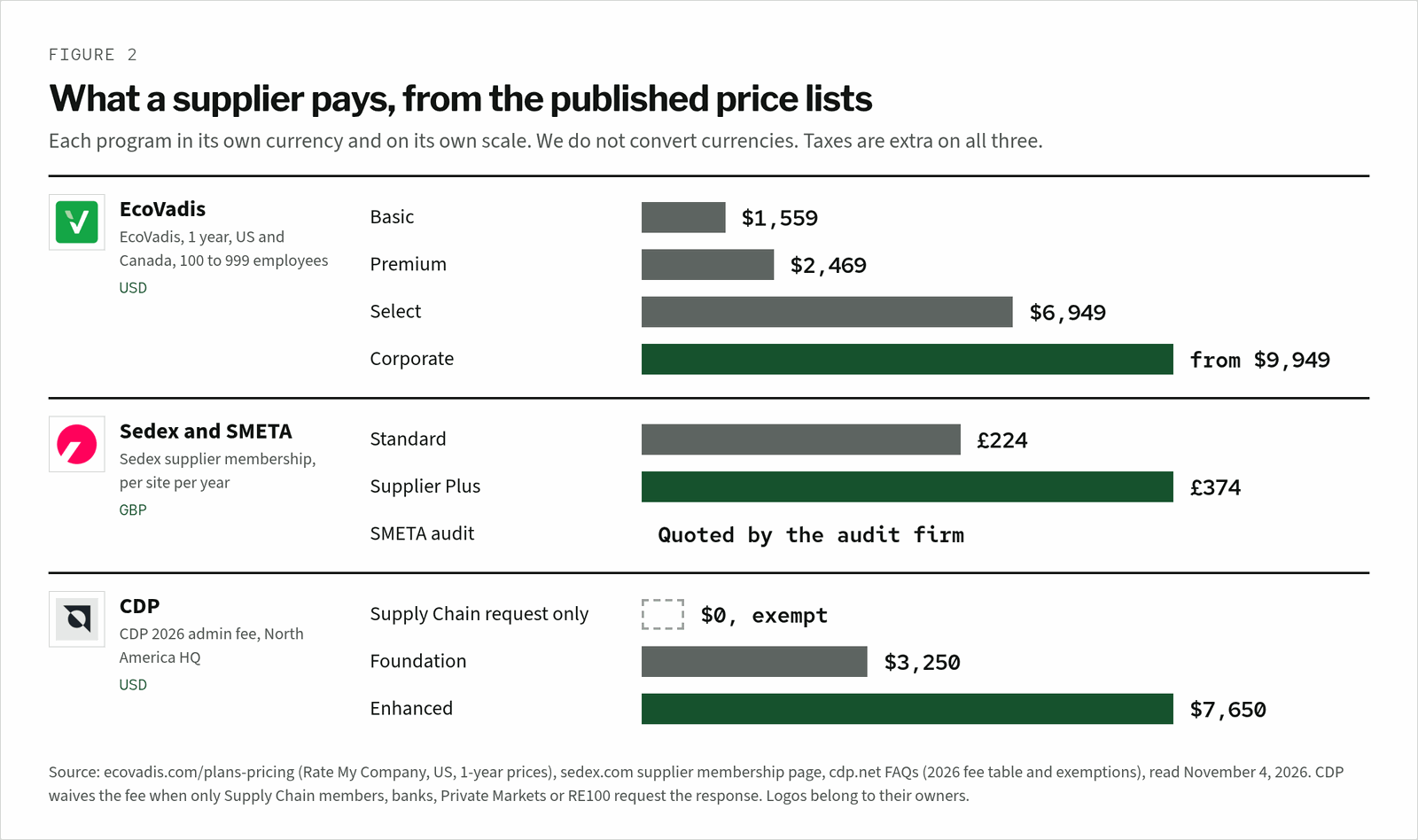
All three keep the buyer price private, so you will need a quote in writing. The supplier side is published for all three: EcoVadis by size and plan, Sedex per site and CDP by headquarters region. That matters, because your request becomes a cost on your supplier’s budget.
| EcoVadis plan (US, 1 year) | Up to 25 staff | 26 to 99 | 100 to 999 | 1,000+ |
|---|---|---|---|---|
| Basic | $589 | $1,009 | $1,559 | $2,609 |
| Premium | $1,149 | $1,529 | $2,469 | $3,899 |
| Select | $3,729 | $4,339 | $6,949 | $12,249 |
| Corporate (from) | $8,839 | $9,259 | $9,949 | $10,889 |
Basic only shares the scorecard inside the EcoVadis network. Premium adds medals, sharing outside the network and rating up to five trading partners, per its plan comparison article. Invited companies get up to six weeks to complete the questionnaire, and a subscription is needed when they submit, per the subscription costs article. Our full EcoVadis price list by country also covers Europe, India and the 3-year discount.
Sedex charges suppliers £224 a site for Standard or £374 for Supplier Plus, billed yearly, on its supplier membership page. A supplier can share with several customers at no extra cost. Sedex does not publish the SMETA audit fee, since the audit firm quotes it.
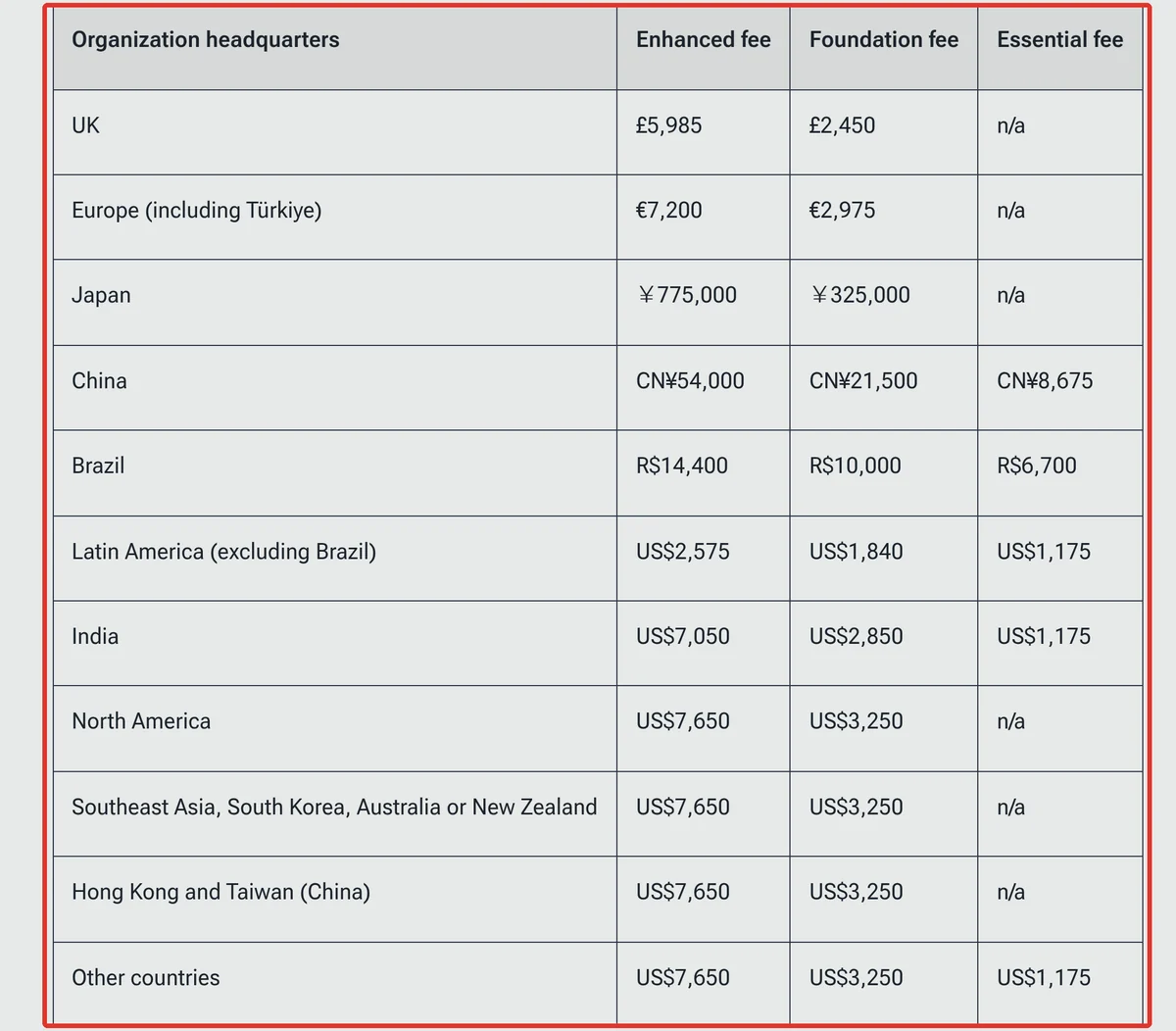
CDP charges an admin fee to companies that disclose, and 2026 fees rose about 5%, per its FAQs. A North American company pays $3,250 for Foundation or $7,650 for Enhanced. There is no fee when the only requesters are Supply Chain members, the Banks Program, Private Markets or RE100.
Here is a worked example with labelled inputs. A US supplier with 300 staff and two factories gets requests from you for all three. EcoVadis Premium costs it $2,469, Sedex Standard costs £448 for two sites plus audits, and CDP costs $0 if your company is a CDP Supply Chain member and no investor also asks.
On the buyer side, CDP sets its Supply Chain tier by supplier requests: up to 200, up to 400, or more than 400, per its Supply Chain page. Sedex quotes a setup fee plus an annual fee scaled by turnover. EcoVadis quotes by company size, for an unlimited number of suppliers and users.
After Signature: The Checklist
- Contract clause: the supplier contract names the program, the minimum score or medal and the date it is due, in writing.
- Expiry dates: each scorecard, membership and audit has an expiry date in your system of record and a named owner. Our supplier management software guide covers tools that track expiry. Our ranking of tools that keep supplier certificates current compares eight of them.
- Sharing rights: the supplier has granted you access, and the EcoVadis plan allows sharing outside the network if you need it.
- Corrective actions: every SMETA non-compliance has an owner, a due date and proof of closure.
- Who pays: the contract says who pays the rating fee and any re-audit, before it becomes a problem.
- Re-assessment: the next EcoVadis or CDP cycle is on the calendar, with the November 30 CDP score release noted.
Red Flags in a Demo
- The buyer dashboard is shown on sample suppliers, never a match against your own supplier list.
- Nobody can say how many of your suppliers already have a rating, profile or audit on the platform.
- The ERP or S2P link is a logo on a slide, with no named direction of sync.
- A medal or score is sold as a certification. Sedex says SMETA and its benchmarks are not certifications.
- The quote has no cap on supplier requests, or the request tier is unclear.
- Nobody can say in writing what your suppliers will be charged when you invite them.
If None of the Three Fits
If you need to store ratings and audit dates against supplier contracts, start with our contract management software for procurement guide. If sustainability data should sit inside your sourcing suite, see the source-to-pay suites ranking. For AI tools that read supplier documents, read our AI procurement software list. For financial, sanctions and ESG checks in one place, see our supplier risk management software ranking. For sub-tier mapping and event alerts, see our supply chain risk management software ranking. Our Resilinc vs Everstream vs Interos comparison covers three of those platforms. For diverse supplier certificates and Tier 2 spend, see our supplier diversity software ranking. To weigh more programs side by side, see the six EcoVadis alternatives we compared, including IntegrityNext, Assent, Prewave and Sphera.
The Verdict: EcoVadis, Sedex or CDP?
EcoVadis scores 8.2 because one score covers environment, labour, ethics and sustainable procurement, and every supplier price is public. Sedex scores 7.6, with the strongest evidence from SMETA audits at the site. CDP scores 7.5 and is the best source of supplier climate data.
The verdict
- Choose EcoVadis if you want one comparable score across a mixed supplier base.
- Choose Sedex and SMETA if your risk sits in factories, farms or packing sites.
- Choose CDP if you need supplier emissions data for your own climate reporting.
- Combine two if you buy from high-risk sites and also report Scope 3 emissions.
Frequently Asked Questions
Is EcoVadis better than Sedex?
For a broad view, yes. EcoVadis scores the whole company across four themes, and scores 8.2 to Sedex’s 7.6 in our comparison. Sedex is better when you need proof of working conditions at a site, because a SMETA audit puts an auditor on the factory floor. You can ask for both.
What is the difference between CDP and EcoVadis?
CDP scores environmental disclosure, mainly climate, forests and water, from D- to A. EcoVadis scores a company’s whole sustainability management system from 0 to 100, across environment, labour, ethics and procurement. CDP scores rest on the response alone. EcoVadis analysts also review supporting documents and public news.
How much does EcoVadis cost a supplier?
EcoVadis publishes its supplier prices. In the US and Canada, a one-year plan runs from $589 for Basic at the smallest size to $12,249 for Select at 1,000 staff or more. A company with 100 to 999 staff pays $1,559 for Basic or $2,469 for Premium.
Is SMETA a certification?
No. Sedex says SMETA is an audit methodology, not a certification. An Affiliate Audit Company checks a site against the ETI Base Code, ILO conventions and local law, then issues a report and a Corrective Action Plan. A supplier must be a Sedex member, and the audit fee is quoted by the audit firm.
Who pays the CDP fee?
The disclosing company pays an admin fee, not the requester. In 2026 a North American company pays $3,250 for Foundation or $7,650 for Enhanced. The fee is waived when the only requesters are CDP Supply Chain members, the Banks Program, Private Markets or RE100. Investor requests remove that waiver.
Does a SMETA audit help with EcoVadis?
It can. EcoVadis says a company with a valid SMETA, RBA or BSCI audit from the last two years will generally not be picked for EcoVadis site verification. Upload the audit report to the EcoVadis questionnaire as a supporting document. It still does not replace the EcoVadis assessment itself.