A fire breaks out at a resin plant three tiers down, and nobody on your team has heard of it. Your tier-1 supplier finds out two weeks later, when its own orders slip. By then the spot market has moved, and your line is short. The record never showed that plant.
Supply chain risk management software maps the suppliers behind your suppliers and watches them for events. We ranked the 10 best supply chain risk management software tools on five weighted criteria. Every fact comes from vendor product pages, FAQs and press releases read on November 4, 2026. Our scoring rules are public.
What Is the Best Supply Chain Risk Management Software in 2026?
Resilinc is the best supply chain risk management software for most manufacturers in 2026, scoring 8.4 out of 10. Its maps link parts to supplier sites with supplier-validated data. Everstream Analytics (8.2) leads on analyst-checked monitoring. Prewave (8.0) is the pick for revenue at risk per part.
| # | Tool | Mapping method | Best for | Score |
|---|---|---|---|---|
| 1 | Resilinc | Supplier-validated part-site maps plus AI | Manufacturers that need to know which parts sit at which sites | 8.4 |
| 2 | Everstream Analytics | Trade and shipment data, checked by analysts | Teams that want fewer, verified alerts | 8.2 |
| 3 | Prewave | Specialist agents trace materials, no surveys | Ranking disruptions by revenue at risk | 8.0 |
| 4 | Exiger 1EXIGER.AI | Nth-tier data graph with BOMs | Defense, government and regulated buyers | 7.8 |
| 5 | Interos | Relationship graph of 250M+ companies | Tariff exposure and restricted-party checks | 7.6 |
| 6 | Z2Data | Electronic parts traced to factory sites | Electronics makers with large BOMs | 7.5 |
| 7 | Sphera SCRM | Product-centric n-tier, tier-1 suppliers share data | Buyers who start from critical products | 7.4 |
| 8 | Sourcemap | Cascading supplier portal, supplier-declared | Traceability for customs and forced labor rules | 6.9 |
| 9 | IntegrityNext | Mapping from HS codes, DUNS and NACE | ESG and due diligence programs | 6.4 |
| 10 | Craft | Supplier intelligence from hundreds of sources | Supplier vetting with an audit trail | 6.1 |
Our pick
Resilinc
Resilinc’s multi-tier mapping page describes part-to-site links across tiers, built from 15+ years of validated data. It flags parts and suppliers at risk when an event hits a mapped site. Pricing is quote based. Get the tier depth and supplier response rate in writing.
What Supply Chain Risk Management Software Does
Supply chain risk management software, or SCRM software, shows which sub-tier suppliers, sites and materials sit behind your parts. It then watches those places for fires, floods, strikes, sanctions and financial trouble. When something happens, it tells you which parts and orders are exposed, before it becomes a problem.
This is a different job from supplier risk scoring, which checks the companies you pay, mostly at tier 1. Our supplier risk management software ranking covers that side. SCRM tools go deeper, to the plant that makes the part your supplier needs. Many buyers end up with both. Our AI procurement software guide covers the wider suite side.
How does each tool find your sub-tier suppliers?
| Method | Tools here | Strength | Weak spot |
|---|---|---|---|
| Supplier-validated mapping | Resilinc, Sourcemap | Suppliers confirm sites and parts | Depends on supplier response |
| Trade and shipment data | Everstream Analytics | No supplier effort needed | Inferred links need checking |
| Agents or AI over large data sets | Prewave, Exiger, Interos, Craft | Fast and broad | Hard to audit without sources |
| Part and BOM tracing | Z2Data, Sphera SCRM | Ties risk to the parts you build | Needs clean BOM data |
| Classification codes | IntegrityNext | Works with little data | Shows likely, not confirmed, sources |
How Do the 10 Supply Chain Risk Management Tools Score?
Resilinc scores 8.4, Everstream Analytics 8.2 and Prewave 8.0. Exiger (7.8), Interos (7.6), Z2Data (7.5) and Sphera SCRM (7.4) form a close middle group. Sourcemap scores 6.9, IntegrityNext 6.4 and Craft 6.1. Those three are strong on compliance but say less about event impact.
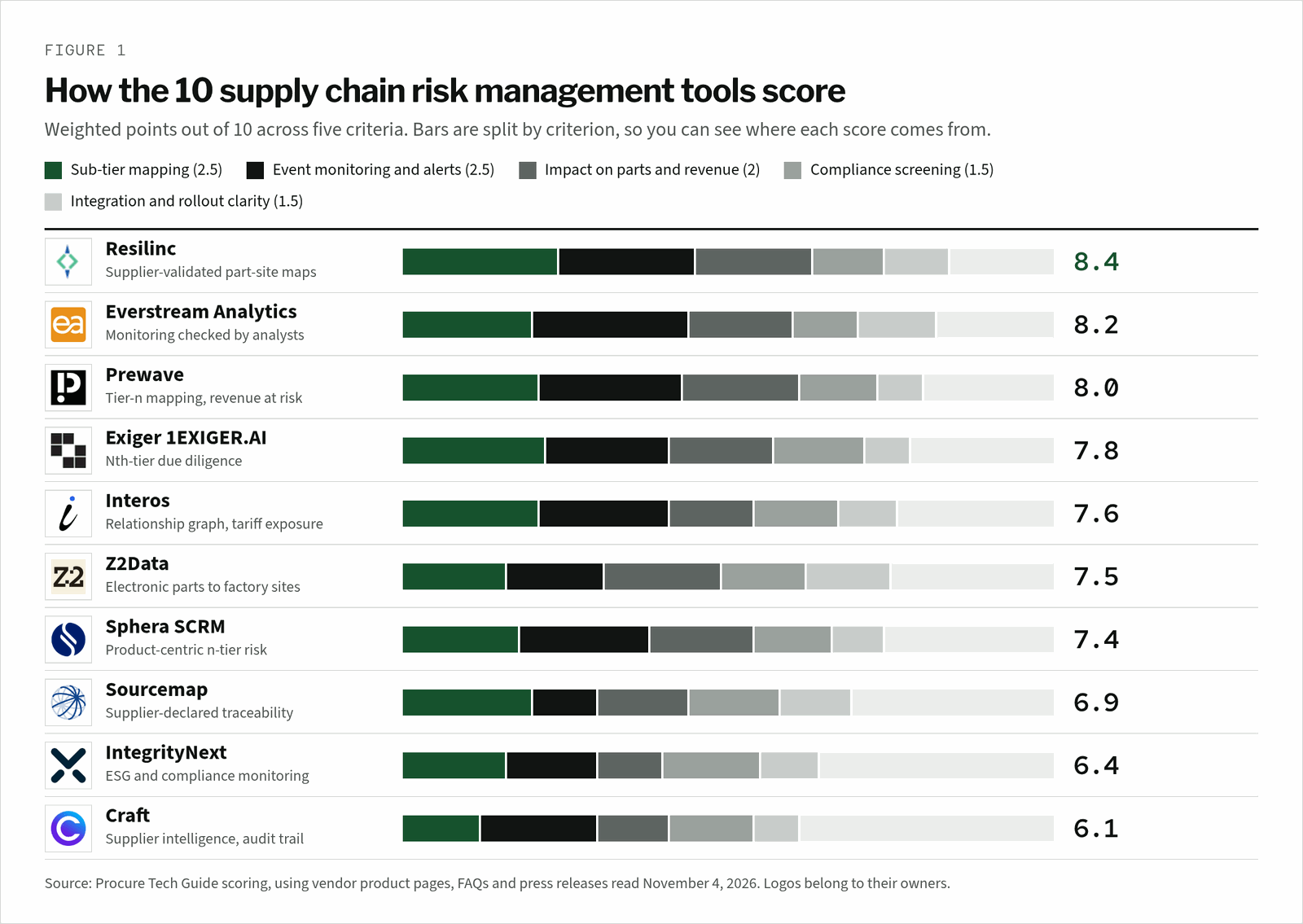
Read the bars by colour, not just the total. Z2Data scores high on part impact but maps electronic components only. Sourcemap maps deep but says little about live event monitoring. A tenth of a point is not a reason to pick one tool over another.
| Criterion | Weight | What earns points |
|---|---|---|
| Sub-tier mapping | 2.5 | Stated tier depth, how links are found, and whether suppliers confirm them |
| Event monitoring and alerts | 2.5 | Coverage of events at mapped sites, and alerts checked by people before they reach you |
| Impact on parts and revenue | 2 | Alerts tied to parts, BOMs, products or revenue, not just supplier names |
| Compliance screening | 1.5 | Sanctions, forced labor and restricted-party lists checked across tiers |
| Integration and rollout clarity | 1.5 | Named ERP or PLM connectors, a stated rollout time, or a trial |
What Does Each Tool Map and Monitor?
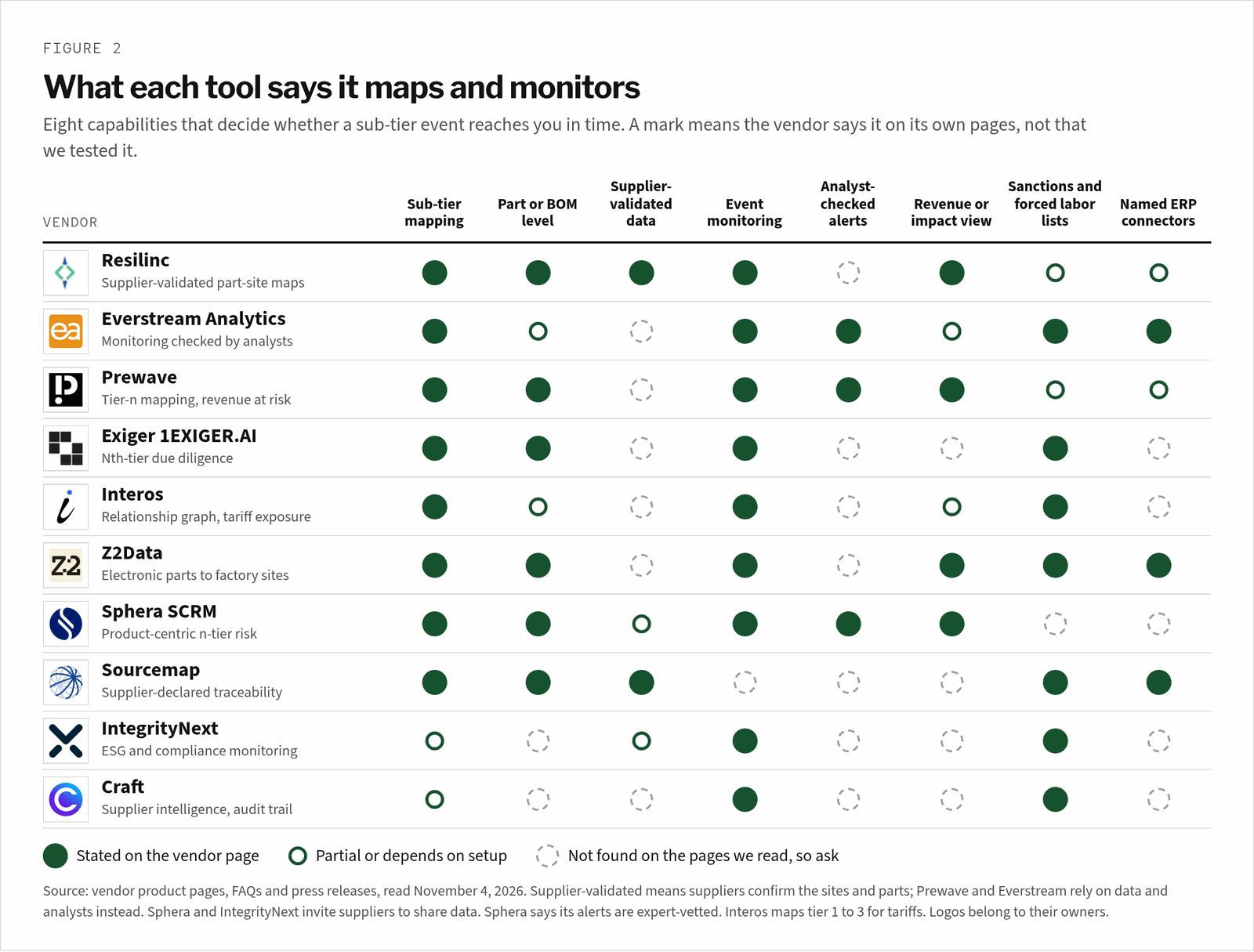
All ten tools say they monitor events, but they differ on how deep the map goes and who confirms it. Resilinc and Sourcemap use supplier-validated data. Everstream, Prewave and Sphera say people check alerts before you see them. Z2Data, Everstream and Sourcemap name their ERP connectors. Our Resilinc vs Everstream vs Interos comparison puts three of them head to head.
How Much Does Supply Chain Risk Management Software Cost?
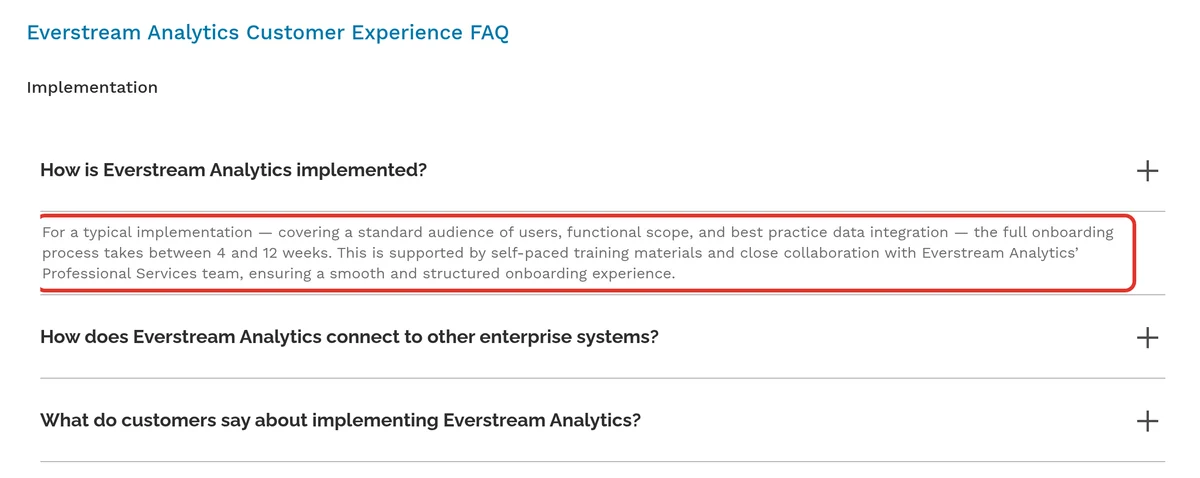
None of the 10 tools publishes a price, so every deal is quoted. Z2Data offers a free trial, the only self-serve start we found. Everstream says platform access comes within days of contracting, and full onboarding takes 4 to 12 weeks. Ask every vendor for a written quote.
The quote usually moves with a few things. Ask about each one before the demo ends, and get the answers in writing.
- Scope of the map: how many tier-1 suppliers, sites and parts are included.
- Tier depth: whether tier 2 and beyond cost extra, and who collects the data.
- Modules: compliance screening, tariffs or ESG are often sold as add-ons.
- Users and seats: procurement, planning and compliance may all want access.
- Integrations: ERP, PLM or BOM connectors and who maintains them.
- Services: supplier outreach, analyst support and onboarding hours.
| Tool | Published price | Trial or start | Rollout detail we found |
|---|---|---|---|
| Resilinc | None, quote based | Demo | Not stated |
| Everstream Analytics | None, quote based | Demo | Access within days; 4 to 12 weeks to onboard |
| Prewave | None, quote based | Demo | Not stated |
| Exiger | None, quote based | Demo | Not stated |
| Interos | None, quote based | Demo | Not stated |
| Z2Data | None, quote based | Free trial | 70% of BOM parts mapped on day one (vendor figure) |
| Sphera SCRM | None, quote based | Demo | Not stated |
| Sourcemap | None, quote based | Demo | Sub-suppliers discovered within hours (vendor claim) |
| IntegrityNext | None, quote based | Demo | Not stated |
| Craft | None, quote based | Demo | Not stated |
What the Record Holds
Before you buy, decide what the system of record must hold for each risk. If a field has no owner, it goes stale within a quarter. Use this table to ask each vendor where the field lives, who fills it, and how often it updates.
| Record | What it should hold | Who owns it |
|---|---|---|
| Supplier site | Address, what the site makes, and which of your parts depend on it | Supplier, confirmed by procurement |
| Sub-tier link | Which tier-2 or tier-3 site feeds which tier-1 site, and how the link was found | Vendor data team or supplier |
| Part or BOM line | Part number, sites that make it, alternates and buffer stock | Engineering and planning |
| Event | What happened, where, when, and whether a person confirmed it | Vendor analysts |
| Impact | Parts, orders and revenue exposed, with the working shown | Supply chain risk lead |
| Compliance hit | List name, entity matched, tier and date checked | Compliance |
| Action | Who was told, what was done, and when it closed | Category manager |
The 10 Best Supply Chain Risk Management Software Tools, Reviewed
1. Resilinc
Resilinc’s multi-tier mapping page combines supplier declarations, ERP integrations and AI to map suppliers across tiers. It links part-to-site relationships using 15+ years of validated data. It says 4M+ parts are linked to real supplier locations. When an event hits a mapped site, it flags the parts and suppliers at risk.
The page also describes revenue impact across tiers and scenario modelling. A March 18, 2026 press release added Model Context Protocol and Agent-to-Agent support, so other systems can call Resilinc data. Ask how many of your suppliers are already mapped, and what share answered surveys.
Strengths
- Part-to-site maps confirmed by suppliers
- Flags parts at risk from events at mapped sites
- Revenue impact and what-if modelling
Watch-outs
- No published price
- Supplier survey effort can fall on your team
2. Everstream Analytics
Everstream’s Network Mapping builds a digital twin of your suppliers, locations, lanes and materials. Its sub-tier visibility module looks for “Sourcing Diamonds”, where several supply paths meet one hidden supplier. That is the kind of single point of failure a tier-1 view misses.
Its FAQ says intelligence analysts, meteorologists and logistics specialists validate AI alerts. It integrates with SAP, Oracle and Kinaxis, and keeps a UFLPA supplier watch list. Everstream was named a Leader in the 2026 Gartner Magic Quadrant for supplier risk management.
Strengths
- People validate alerts before you see them
- Finds hidden convergence points in sub-tiers
- Named SAP, Oracle and Kinaxis integration
Watch-outs
- No published price
- Sub-tier links are inferred, not supplier-confirmed
3. Prewave
Prewave’s multi-tier visibility page says specialist agents map from tier 1 to raw-material origins without supplier surveys. It claims this cuts the scope of what needs investigating by 70 to 90%, a vendor figure. Its monitoring page says a human specialist confirms each event is real.
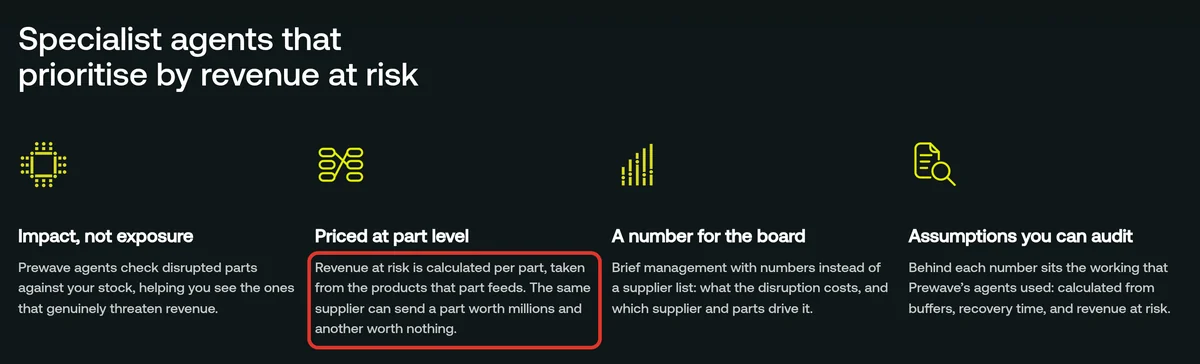
Its financial impact page calculates revenue at risk per part, from the products each part feeds. The business data connector takes BOMs and stock from your ERP or a spreadsheet. Ask to see the working behind one number in the demo.
Strengths
- Revenue at risk per part, with working shown
- Human check on each event
- No supplier surveys needed for mapping
Watch-outs
- No published price
- Mapped links are found by agents, so ask how they are verified
4. Exiger 1EXIGER.AI
Exiger’s 1EXIGER.AI page says it maps value chains and BOMs, then tracks risk across tiers. It applies AI to three trillion connected data points across 200 jurisdictions. Its supply chain risk page says it identifies nth-tier suppliers, scores them and traces their data sources.
Risk areas include sanctions, bribery and corruption, financial health, cyber, ownership, operational disruption and human rights. You can configure risk weights and thresholds for your program. That suits teams that answer to auditors. Ask which data sources sit behind each score.
Strengths
- Deep due diligence across tiers
- Configurable risk weights
- Traces data sources for each supplier
Watch-outs
- No published price
- No named ERP connectors on the pages we read
5. Interos
Interos says on its software page that it maps and monitors 250 million+ companies and billions of relationships. Its iScore rates suppliers across six risk domains. The Resilience Watchtower watches for events, and restricted lists cover UFLPA and Section 889.
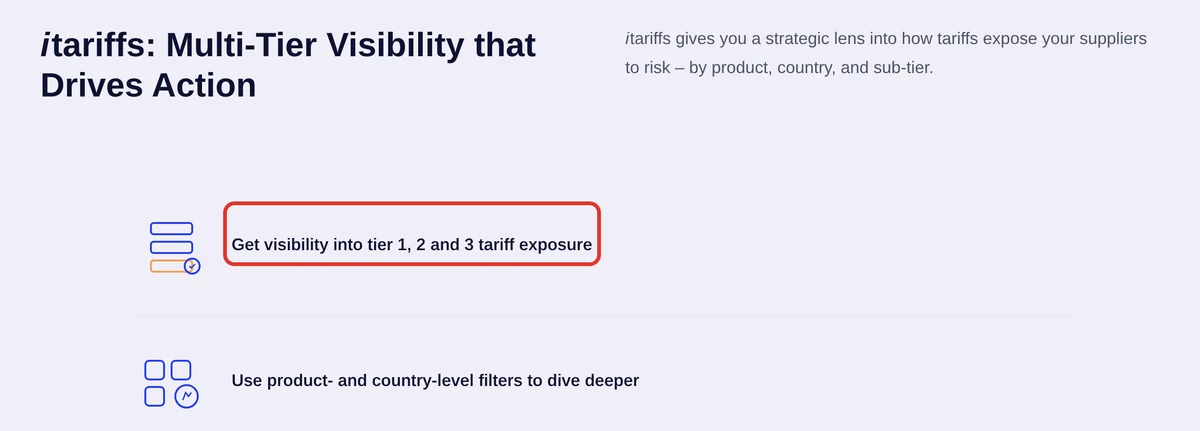
Its itariffs product shows tier 1, 2 and 3 tariff exposure by product and country. It updates US Executive Order data daily. A Similar Suppliers feature suggests alternates. Interos fits buyers whose biggest risk this year is trade policy.
Strengths
- Large relationship graph for sub-tier discovery
- Tariff exposure across three tiers
- UFLPA and Section 889 restricted lists
Watch-outs
- No published price
- Part-level impact is less clear than product-level
6. Z2Data
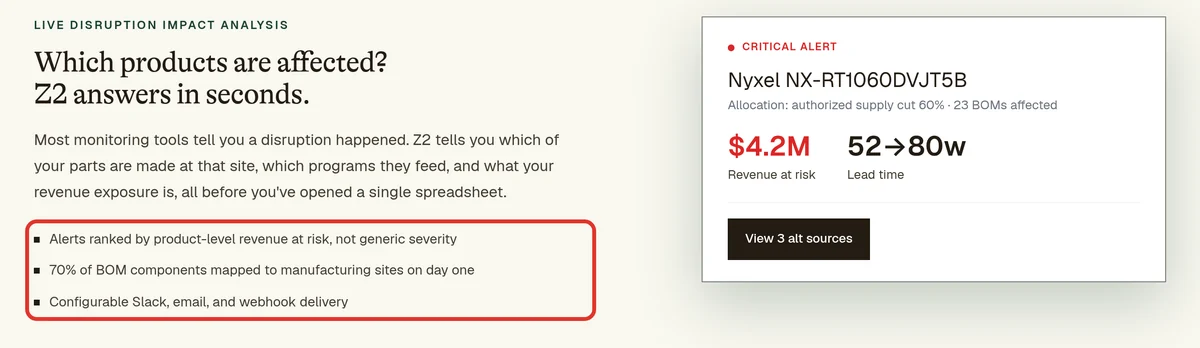
Z2Data’s Supply Chain Watch traces BOM components to their manufacturing sites, from tier 1 through tier 4. It says 70% of off-the-shelf components map on day one, a vendor figure. Each site gets a 0 to 100 risk score. Alerts rank by product-level revenue at risk.
Native connectors cover SAP, Oracle, Arena and Agile PLM. Alerts go to Slack, email or webhooks. It screens 31 sanctions lists, including UFLPA and BIS. The data covers electronic components, so it fits electronics makers more than food or chemicals buyers.
Strengths
- Named ERP and PLM connectors
- Free trial
- Site risk scores and revenue-ranked alerts
Watch-outs
- Built for electronic components
- No published price beyond the trial
7. Sphera SCRM
Sphera Supply Chain Risk Management, formerly riskmethods, starts from your products. Its N-Tier Intelligence breaks a product into components and materials, then maps tier 1, 2 and 3 suppliers behind them. Its Risk Radar pairs AI with expert-vetted alerts and claims 99.98% risk relevance, a vendor figure.
The Impact Analyzer adds revenue and spend so you can see the damage a risk could do. Tier-1 suppliers can join the Supply Risk Network and share their own supplier data. Ask how many suppliers in your category already share.
Strengths
- Starts from products, not supplier lists
- Expert-vetted alerts
- Revenue and spend impact view
Watch-outs
- No published price
- Sanctions and forced labor lists not stated on the pages we read
8. Sourcemap
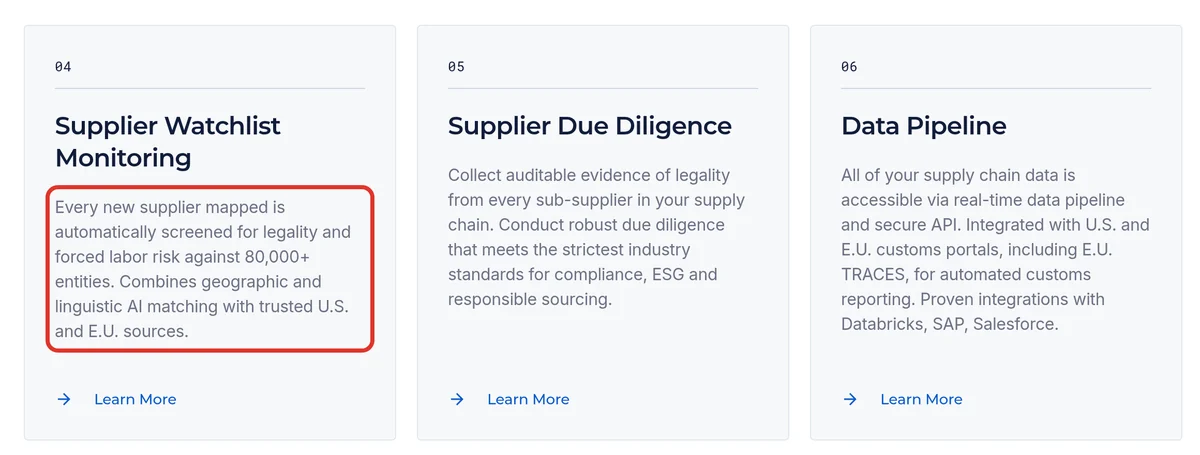
Sourcemap’s homepage describes an automated cascading supplier portal. Suppliers invite their own suppliers, and it says it discovers sub-suppliers within hours. It calls itself BOM and part-level n-tier mapping software. Each new supplier is screened for forced labor risk against 80,000+ entities.
It integrates with US and EU customs portals, including EU TRACES, and names SAP, Databricks and Salesforce. That makes it strong for evidence a customs officer will ask for, but the pages we read say little about live event monitoring.
Strengths
- Supplier-declared data down the chain
- Forced labor screening at every new supplier
- Customs portal integrations
Watch-outs
- Little on live event monitoring
- No published price
9. IntegrityNext
IntegrityNext’s supply chain visibility page says you upload product data and it maps value chains using HS codes, DUNS numbers and NACE classes. That works even with little data, but it shows likely sources, not confirmed sites. It flags suppliers on UFLPA and other watchlists.
Its platform page scores 52 ESG risk areas and monitors millions of news sources. It says 600+ companies use it. IntegrityNext suits sustainability and compliance teams more than planners who need part-level impact. For supplier sustainability ratings and audits, see our EcoVadis vs Sedex vs CDP comparison.
Strengths
- Works with minimal input data
- 52 ESG risk areas
- UFLPA and watchlist flags
Watch-outs
- Mapped sources are estimated from codes
- Little on part or revenue impact
10. Craft
Craft’s platform page pulls hundreds of sources, including sanctions lists and registries, into one supplier record. It scores financial, foreign ownership and control, cyber, geopolitical and operational risk. Assessments are written with traceable sources, so they hold up in an audit.
Alerts feed case management, so an issue has an owner and an audit trail. Its sample finding is a tier-2 supplier added to a sanctions watch list. Ask how far below tier 1 the record goes, since the page says less about sub-tier mapping.
Strengths
- Traceable sources for each assessment
- Case workflow for alerts
- Foreign ownership and control coverage
Watch-outs
- Sub-tier depth not stated
- Little on part or BOM impact
After Signature: The First 60 Days
Run this list in every supply chain risk management software demo, then again in your first two months live. Use five of your own critical parts. If a step needs a workaround, it becomes manual work later. Get each answer in writing, with who owns it.
- Scope: the contract lists which suppliers, sites and parts are in the first map.
- Tier depth: you can see which links are supplier-confirmed and which are inferred.
- Test event: a past disruption, replayed, shows the right parts and orders.
- Alert owner: every alert type has a named owner and a response time.
- Noise: you agree a weekly alert count that the team can actually read.
- BOM sync: BOM changes reach the map without a manual upload.
- Compliance hits: a sanctions or forced labor match goes to compliance, with evidence.
- Contract terms: notice and audit clauses sit in your contract system.
Red Flags in a Demo
- The demo map is a sample company, not your suppliers.
- Nobody can say which sub-tier links were confirmed by a supplier.
- Every alert looks urgent, and nobody can show how noise is filtered.
- Impact is shown per supplier, never per part or order.
- The “coverage” number has no date and no source.
- The quote has no line for tier 2 and beyond.
Which Supply Chain Risk Management Software Should You Choose?
Choose supply chain risk management software by how it finds sub-tiers and who checks the alerts. Resilinc leads at 8.4 with supplier-validated part-site maps. Everstream suits teams drowning in noisy alerts. Prewave fits revenue-first triage, Exiger fits regulated buyers, and all ten quote each deal.
The verdict
- Choose Resilinc if you need to know which parts are made at which sub-tier sites.
- Choose Everstream Analytics if you want people to check alerts before your team sees them.
- Choose Prewave if you triage disruptions by revenue at risk per part.
- Choose Exiger if auditors or government customers review your supplier checks.
- Choose Interos if tariffs and restricted parties are your biggest risk this year.
- Choose Z2Data if you build electronics and want a free trial first.
- Choose Sphera SCRM if you start from critical products and work down.
- Choose Sourcemap if customs and forced labor evidence drive the purchase.
- Choose IntegrityNext if ESG due diligence is the main job.
- Choose Craft if you need supplier assessments with traceable sources for audit.
More guides sit in our supplier management hub. For the wider suite choice, see our source-to-pay suites ranking. For the supplier record itself, see our supplier management software guide and best supplier management software ranking.
Frequently Asked Questions
What is the best supply chain risk management software?
Resilinc is the best supply chain risk management software for most manufacturers, scoring 8.4 out of 10 in our ranking. It maps parts to supplier sites with supplier-validated data and flags parts at risk from events. Everstream Analytics (8.2) and Prewave (8.0) follow closely.
What is supply chain risk management software?
Supply chain risk management software maps the suppliers, sites and materials behind your parts, including sub-tiers you do not buy from. It monitors those places for events such as fires, floods, sanctions and financial trouble. It then shows which parts and orders are exposed.
How much does supply chain risk management software cost?
None of the ten tools in our ranking publishes a price, so each vendor quotes based on suppliers and parts mapped, tier depth, modules and services. Z2Data offers a free trial. Everstream says full onboarding takes 4 to 12 weeks. Ask for a written quote with every line itemised.
What is the difference between supplier risk and supply chain risk software?
Supplier risk software checks the companies you pay, mostly at tier 1, for financial, compliance and ESG issues. Supply chain risk software maps deeper tiers and sites, then monitors events that could stop a part. Many manufacturers use both, with supplier risk feeding onboarding decisions.
How do SCRM tools find tier-2 and tier-3 suppliers?
They use four main methods. Some ask suppliers to confirm their own sites and sub-suppliers, while others infer links from trade and shipment data. Some run agents over large company graphs, and others trace BOMs or classification codes. Ask each vendor which links are confirmed and which are inferred.
Which SCRM tools check forced labor and sanctions lists?
Everstream keeps a UFLPA supplier watch list, and Interos covers UFLPA and Section 889 restricted lists. Z2Data screens 31 sanctions lists. Sourcemap screens each new supplier against 80,000+ entities. Exiger, IntegrityNext and Craft also cover sanctions or forced labor risk on their pages.