The deciding question when you shortlist the best procurement orchestration platforms is what stays underneath. An orchestration layer sits on top of your ERP, contract and risk tools and moves each request between them. It does not replace them, so the fit with the systems you already own matters more than any single feature.
We ranked 8 procurement orchestration platforms on five weighted criteria: system reach and the ERP handoff (30), the workflow builder and routing (25), the AI front door and agents (20), deployment evidence (15) and pricing clarity (10). Facts come from vendor product, integration, pricing and press pages read on October 29, 2026, and our scoring rules are public.
What are the best procurement orchestration platforms in 2026?
Zip is the best procurement orchestration platform for most teams in 2026, scoring 8.8 out of 10 for its 100+ integrations, Slack requests and a public pilot price. ORO Labs (8.4) leads on keeping SAP, Oracle or Coupa underneath, and Tonkean (8.2) suits Coupa estates. Omnea, Opstream, ServiceNow, Pipefy and Focal Point follow.
| # | Platform | Type | Best for | Score |
|---|---|---|---|---|
| 1 | Zip | Orchestration platform with its own iPaaS | Mid-market and enterprise teams that want one front door across every system | 8.8 |
| 2 | ORO Labs | Orchestration layer | Enterprises keeping SAP, Oracle or Coupa as the system of record | 8.4 |
| 3 | Tonkean (Coupa) | Orchestration layer, now part of Coupa | Coupa and SAP customers that want a plain-language front door | 8.2 |
| 4 | Omnea | Agentic operating system for procurement | Requests that start in Teams, Slack or an AI assistant | 7.8 |
| 5 | Opstream | Intake and orchestration | Parallel legal, IT, security and finance reviews | 7.6 |
| 6 | ServiceNow Source-to-Pay Operations | Workflow platform module | Companies already running ServiceNow for IT and HR | 7.4 |
| 7 | Pipefy | No-code orchestration platform | Mid-market teams that want to build their own flows | 7.3 |
| 8 | Focal Point | Procurement orchestration suite | Teams that route intake into sourcing, contracts and POs | 6.7 |
Our pick
Zip
Zip is the only platform where we found all six orchestration features we checked. Its integrations page lists 100+ integrations across ERP, P2P, CLM, GRC and ITSM, and its AWS Marketplace listing shows a 12-month pilot for 100 active users and one workflow at $75,000.
Suite, module or point tool?
Pick a dedicated orchestration platform when requests cross several systems and teams. Pick the workflow module of a platform you already run, such as ServiceNow, when your IT and HR requests live there. Pick a general no-code tool like Pipefy when you have builders in house and a modest budget.
Suite, module or point tool?
| Your situation | Lean toward | The question to ask |
|---|---|---|
| SAP, Oracle or Coupa stays as the system of record | ORO Labs, Tonkean, Zip | Which system creates the requisition and the PO |
| You already run Coupa | Tonkean, now part of Coupa | How many monthly tracked users you will have |
| ServiceNow already runs IT and HR requests | ServiceNow Source-to-Pay Operations | Which ERP integrations are prebuilt |
| Legal, IT and security review most purchases | Opstream, Omnea, Zip | Can reviews run in parallel, and who sees what |
| You want to build flows yourself on a small budget | Pipefy | Which plan includes the integrations you need |
In practice, the system that must create the purchase order decides the shortlist before any demo does. If a dedicated tool should own the PO, our guide to PO software for mid-market teams compares 12 options.
What can each procurement orchestration platform do?
Zip is the only platform where we found all six orchestration features on the vendor’s own pages, including a public price. Omnea matches it on intake, Slack and Teams and MCP access, but shows no price. Only Zip, Omnea and Pipefy publish a connector count, so ask the others for a list.
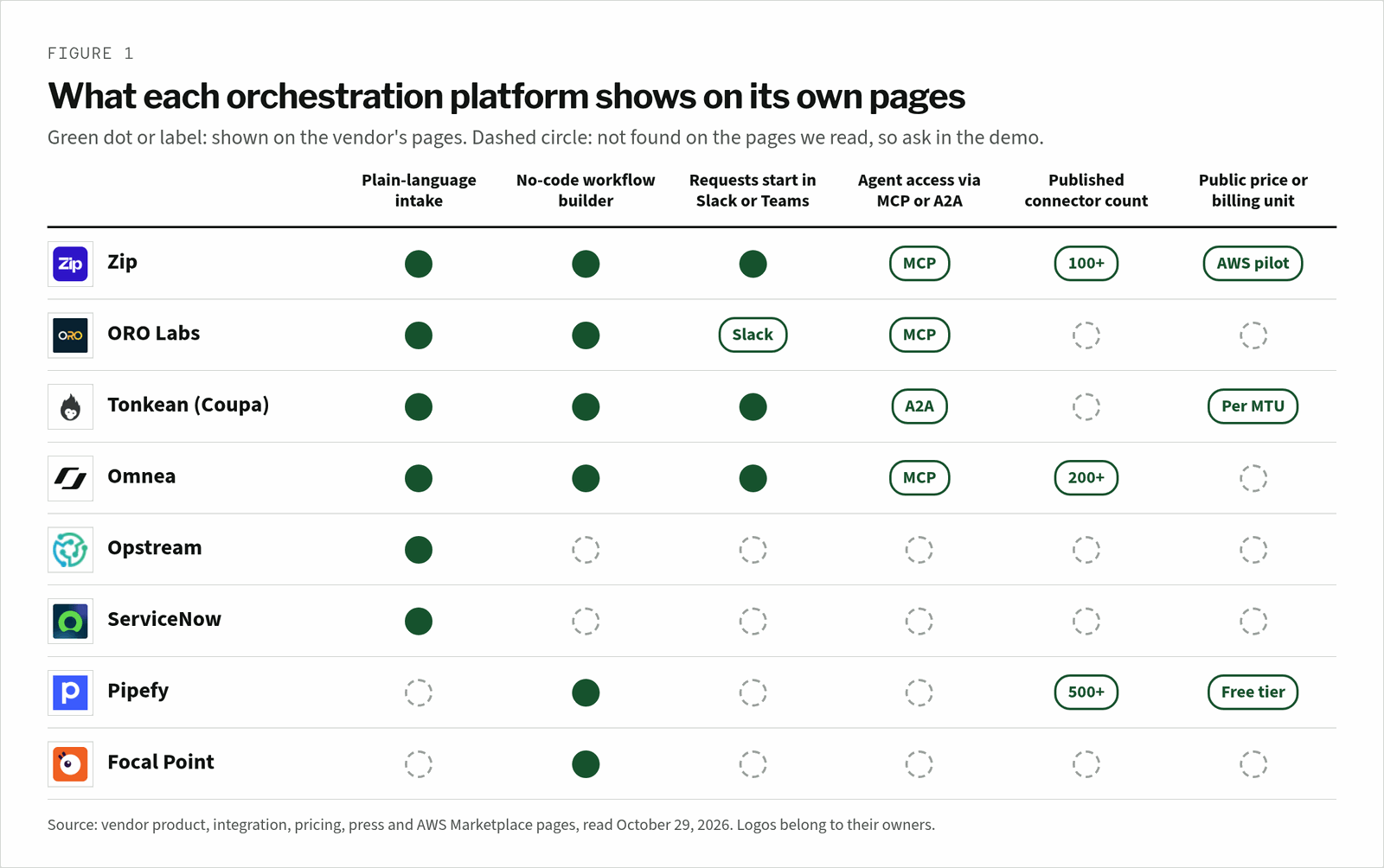
A dashed circle is a demo question, not a verdict. ServiceNow and Opstream both describe integrations with existing systems, for example, but neither page we read gives a connector count or names Slack or Teams as a place to start a request.
How did we score the procurement orchestration platforms?
Each platform earns weighted points out of 10 across five criteria, with system reach and the ERP handoff worth the most at 3 points. ORO Labs scores highest on reach at 2.8, because it is built to sit on SAP, Oracle and Coupa. Zip pulls ahead overall on pricing clarity and its Slack and MCP front door.
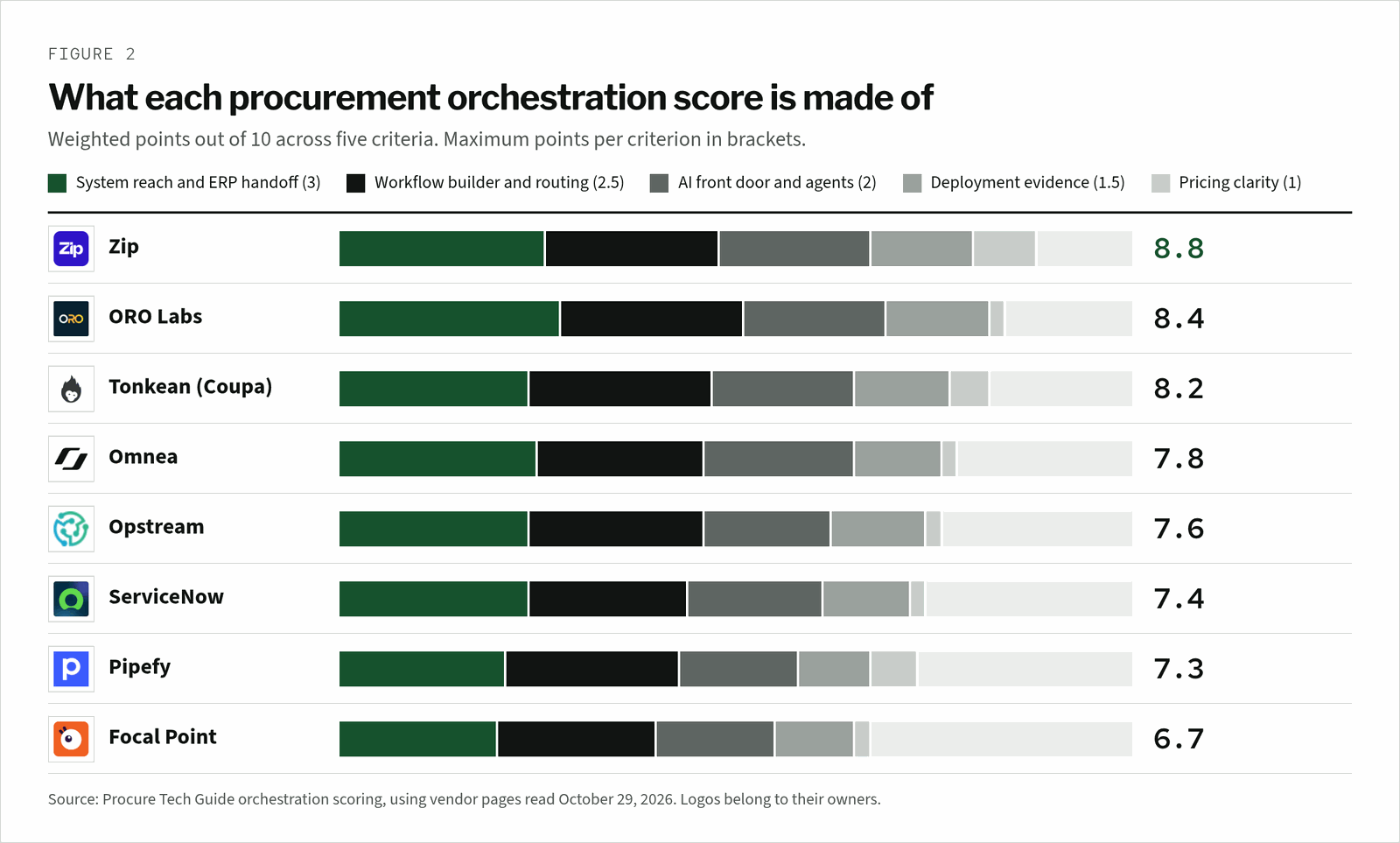
Pricing clarity is the smallest weight, yet it separates close scores. Zip and Pipefy show a price on a public page, and Tonkean explains its billing unit. The other five quote per deal.
How much do procurement orchestration platforms cost?
Most procurement orchestration platforms are quote based. Zip’s AWS Marketplace pilot is $75,000 for 12 months with 100 active users and one workflow. Pipefy has a free Starter plan for up to 10 users and five processes, and Tonkean bills on monthly tracked users. The rest price per deal.
| Platform | Pricing from | The line item to watch |
|---|---|---|
| Zip | $75,000 for a 12-month pilot (100 active users, 1 workflow) | Active users and workflows after the pilot |
| Pipefy | Free Starter plan (up to 10 users, 5 processes) | Business bills per user, and Business and Enterprise go through sales |
| Tonkean (Coupa) | Quote based | Monthly tracked users, not named seats |
| Opstream | Quote based | Employee count, asked on the pricing page |
| ORO Labs, Omnea, ServiceNow, Focal Point | Quote based | Ask for the unit in writing: users, requests or spend |
For most mid-market teams, the user definition matters more than the list price. Tonkean’s pricing page counts each person who directly interacts with Tonkean in a month, so occasional requesters change the bill.
The best procurement orchestration platforms, reviewed one by one
Each review covers who the platform suits, where its pricing starts, one standout fact and the watch-outs we found. The red outline on each screenshot marks the line the review relies on. Platforms appear in score order, from Zip at 8.8 to Focal Point at 6.7.
1. Zip
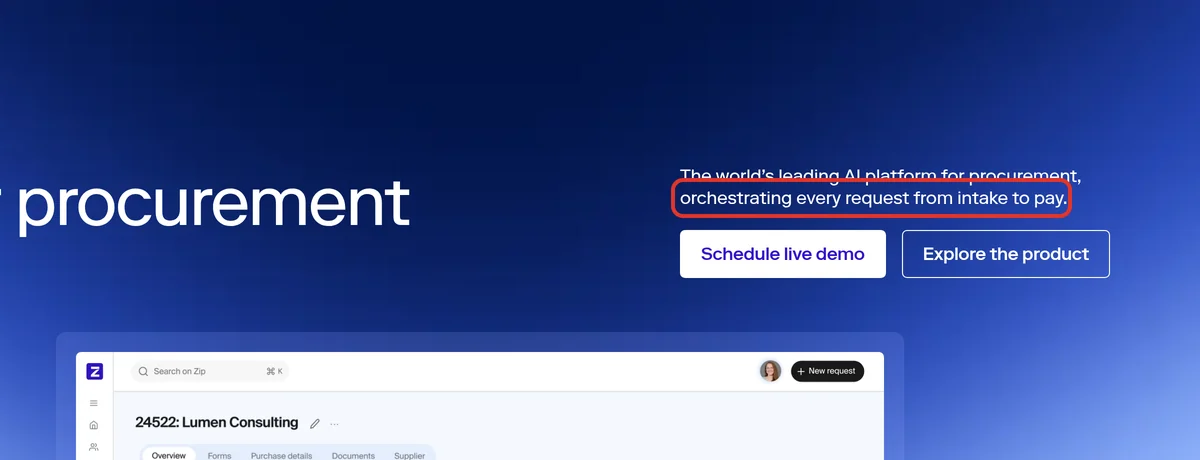
Zip’s home page describes a platform “orchestrating every request from intake to pay” and calls it “The only procurement orchestration platform in the 2026 Gartner Magic Quadrant for Source-to-Pay Suites”. Its orchestration page says it “combines structured workflows with autonomous AI agents”.
The integrations page lists 100+ integrations and App Studio, Zip’s own iPaaS for custom builds, plus Zip MCP for Claude, ChatGPT and other AI tools. Employees can start requests in the Zip app for Slack, and Superagents act as AI users inside Zip.
Strengths
- 100+ published integrations plus its own iPaaS
- Requests can start in Slack, and data reaches MCP tools
- A public pilot price
Watch-outs
- The pilot covers one workflow, so price the full rollout early
- More than a team needs when finance approves most purchases alone
2. ORO Labs
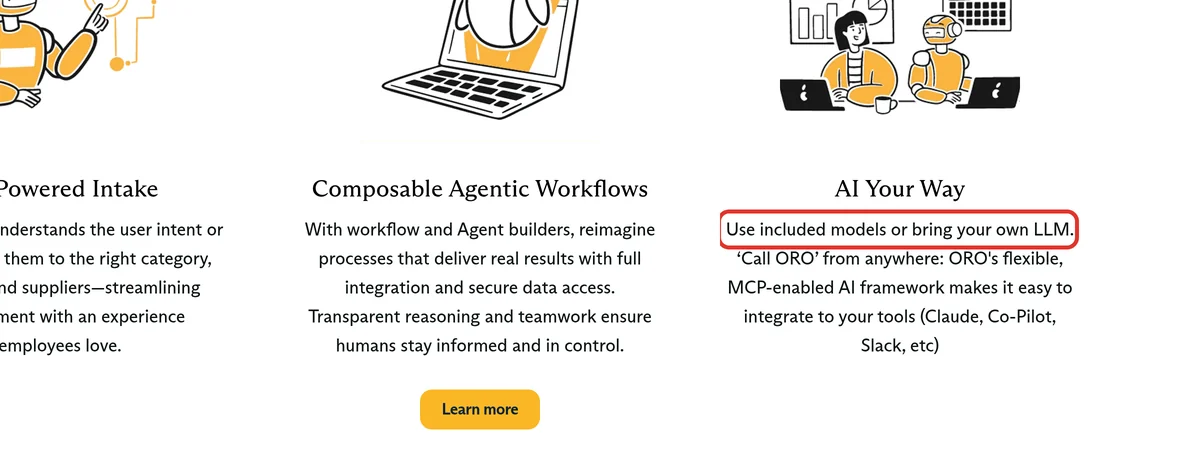
ORO’s platform page says “ORO does not replace ERP, sourcing, or contract management systems” and acts as an orchestration layer across SAP, Oracle, Coupa, Ariba and DocuSign. It offers no-code workflow and agent builders, lets you bring your own LLM, and reaches Claude, Copilot and Slack through an MCP framework.
ORO’s SAP partnership release says SAP will sell it as SAP Ariba Procurement Orchestration by ORO Labs, planned for general availability by November 2026. The home page lists SOC 1, SOC 2 and ISO 42001.
Strengths
- Built to sit on top of SAP, Oracle and Coupa
- Bring your own LLM, with MCP access
- A route to buy through SAP
Watch-outs
- No public price or connector count
- The SAP edition is not generally available until November 2026
3. Tonkean (Coupa)
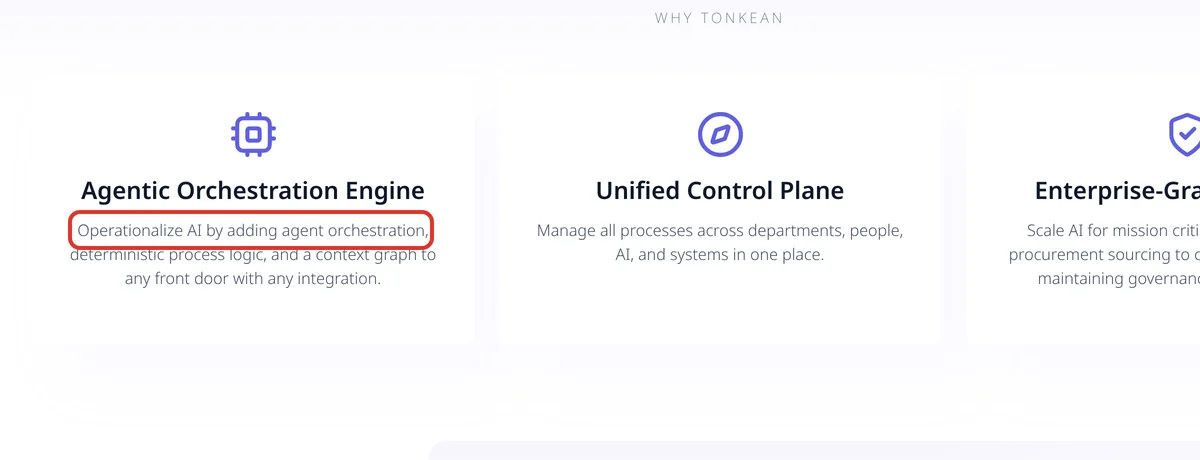
Tonkean’s home page calls it “The No. 1 Agentic Orchestration Platform for the Enterprise”, a vendor claim. Its Coupa page describes guided intake that can start “from Slack, Teams, email, or forms” and says it will “Automatically create the requisition in Coupa”.
Coupa announced the acquisition as its fourth after Cirtuo, Scoutbee and Rossum, citing a framework for multi-agent orchestration and Agent-to-Agent (A2A) coordination. Tonkean’s pricing page bills on monthly tracked users rather than named seats.
Strengths
- Requests start in Slack, Teams, email or forms
- Writes the requisition straight into Coupa
- A clear billing unit
Watch-outs
- Its roadmap now follows Coupa’s
- No published connector count
4. Omnea
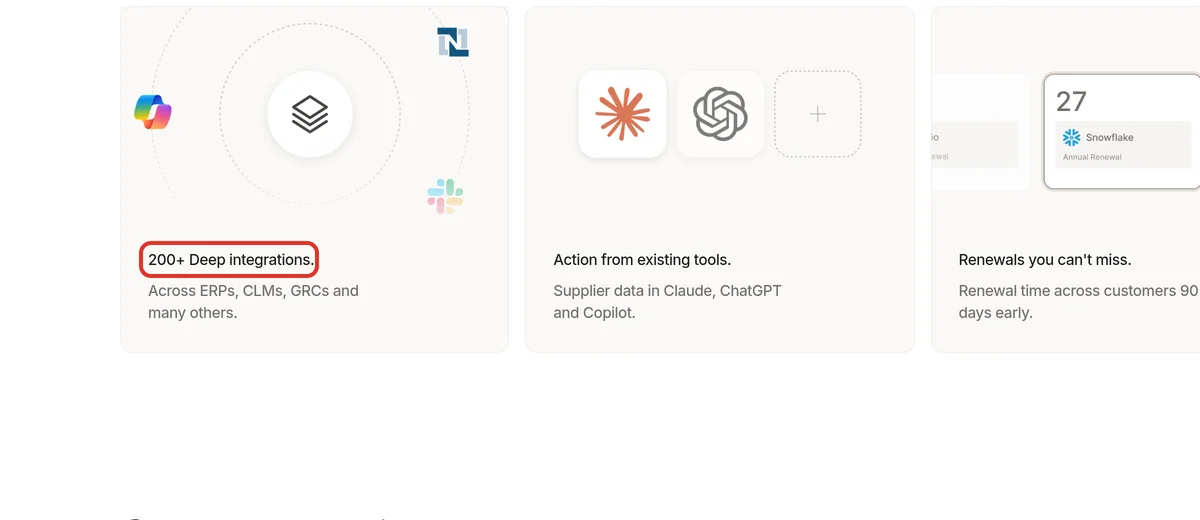
Omnea’s home page calls it “The Agentic Operating System for Procurement”, with conversation intake via Teams, Slack and MCP and no-code workflows that need no IT. It lists “200+ Deep integrations” and says every decision is logged and auditable.
Its intake page says “Omnea accepts messages, form completions, uploads, and URLs”, and a Form Review Agent captures complete requests without back-and-forth.
Strengths
- 200+ published integrations
- Intake via Teams, Slack and MCP
- Every decision logged
Watch-outs
- No public price
- No PO or ERP handoff detail on the pages we read
5. Opstream
Opstream’s home page calls it “The #1 Procurement Orchestration Platform”, a vendor claim, and says its AI unifies vendor data across ERPs, CLMs, HRIS and compliance tools. Its intake page says “Opstream connects with virtually any tech stack via bidirectional APIs”.
The same page says Exegy connected Opstream to NetSuite in under 24 hours, and LastPass cut average request handling from two weeks to 72 hours.
Strengths
- Plain-language Adaptive Intake
- Named customer go-live and cycle-time examples
- Bidirectional APIs into ERP, CLM and HRIS
Watch-outs
- No connector count or chat-based intake on the pages we read
- No public price
6. ServiceNow Source-to-Pay Operations
ServiceNow’s Source-to-Pay Operations page says it “takes procurement requests in plain language” and coordinates stakeholders for off-catalog purchases, supplier onboarding and invoice exceptions. It supports the work that happens before and between ERP transactions.
The page says most implementations take 12 to 24 weeks, and that teams connect to leading ERP and procurement systems with prebuilt integrations and APIs.
Strengths
- One request portal for IT, HR and procurement
- A stated implementation range
- Prebuilt ERP integrations
Watch-outs
- Best value only if you already run ServiceNow
- No connector count or price on the page we read
7. Pipefy
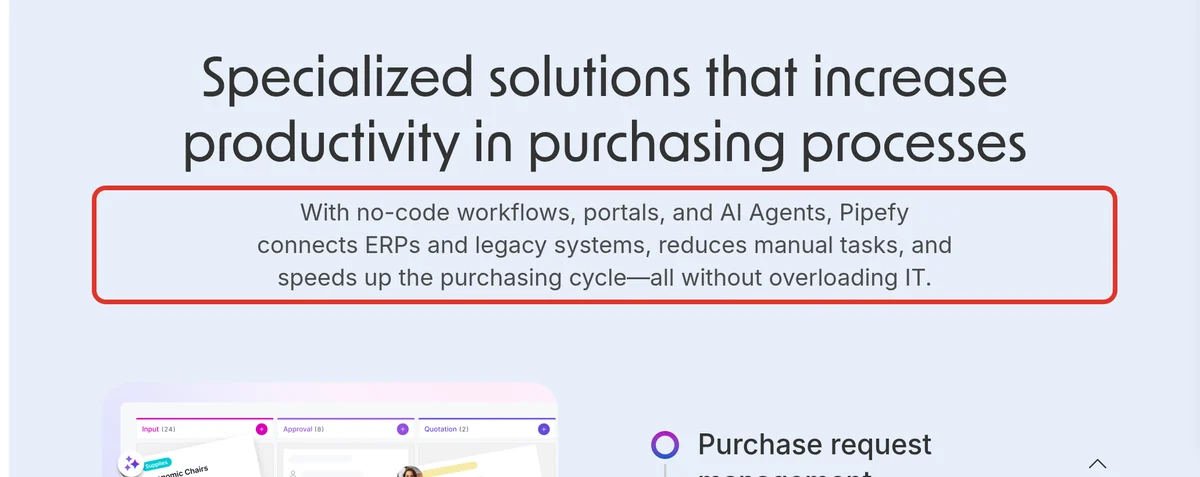
Pipefy’s procurement page says “With no-code workflows, portals, and AI Agents, Pipefy connects ERPs and legacy systems”. The same page describes procurement orchestration that works without replacing SAP, Oracle or NetSuite.
Its pricing page lists a free Starter plan and per-user billing on Business, and its SMB package lists integration with over 500 other tools. The home page cites a Strong Performer rating in Gartner Peer Insights for business orchestration and automation.
Strengths
- A free plan to prototype on
- 500+ integrations listed
- You can build and change flows yourself
Watch-outs
- A general workflow tool, not procurement-specific
- Plain-language intake was not on the pages we read
8. Focal Point
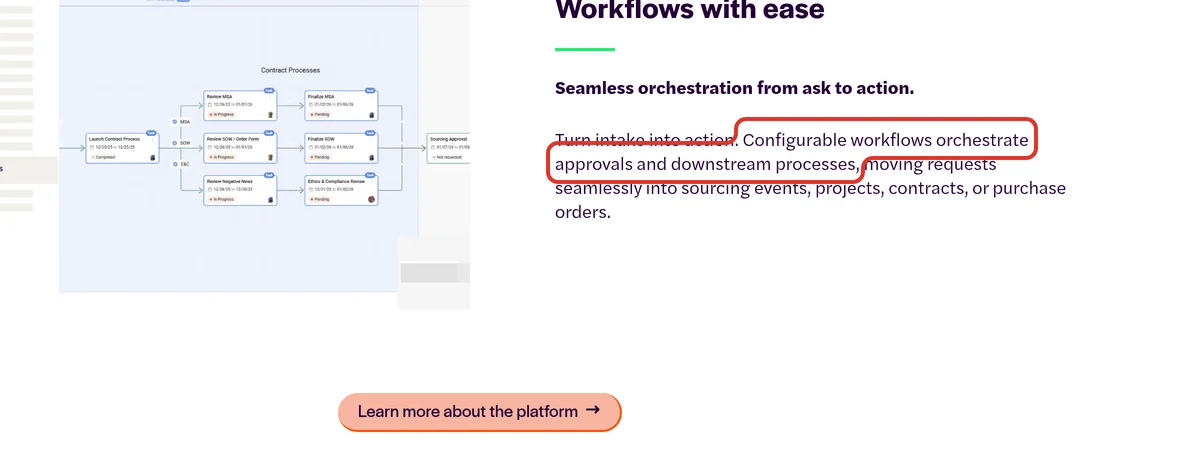
Focal Point’s intake to anything page says “Configurable workflows orchestrate approvals and downstream processes”, moving requests into sourcing events, projects, contracts or purchase orders. Requests are routed by spend thresholds, category, risk and prior patterns.
Its agentic AI page describes OFAC and W9 checks, data ringfenced per client and human-in-the-loop approvals. Its home page adds drag-and-drop tools for procurement projects.
Strengths
- Routes intake into sourcing, contracts or POs
- Human-in-the-loop controls for agents
- Supplier checks such as OFAC and W9
Watch-outs
- No Slack, Teams or MCP intake on the pages we read
- No public price or connector count
When your ERP’s own module is enough
Your ERP or suite module is enough when most purchases flow through one system, few teams review them, and requesters already use that system. Coupa and SAP Ariba both offer intake, and SAP will resell ORO Labs for mixed estates. Add an orchestration layer once one of these signals appears.
- Requests touch three or more systems before a PO exists
- Legal, IT or security reviews add weeks to software purchases
- Requests arrive by email and chat and get retyped into the ERP
- Different teams run the same purchase through different tools
One signal usually justifies an orchestration layer such as Zip, ORO Labs or Tonkean. Several justify a fresh look at the wider stack, starting with our best source-to-pay suites ranking.
Which procurement orchestration platform should you choose?
To choose a procurement orchestration platform, list the systems a typical request touches, then check which one must create the PO. Zip leads overall, ORO Labs for SAP, Oracle or Coupa underneath, Tonkean for Coupa estates, and Omnea for chat-first intake. Opstream, ServiceNow, Pipefy and Focal Point fit narrower cases.
The verdict
- Choose Zip if you want one front door with Slack and MCP access and a public pilot price.
- Choose ORO Labs if SAP, Oracle or Coupa stays as the system of record.
- Choose Tonkean if you run Coupa and want requests to start in Slack or Teams.
- Choose Omnea if employees should ask in Teams, Slack or an AI assistant.
- Choose Opstream if several teams review most purchases in parallel.
- Choose ServiceNow, Pipefy or Focal Point if you already run ServiceNow, want to build flows yourself, or route intake into sourcing.
Teams on Coupa can read our Coupa pricing guide and Coupa alternatives, and SAP shops can compare Coupa vs SAP Ariba or our SAP Ariba alternatives. New buyers can start with the procurement software guide, and more guides sit in our intake and orchestration hub.
Frequently asked questions
What is a procurement orchestration platform?
A procurement orchestration platform is a layer that sits on top of your ERP, contract, risk and purchasing tools and moves each request between them. It takes the request, routes it through reviews and approvals, and hands the result to the system of record. It coordinates those systems rather than replacing them.
What is the difference between procurement orchestration and intake-to-procure?
Intake-to-procure covers the request and approvals before a purchase order exists. Procurement orchestration is wider: it connects every system a request touches, from intake to ERP, contracts and supplier risk, and can carry on after the PO. Most orchestration platforms, such as Zip and ORO Labs, include intake.
Does procurement orchestration replace my ERP?
No. Orchestration platforms keep your ERP as the system of record. ORO Labs says it does not replace ERP, sourcing or contract systems, and Pipefy says it works without replacing SAP, Oracle or NetSuite. The platform creates the requisition or PO in your ERP through an integration.
How much does a procurement orchestration platform cost?
Most vendors quote per deal. Zip lists a 12-month AWS Marketplace pilot at $75,000 for 100 active users and one workflow. Pipefy offers a free Starter plan for up to 10 users and five processes, and Tonkean bills on monthly tracked users. ORO Labs, Omnea, Opstream, ServiceNow and Focal Point do not publish prices.
Can AI agents use a procurement orchestration platform?
Yes, on some platforms. Zip MCP brings Zip data into Claude, ChatGPT and other MCP tools, ORO Labs offers an MCP framework, and Omnea offers intake via MCP. Coupa cited Agent-to-Agent coordination when it bought Tonkean. The other four describe their own AI features, but we did not find MCP or A2A access on the pages we read.
How long does it take to implement procurement orchestration?
The timeline follows the number of systems you connect. ServiceNow says most Source-to-Pay Operations implementations take 12 to 24 weeks. Opstream says Exegy connected it to NetSuite in under 24 hours. Most other vendors do not publish a timeline, so ask for one per integration in the demo.