The deciding question in source-to-pay vs procure-to-pay is how much of the buying cycle you want one system to own. Procure-to-pay runs the purchases you already decided to make. Source-to-pay also runs the work before that: finding suppliers, running bids and signing contracts.
This guide is for finance and procurement leads choosing between a P2P tool and a full S2P suite. It uses the definitions in Gartner’s 2026 Magic Quadrant for Source-to-Pay Suites, the vendors’ own product and pricing pages read on October 28, 2026, and our public scoring rules for how we compare software.
What is the difference between source-to-pay and procure-to-pay?
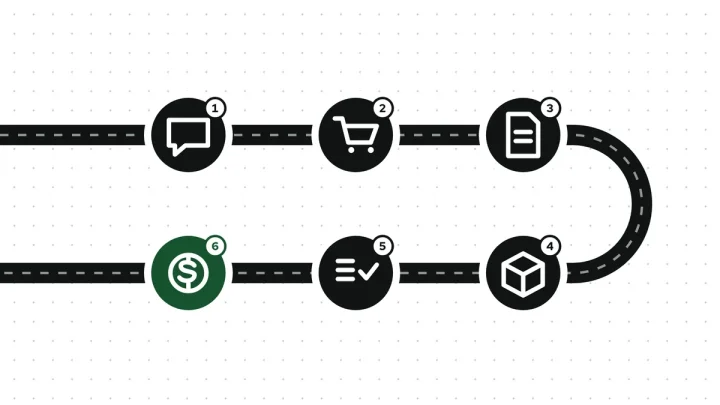
Procure-to-pay (P2P) covers the transactional steps of buying: requests, purchase orders, goods receipts and invoice matching up to payment. Source-to-pay (S2P) includes all of P2P and adds the strategic steps before it: spend analysis, sourcing events, contract management and supplier management. Every S2P suite contains P2P, but a P2P tool is not an S2P suite.
| Procure-to-pay (P2P) | Source-to-pay (S2P) | |
|---|---|---|
| Starts at | A request for something you need | Spend analysis and choosing what to source |
| Ends at | Invoice approved, or the payment | Payment to the supplier |
| Core jobs | Requests, approvals, POs, catalogs, receipts, invoice matching | All of P2P plus RFx events, contracts, supplier onboarding and performance |
| Main users | Employees, approvers, AP team | Category managers and sourcing teams, plus all P2P users |
| Built for | Any team that buys through POs | Large procurement teams; Gartner judges suites on $500M+ customers |
| Price signal | Precoro from $499 a month, billed annually | Coupa from $50k a year on 3 or 5 year terms |
Suite, module or point tool: which one do you need?
You need a P2P tool when the pain is control over everyday buying: approvals, purchase orders and invoice matching. You need an S2P suite when sourcing events, contracts and supplier risk are also slow or scattered. If your ERP already has a procurement module, check what it covers before you buy either. If the front end of buying is the gap, our guide to intake-to-procure software covers that layer, and our what is intake-to-procure explainer defines the process.
| Your situation | Lean toward | The question to ask |
|---|---|---|
| Spend leaks through unapproved purchases | P2P tool such as Precoro or Procurify | How fast can approvers act from email or Slack? |
| AP is buried in invoices | AP-first P2P such as Basware | What share of invoices match with no touch? |
| Bids and contracts live in email and shared drives | S2P suite such as Coupa, Ivalua or JAGGAER | Which modules are in the base price? |
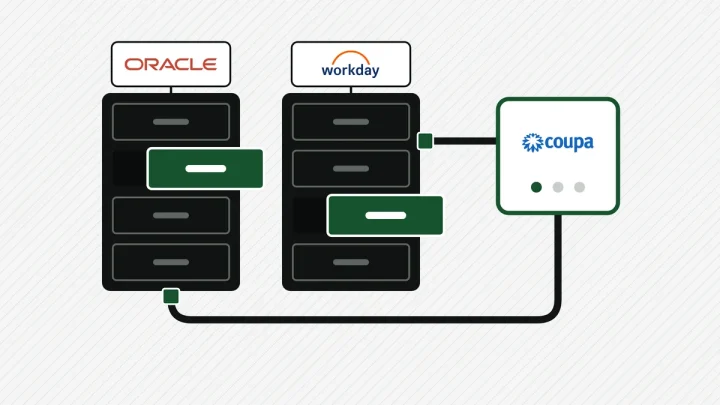
| You run several ERPs | S2P suite or SAP Ariba Buying and Invoicing | Is it ERP-agnostic, and who builds each link? |
| Oracle or SAP already runs finance | The ERP vendor’s own procurement module | Which S2P modules need a separate licence? |
In practice, the line item to watch is the upgrade path: what sourcing and contracts will cost once you need them.
Where does procure-to-pay end and source-to-pay begin?
Procure-to-pay begins when someone requests a purchase, and source-to-pay begins earlier, with spend analysis and sourcing. Gartner’s mandatory S2P modules are sourcing, contract lifecycle management, supplier information and performance management, procure-to-pay and a supplier collaboration portal. P2P is one module inside that suite, not a rival to it.
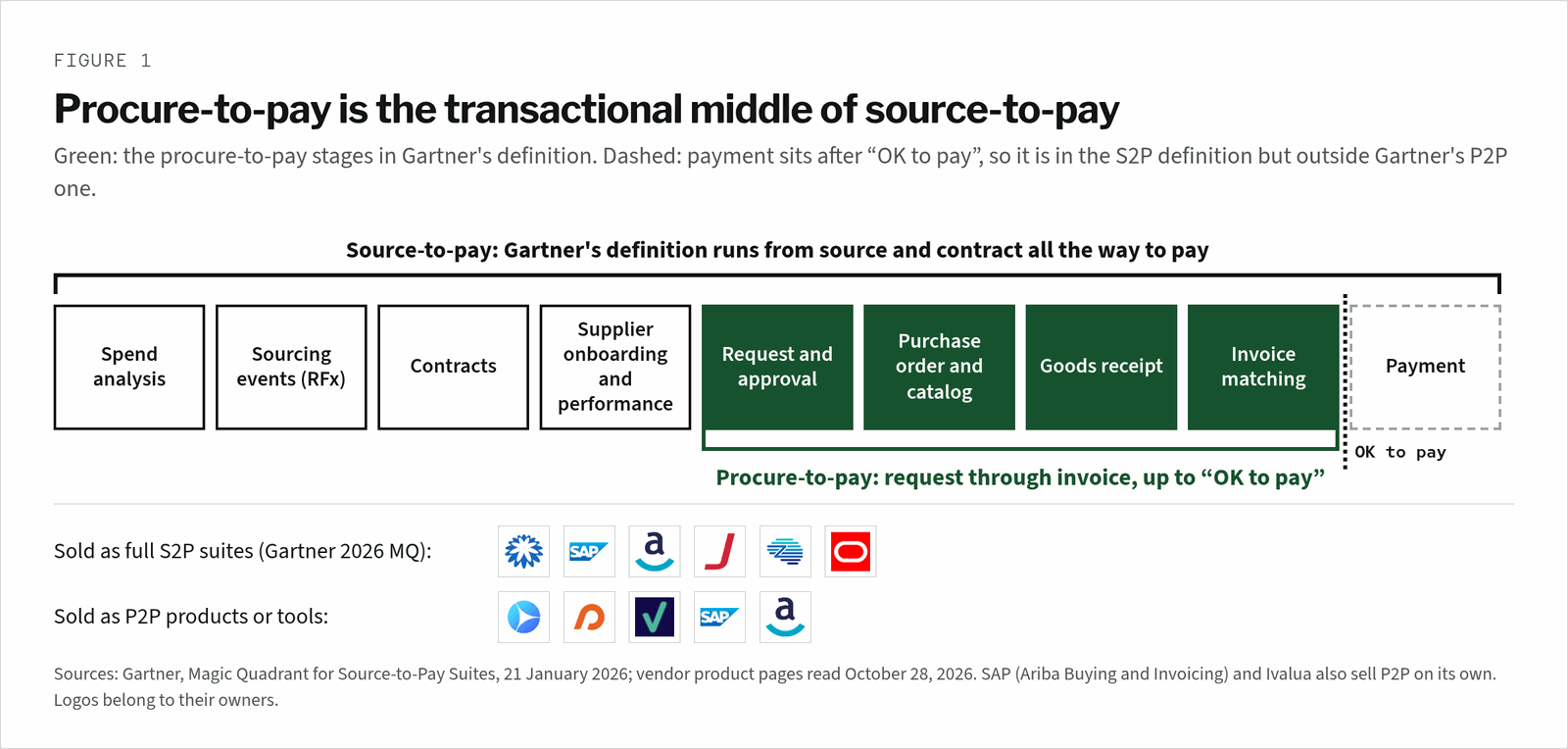
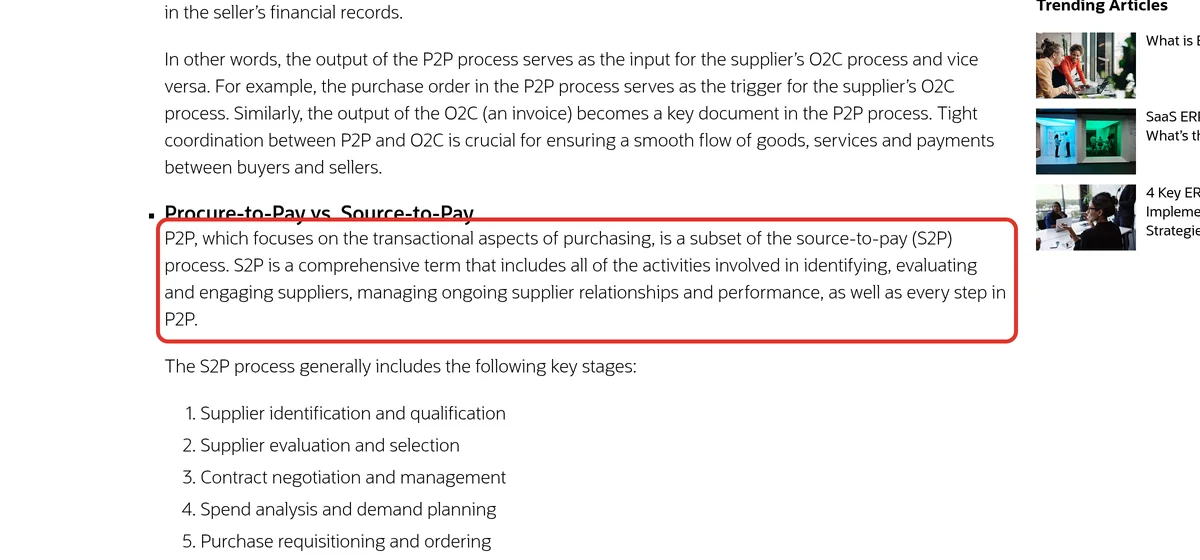
Definitions differ on one point: payment. Gartner’s P2P stops at “OK to pay”, so the payment step can sit outside the P2P module, for example in the ERP. NetSuite’s P2P guide runs P2P through to paying the supplier and describes accounts payable as a subset of P2P.
What does procure-to-pay software cover?
Procure-to-pay software covers purchase requests, approvals, purchase orders, catalogs, goods receipts and invoice matching, and many tools add supplier payments. Gartner defines it as the automation of the transactional procurement process. Its job is control: every purchase is approved, ordered against a PO and matched to an invoice before money leaves.
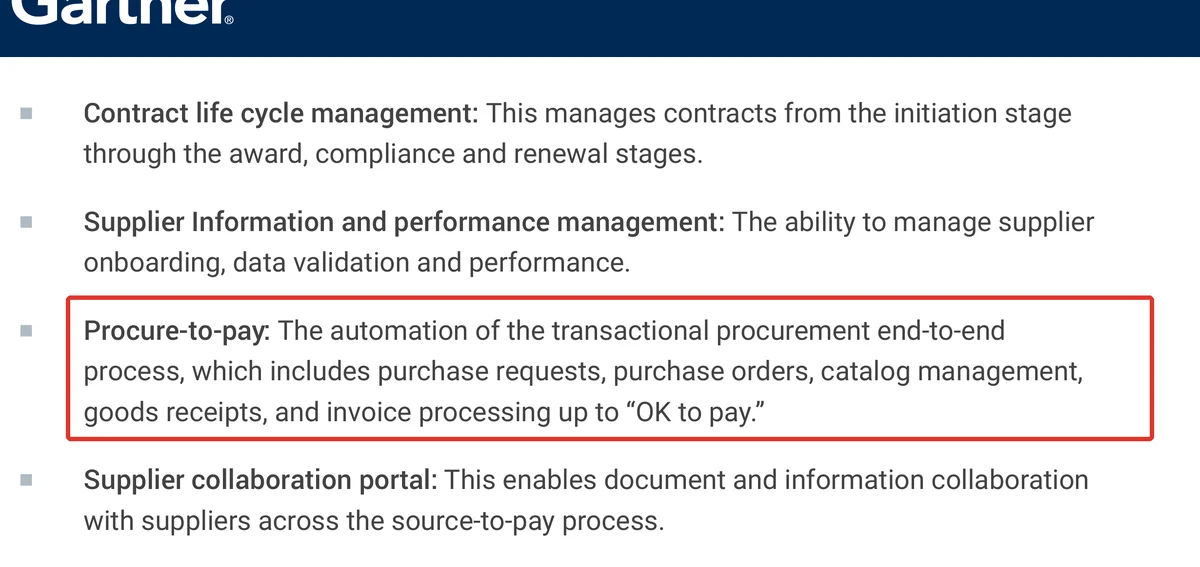
Gartner’s wording is “purchase requests, purchase orders, catalog management, goods receipts, and invoice processing up to OK to pay”. That list is the test for any P2P tool on your shortlist.
Invoice matching is where P2P earns its keep. A two-way match checks the invoice against the PO, and a three-way match also checks the goods receipt, so you pay only for what arrived.
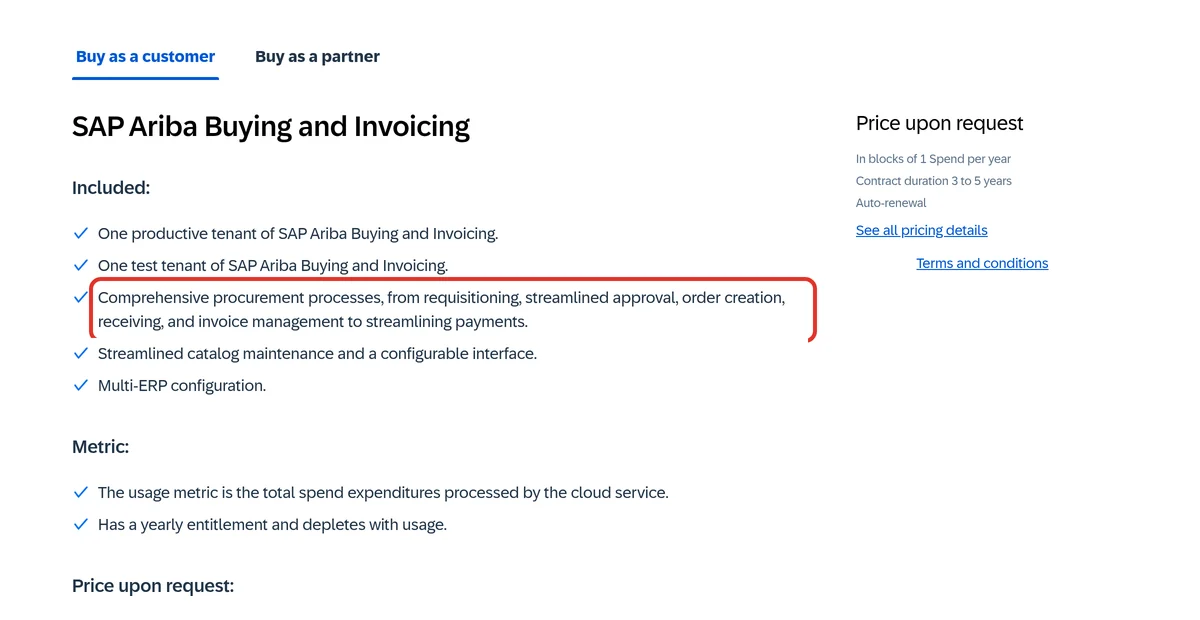
SAP sells this layer as its own product. The pricing page for SAP Ariba Buying and Invoicing lists the full P2P flow and prices it on total spend processed.
What does source-to-pay add on top of procure-to-pay?
Source-to-pay adds the upstream work that decides what you buy, from whom and on what terms. That means spend analysis, sourcing events such as RFIs, RFQs and RFPs, contract lifecycle management, supplier onboarding and performance, and a supplier portal. Gartner also requires the modules to share data natively, with no extra integration work.
- Sourcing: RFx events with bid collection, evaluation, negotiation and award, per Gartner’s mandatory feature list.
- Contracts: management from initiation through award, compliance and renewal, so POs can be checked against negotiated terms.
- Suppliers: onboarding, data validation and performance tracking in one record.
- Spend analytics: reporting across all systems and data sources, which Gartner also requires of suites.
The payoff is the joined-up record. Gartner’s example is a buyer viewing a purchase order alongside its contract, the sourcing event behind it, and the receipts, invoices and payments that followed. JAGGAER’s S2P page sums up the suite model in one line.
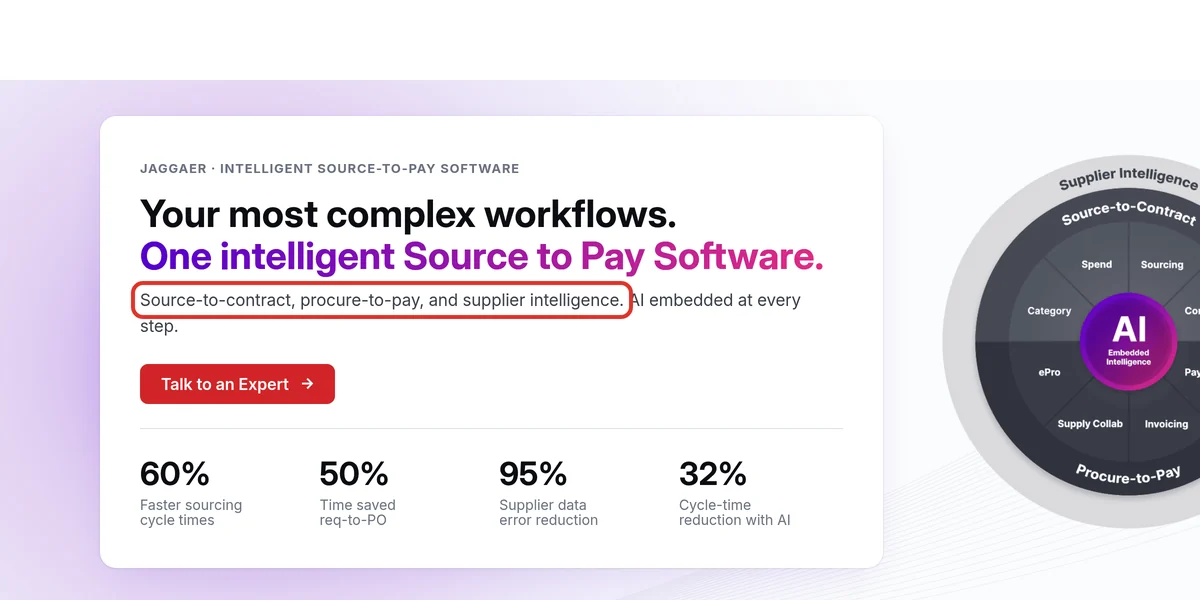
Zycus pitches its S2P platform the same way, promising savings “from spend analysis to payment”. Next-gen SAP Ariba is marketed on its S2P page as “the first AI-native source-to-pay suite”.
Is the line between P2P and S2P software blurring?
Yes, several P2P tools now list a light version of an S2P module, such as a contract repository or RFPs on a higher plan. Precoro, Procurify and Zoho Procurement all do. A full S2P suite still differs in depth and in how tightly the modules share data, which is what Gartner tests for.
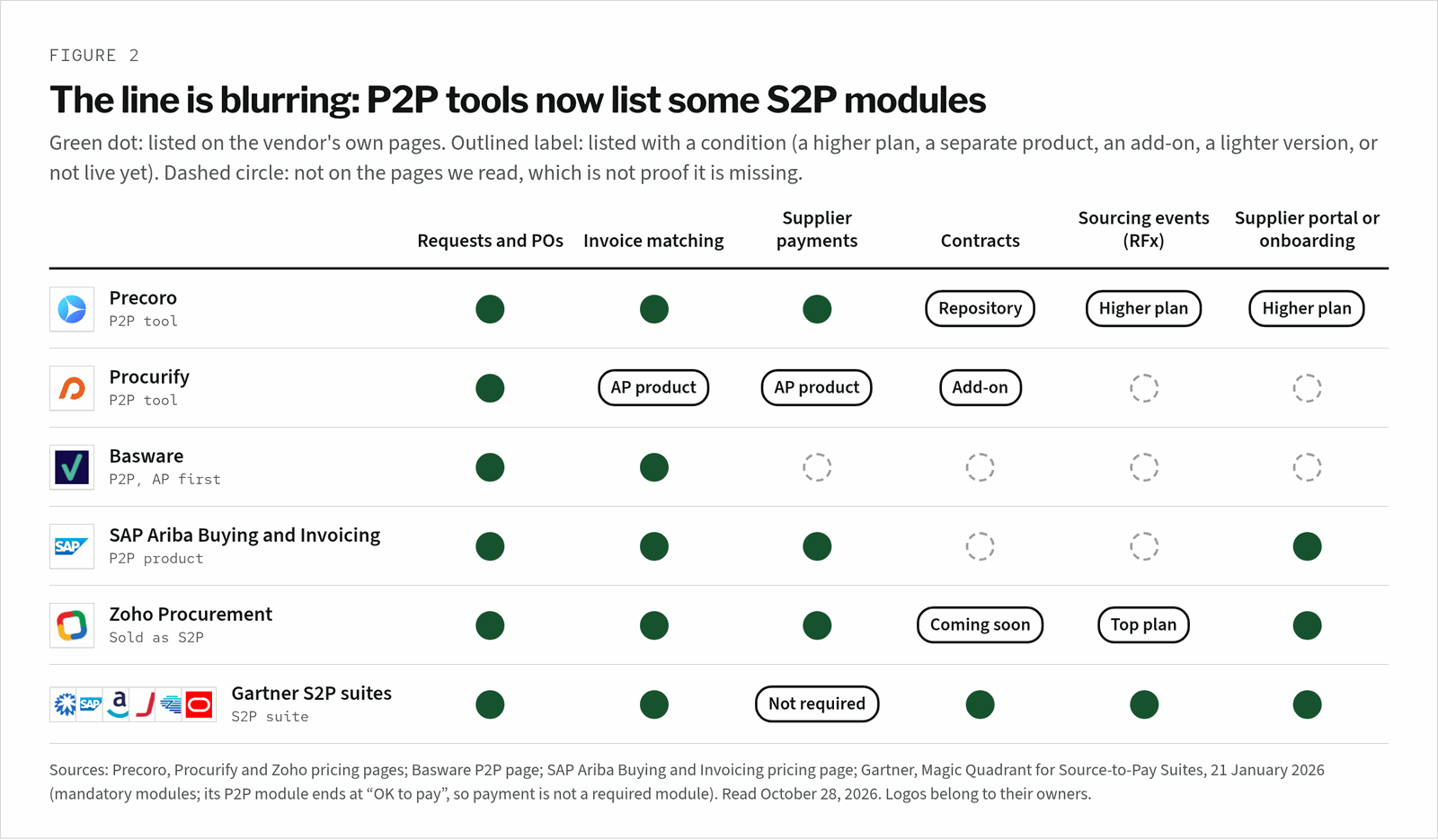
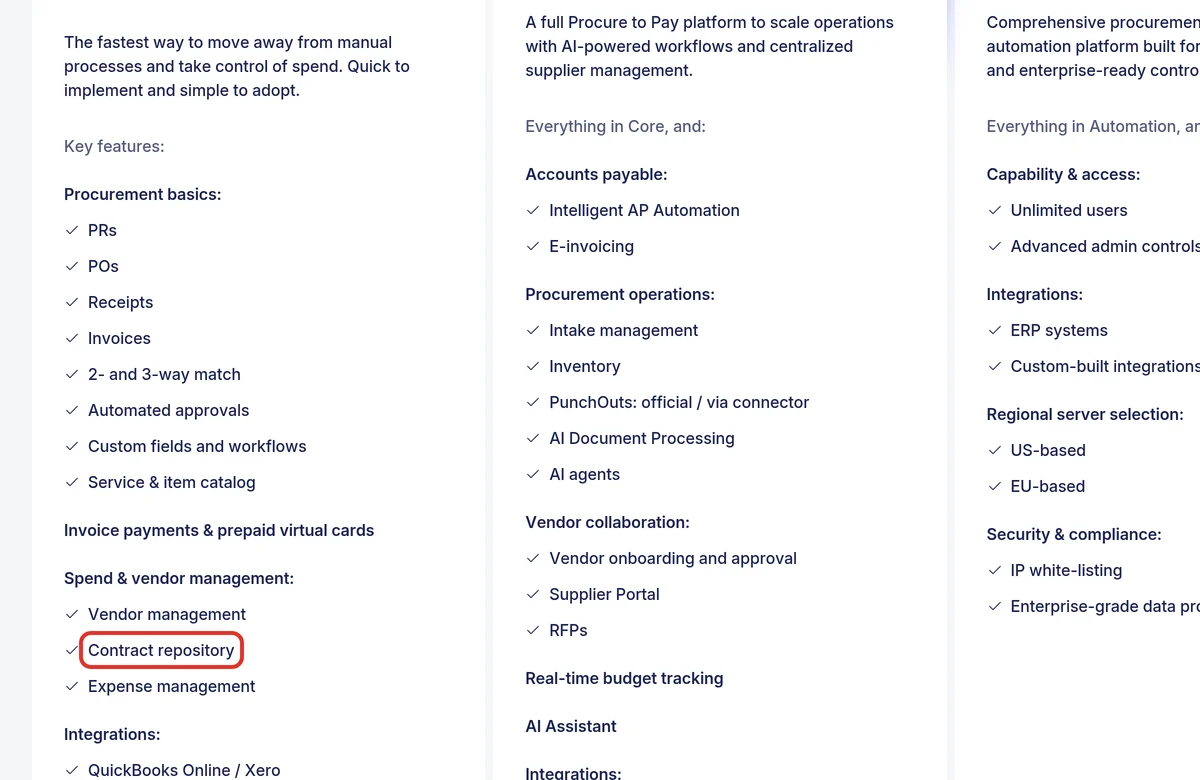
Precoro is the clearest example. Its Core plan includes a contract repository, and its Automation plan adds a supplier portal and RFPs.
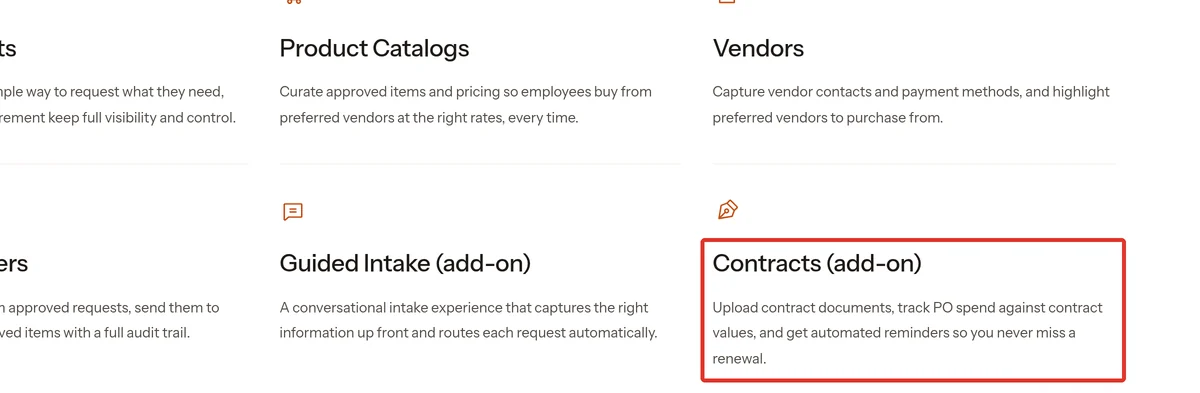
Procurify sells contracts as an add-on. Its pricing page says every customer starts with Purchasing, then adds products such as AP or Expense & Card, and add-ons such as Guided Intake or Contracts.
Zoho goes further and calls Zoho Procurement “a complete source-to-pay platform” on its home page. Its pricing table puts strategic sourcing and contract management in the Enterprise plan only, with contract management marked as coming soon.
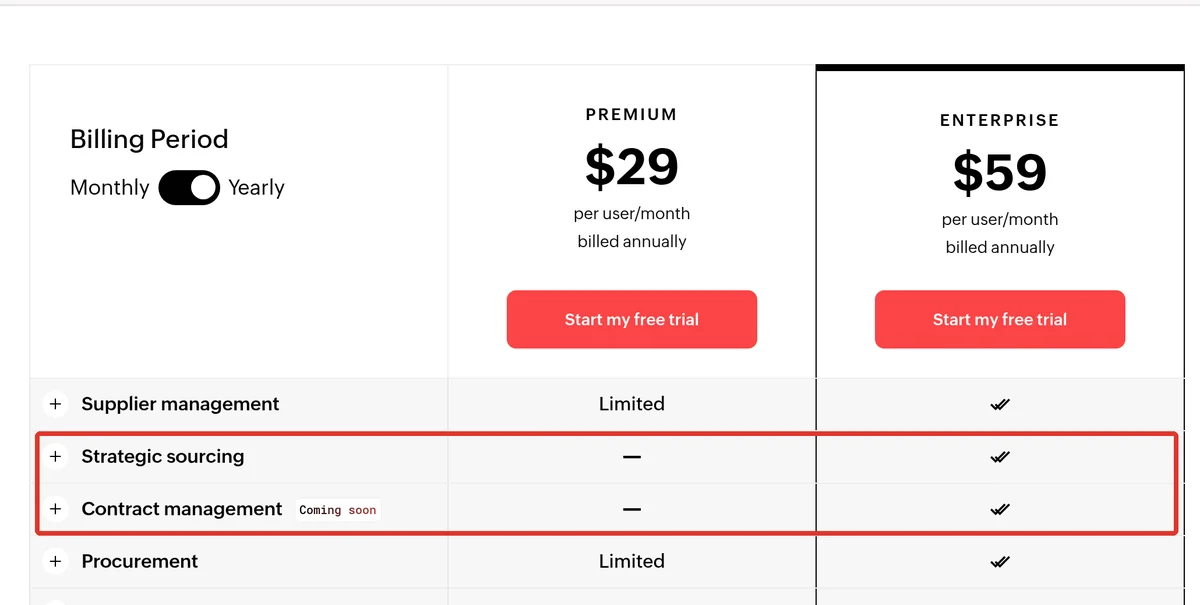
A contract repository stores contracts. Gartner defines contract lifecycle management as managing contracts from initiation through award, compliance and renewal, so ask which one a P2P tool means.
How do S2P and P2P software prices compare?
P2P tools are cheaper to start: Precoro lists $499 a month and Zoho $29 per user a month. S2P suites sell multi-year contracts, such as Coupa from $50k a year on 3 or 5 year terms. The pricing unit also differs: platform tiers, users, spend processed or hosted named users.
| Product | Sold as | Pricing unit | Published price |
|---|---|---|---|
| Precoro | P2P tool | Platform plan, billed annually | Core from $499 a month; Automation from $999 a month |
| Procurify | P2P tool | Quote built from products, add-ons, users and integrations | Quote based |
| Zoho Procurement | Sold as S2P | Per user a month, billed annually | Premium $29; Enterprise $59 |
| SAP Ariba Buying and Invoicing | P2P product | Total spend processed, 3 to 5 year contract | Price on request |
| Oracle Procurement | Part of Oracle Fusion Cloud | Per hosted named user a month | $625, 10-user minimum; self service $8, 100-user minimum |
| Coupa | S2P suite | Annual subscription, 3 or 5 year terms | From $50k a year |
Our procurement software guide covers the wider cost drivers, such as implementation and supplier fees.
When is your ERP’s own procurement module enough?
Your ERP’s own procurement module is often enough when one ERP runs the business and most spend goes through catalogs and POs. Oracle says its Fusion Cloud Procurement “automates procure-to-pay, sourcing, and supplier management”. A separate suite earns its place when you run several ERPs or need deeper sourcing.
Gartner flags the trade-off in both directions. It warns buyers on non-Oracle infrastructure to assess the challenges of deploying Oracle’s S2P solution. It also requires every suite in its report to be “ERP/financial-system-agnostic”, which is the case for buying a suite over a module.
Basware states the multi-ERP case for P2P directly on its P2P page: start with AP automation and “Cover all purchase order sources by integrating into any existing procurement or ERP system.” It aims that product at teams with more than 50,000 invoices a year.
What are the signs you have outgrown procure-to-pay?
You have outgrown procure-to-pay when the problems sit before the purchase order. Contracts are hard to find, suppliers are chosen without a bid, and nobody can tie a PO back to the price that was negotiated. A P2P tool controls spend once it starts, but S2P shapes it earlier.
- Renewals slip because contracts live in inboxes and shared drives
- Large purchases skip a competitive bid
- Supplier onboarding and risk checks happen outside the buying system
- Spend reports need data pulled from several tools by hand
- POs cannot be checked against negotiated contract prices
One or two signs can be handled by a P2P plan with contracts or RFPs. Several point to a suite, and our best source-to-pay suites ranking is the place to start.
Should you choose source-to-pay or procure-to-pay?
Choose procure-to-pay if your main problem is control over everyday purchases and invoices, especially in a mid-market team on one ERP. Choose source-to-pay if sourcing, contracts and supplier risk also need fixing, or if you run several ERPs. Price the upgrade path before you sign, in case you need sourcing or contracts later.
The verdict
- Choose a P2P tool if approvals, POs and invoice matching are the pain and sourcing is occasional.
- Choose an AP-first P2P product if invoice volume, not purchasing, is the bottleneck.
- Choose your ERP’s module if one ERP runs finance and its procurement licence covers your needs.
- Choose an S2P suite if you run regular sourcing events, manage many contracts or run several ERPs.
To compare suites, read our best procurement software ranking, Coupa vs SAP Ariba and the Ivalua vs Coupa vs JAGGAER comparison. Teams leaving Coupa can start with our Coupa alternatives guide.
Frequently asked questions
Is procure-to-pay part of source-to-pay?
Yes, procure-to-pay is one module inside source-to-pay. Gartner lists P2P as a mandatory part of every S2P suite, alongside sourcing, contract lifecycle management, supplier management and a supplier portal. NetSuite also calls P2P a subset of S2P, focused on the transactional side of buying.
What is the difference between S2P and P2P?
S2P covers the full cycle from spend analysis and sourcing to paying the supplier. P2P covers only the transactional part: requests, approvals, purchase orders, goods receipts and invoice matching. S2P adds sourcing events, contract management and supplier management before the purchase order is raised.
Is source-to-contract the same as source-to-pay?
No, source-to-contract covers the upstream half of source-to-pay: spend analysis, sourcing events and contracts. Source-to-pay adds procure-to-pay after the contract is signed. JAGGAER describes its suite as source-to-contract, procure-to-pay and supplier intelligence together, and Gartner lists sourcing and contract lifecycle management as separate mandatory S2P modules.
Does procure-to-pay include accounts payable?
Usually, yes: invoice processing sits inside P2P, and NetSuite describes accounts payable as a subset of P2P. Gartner’s P2P definition stops at invoice approval, or OK to pay, so the payment itself may run in your ERP. Basware takes the AP-first route and starts P2P with invoice automation.
Do small businesses need source-to-pay software?
Most small businesses do not need a full source-to-pay suite, and our list of the best purchasing software for small business covers lighter tools. A P2P tool handles approvals, purchase orders and invoice matching, and some include a contract repository or RFPs on higher plans. Gartner’s S2P suites are judged on large customers with $500 million or more in revenue.
What is the difference between source-to-pay and procure-to-pay pricing?
P2P tools often publish prices, such as Precoro from $499 a month or Zoho from $29 per user a month. S2P suites usually sell multi-year contracts, such as Coupa from $50k a year on 3 or 5 year terms, or quote based on spend.