A sole-source supplier misses two shipments in a row. The buyer opens the approved vendor list to find a second source. There is nothing on it, and the search starts again from a blank page.
That is a discovery problem, and it costs weeks. Most teams still run it on web searches, trade directories and old contacts. Scoring incumbents with supplier performance management software shows earlier when a second source is needed.
A supplier discovery platform searches a large supplier database, checks the evidence and hands you a shortlist you can send an RFI to. We ranked the 8 best supplier discovery platforms on six weighted criteria. Every fact comes from vendor product, pricing and news pages read on November 5, 2026.
Our scoring rules are public. Related guides sit in the supplier management hub. Once a supplier is chosen, our supplier management software guide covers the record that follows.
What Is the Best Supplier Discovery Platform in 2026?
Speya is the best supplier discovery platform for most procurement teams in 2026, scoring 7.6 out of 10. It searches millions of suppliers in plain language and vets each one with a source for every answer. Veridion (7.4) suits teams that want company data by API. SourceReady (7.2) publishes its prices.
| # | Platform | Type | Best for | Score |
|---|---|---|---|---|
| 1 | Speya | AI search and vetting agent | Category teams that need a sourced shortlist and an RFI in one place | 7.6 |
| 2 | Veridion | Global company data layer | Teams feeding supplier data into their own tools by API | 7.4 |
| 3 | SourceReady | AI manufacturer search | Product teams sourcing manufacturers, with published prices | 7.2 |
| 4 | Supplier.io | Supplier data platform, now with TealBook | Enterprises that need supplier data, diversity data and a clean vendor master | 7.0 |
| 5 | Coupa (Scoutbee) | Discovery inside a spend suite | Existing Coupa customers | 6.5 |
| 6 | Sustainment | US manufacturing network with RFQs | Buyers of machined and fabricated parts in the US | 6.4 |
| 7 | Thomasnet | North American supplier directory | Industrial buyers who want a free first search | 5.4 |
| 8 | ImportYeti | US customs shipment records | Checking who a factory really ships to | 5.2 |
Our pick
Speya
Speya puts search, vetting and the RFI in one place. Its product page says agents check certifications, financials, ESG and sanctions, each with its source. Pricing is on request. Choose Veridion when you need the data inside your own systems.
What a Supplier Discovery Platform Does
A supplier discovery platform finds suppliers you do not already buy from. You describe a part, service or capability. The platform searches its supplier database, filters by location, certifications and capacity, and returns a shortlist. The better tools also show the evidence behind each match and send the RFI.
It is not the same job as supplier management. Discovery ends when a supplier is on your shortlist. Onboarding, compliance and performance start after that. Our best procurement software ranking covers the wider suite.
Which kind are you buying?
| Question | Directory | Data layer | AI search agent | Records and networks |
|---|---|---|---|---|
| Examples | Thomasnet | Veridion, Supplier.io | Speya, SourceReady, Coupa (Scoutbee) | ImportYeti, Sustainment |
| How you search | Keywords and filters | API queries or a data feed | A plain-language request | Shipment records, or a network of shops |
| What you get | A list of profiles | Company records to load into your tools | A ranked shortlist with evidence | Proof of real trade, or quotes |
| Who pays | Often the supplier, for visibility | You | You | You, with free tiers |
On r/procurement, one experienced sourcing buyer starts with customs records, then uses directories only to cross-check. The same comment warns that directory ranking can reflect marketing spend, not competence. That is a fair reason to use more than one kind of source.
What the Record Holds
A shortlist is only as good as the evidence on each line. Ask each vendor to show these fields for one real supplier in the demo. If a field has no source and no owner, it will not survive the first RFI.
Fields to see on every shortlisted supplier
| Field | Why it matters | Where it should come from | Who owns it |
|---|---|---|---|
| Capability and processes | Confirms the supplier makes the part, not just sells it | Supplier profile, product data or site visit | Category manager |
| Certifications, such as ISO 9001 | Screens out suppliers who cannot pass quality review | Certificate copy with an expiry date | Supplier quality |
| Location and plants | Sets lead time, freight cost and country risk | Registry data or the supplier profile | Category manager |
| Shipment history | Shows who the supplier really ships to, and how often | Customs or bill of lading records | Sourcing analyst |
| Sanctions and ownership | Stops a problem before it becomes a problem | Screening lists and registry data | Compliance |
| Financial health | Flags suppliers that may not last the contract | Credit or financial data | Finance |
| Contact and RFI status | Keeps the shortlist moving, in writing | The platform or your sourcing tool | Category manager |
How Do the 8 Supplier Discovery Platforms Score?
Speya scores 7.6, Veridion 7.4, SourceReady 7.2 and Supplier.io 7.0. Coupa (Scoutbee) and Sustainment score 6.5 and 6.4. Thomasnet and ImportYeti score 5.4 and 5.2. Scores are lower than in other categories because most vendors quote and few show vetting evidence.
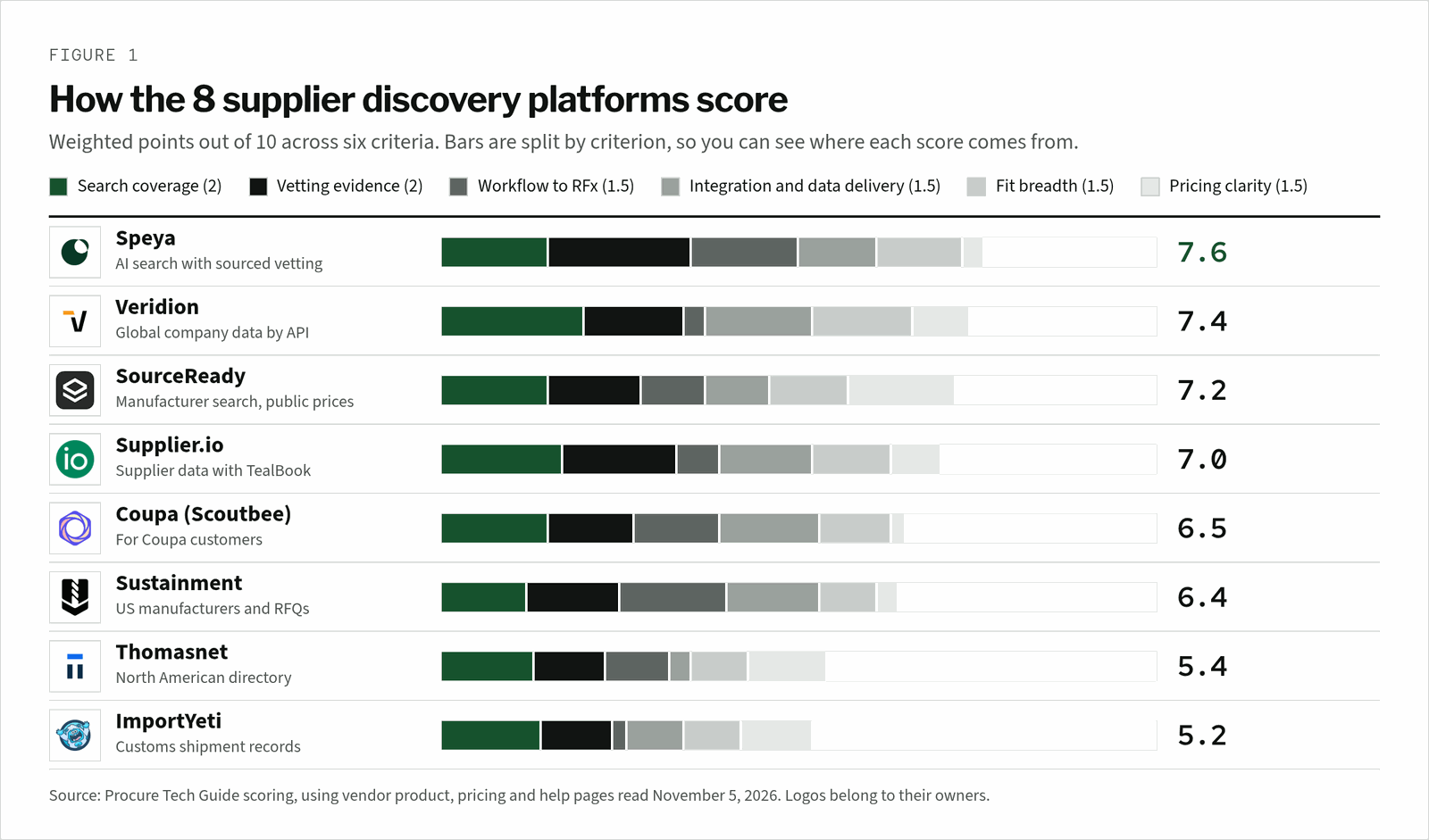
Read the bars by colour, not only the total. Veridion leads on search coverage, Speya on vetting evidence and the path to an RFI, and SourceReady on pricing clarity. A few tenths of a point is not a reason to pick one platform over another.
| Criterion | Weight | What earns points |
|---|---|---|
| Search coverage | 2 | A large, stated supplier universe, searchable by capability, product and location |
| Vetting evidence | 2 | Certifications, sanctions, financials or shipment data, with the source shown |
| Workflow to RFx | 1.5 | Shortlists, RFIs and RFQs sent and compared in the same tool |
| Integration and data delivery | 1.5 | API, connectors or data feeds into ERP, S2P or vendor master |
| Fit breadth | 1.5 | Works across regions, categories and team sizes |
| Pricing clarity | 1.5 | Published prices, or a clear pricing basis |
What Does Each Platform Say It Covers?
Speya and SourceReady state the widest coverage, from plain-language search to sanctions checks. Veridion and Supplier.io are data layers with large published counts. Sustainment and Thomasnet send RFQs or RFIs. Only SourceReady publishes a full price list; ImportYeti and Thomasnet offer free access.
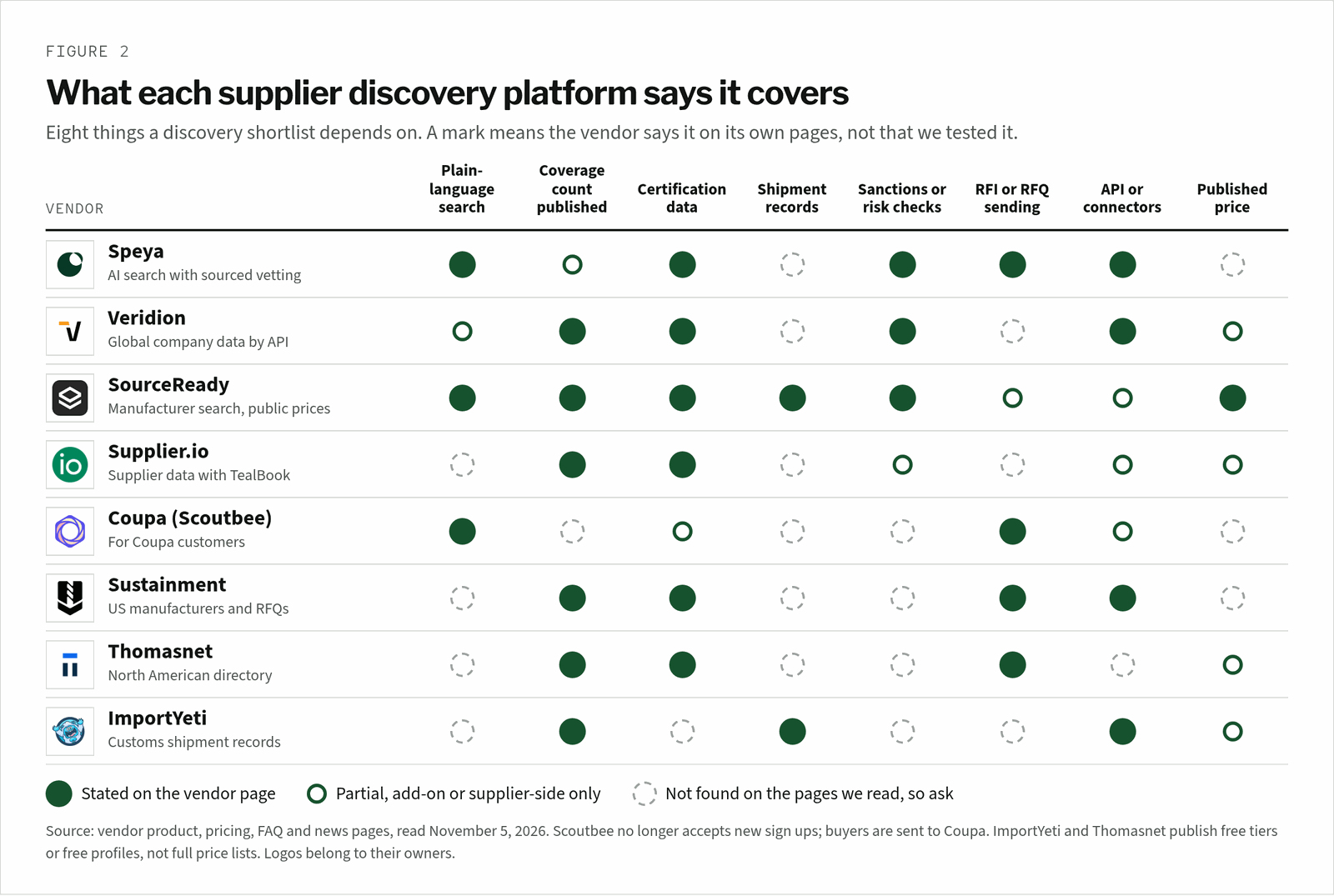
A dashed circle is a demo question, not a verdict. The feature may sit on a page we did not read, or in a higher tier. Ask each vendor to run one of your own open sourcing requests live.
The 8 Best Supplier Discovery Platforms, Reviewed
Each review covers how the platform searches, what evidence it shows, how you reach suppliers, what it costs and what we could not confirm. Every claim links to the vendor page where we read it. Screenshots show the vendor’s own page, with the relevant part outlined in red where it helps.
1. Speya
Speya, formerly Find My Factory, is built by Speya Intelligence AB in Stockholm. Its product page says you describe the need in plain language. Speya searches millions of suppliers and ranks what fits. Agents then fill in certifications, financials, ESG and sanctions for each supplier. If you then ask a new supplier for an EcoVadis rating, our guide to EcoVadis costs for suppliers shows what that request costs them. If EcoVadis is not the rating they hold, our guide to EcoVadis alternatives covers six other ways to check supplier sustainability.
Each answer carries its source. That matters when a stakeholder asks why a supplier made the list. Speya then sends an RFI, RFP or RFQ to the whole shortlist. Replies are read and structured for comparison, and suppliers can be monitored after that.
Speya says it is EU hosted, GDPR compliant, ISO 27001 certified and SOC 2 Type II audited. Its pricing page says “Pricing on request” and asks for your sourcing team size. One customer quote on that page says a search took under 10 minutes instead of two hours.
Strengths
- Search, vetting and RFx in one tool
- Sources shown for each answer
- EU hosting and named security audits
Watch-outs
- No published price
- Database size given only as “millions”
2. Veridion
Veridion is a company data layer, not a search screen for buyers. Its coverage page lists 578.8M registered legal entities and 186M operating companies across 250 countries and territories. It also lists 1.3B products and services, normalized against UNSPSC and refreshed weekly.
Its supplier sourcing page describes boolean queries through Search API V4. It also covers matching against your existing vendor master and risk monitoring, such as sanctions and ownership changes. Category managers can build filters in a playground, but the value lands when data flows into your tools.
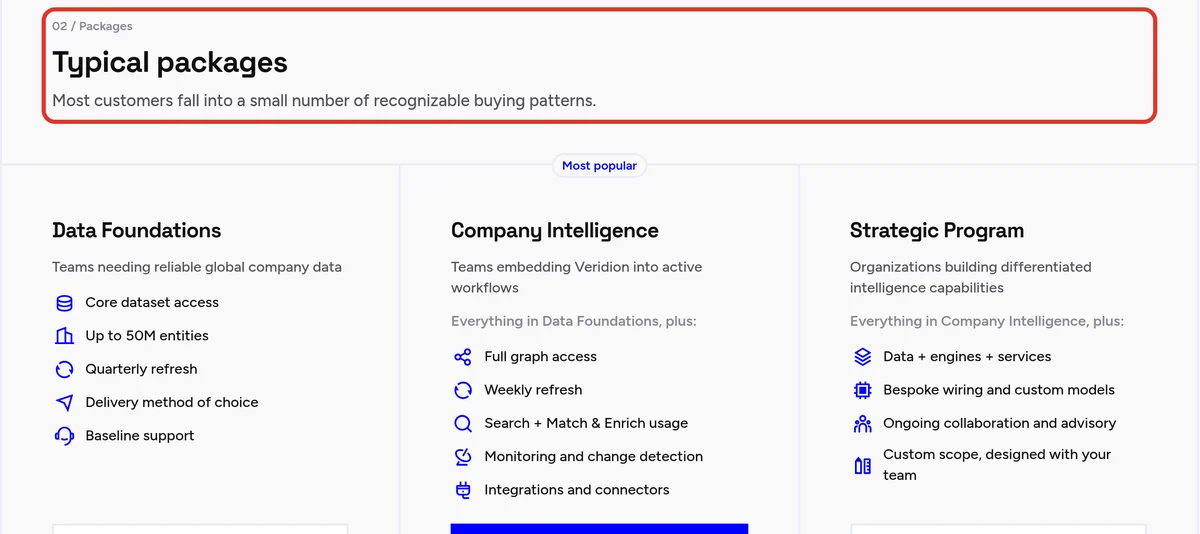
The pricing page describes three typical packages: Data Foundations covers up to 50M entities with a quarterly refresh. Company Intelligence, marked most popular, adds weekly refresh, Search and Match & Enrich. Strategic Program adds custom models. Cost depends on coverage, usage, delivery and services.
Strengths
- Huge, documented coverage
- API-first, with weekly refresh
- Clear package scopes and cost drivers
Watch-outs
- No price figures
- Needs data or IT work to get value
3. SourceReady
SourceReady searches manufacturers with AI. Its supplier discovery page says it covers 4 million manufacturers in 200 countries. Data comes from customs records, trade shows and directories. Profiles show shipment history, certifications and sanction screening, so you can check a supplier before the first email.
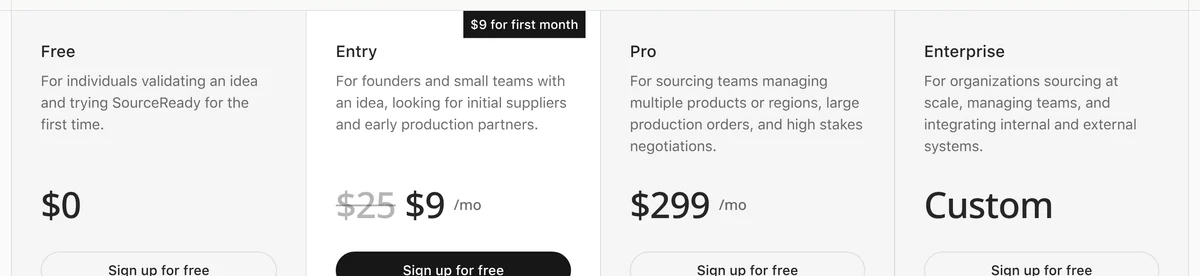
The pricing page lists four plans, starting with Free at $0 and 200 credits. Entry costs $25 a month on annual billing, or $35 monthly, with a lower first month. Pro costs $299 a month annually, or $379 monthly, with 48,000 credits a year. Enterprise is custom, with SSO and API.
Shipment filters, shipment insight and data export sit on Pro. Inquiry management is limited on Free and Entry. SourceReady says it is trusted by 20,000+ teams. It suits physical products far better than services or indirect spend.
Strengths
- Full price list, with a free plan
- Shipment history on supplier profiles
- Fast to start, no sales call
Watch-outs
- Built for manufactured products, not services
- Shipment filters and export need Pro
4. Supplier.io
Supplier.io is a supplier data platform best known for supplier diversity. Its supplier sourcing page lists 20M+ suppliers, 820M+ supplier insights and $12T in historical spend data. Buyers filter by services, experience and location. Alerts flag when a supplier certification expires. For its diversity data, see our supplier diversity software ranking.
On April 2, 2026, Supplier.io announced it had acquired TealBook, a verified supplier data foundation. TealBook now sits under Atlas, its new vendor master data product. The home page describes 240M+ verified legal entities across 145 countries, with 350+ attributes from 450+ sources.
The pricing page lists Basics, Base Platform and Advanced Platform packages, each with a “Get a quote” button. All packages include unlimited users. The release says the platform is trusted by 58% of the Fortune 100.
Strengths
- Large supplier and spend dataset
- Diversity and certification data built in
- Unlimited users on every package
Watch-outs
- No published price
- Discovery is one part of a wider data product
5. Coupa (Scoutbee)
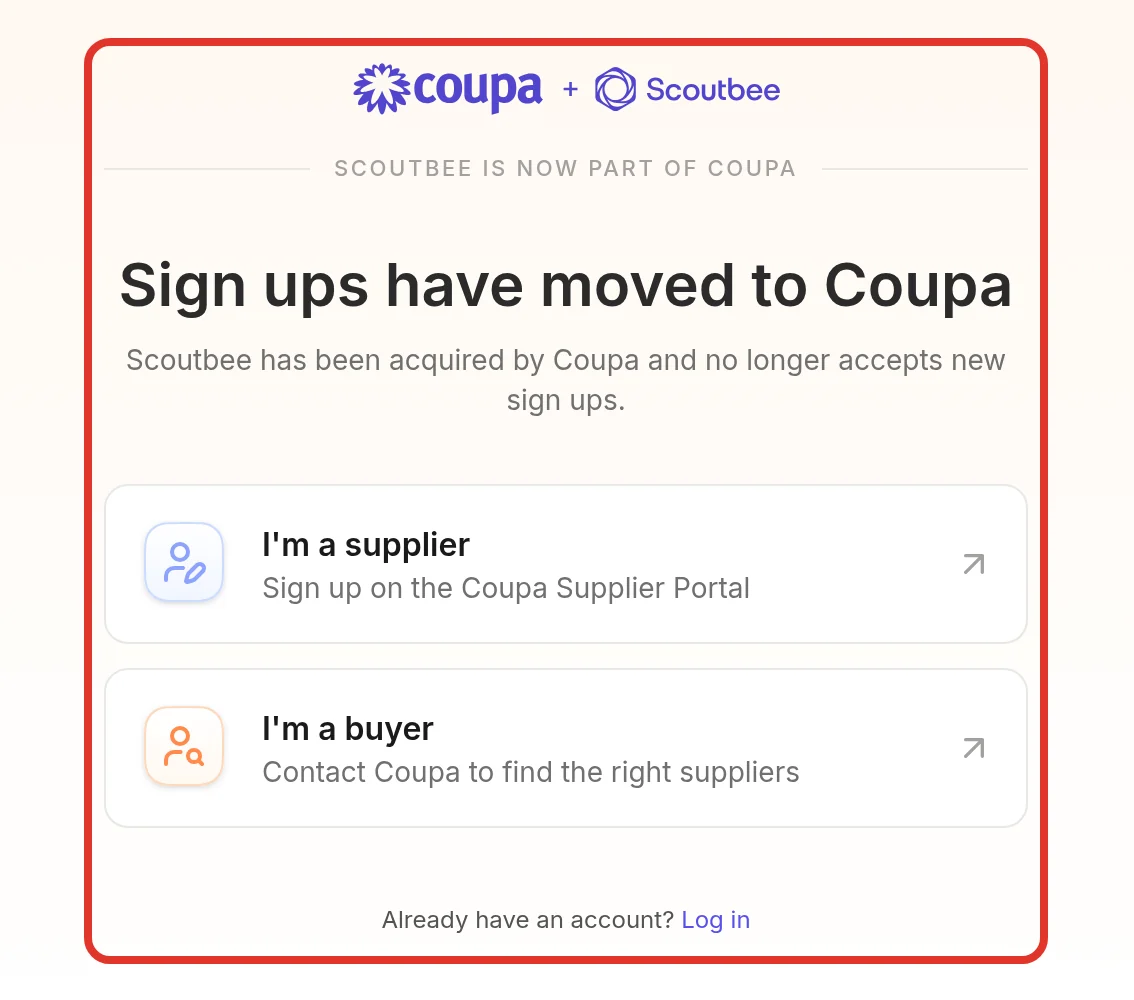
Scoutbee was one of the best-known AI supplier discovery tools. Coupa announced its acquisition on October 6, 2025. The release says Scoutbee search and network data would join the Coupa platform and its network of 10M+ buyers and suppliers.
Scoutbee’s own buyers page now says it “no longer accepts new sign ups”. Buyers are told to contact Coupa. Suppliers are sent to the Coupa Supplier Portal. The same page still describes deep search, RFI prequalification and anonymous supplier messaging.
For a Coupa customer, this can be the shortest path from search to sourcing event. For anyone else, it means buying into Coupa first. Ask Coupa in writing which Scoutbee features are live today, and in which modules.
Strengths
- Search and RFIs inside an existing suite
- Large buyer and supplier network
Watch-outs
- No new standalone sign ups
- No published price or coverage count
6. Sustainment
Sustainment is a network of American manufacturing suppliers. Its strategic sourcing page lists 120,000+ discoverable suppliers and 10,000,000+ data points. Buyers filter by processes, materials, equipment, certifications and location, then send structured RFQs to approved suppliers at once.
Suppliers respond to RFQs at no cost. The supplier relationship management page says everything on a supplier record is private to your organization. Integrations cover NetSuite, SAP, Oracle and Epicor Kinetic, plus an API and MCP server.
Sustainment does not publish a price list; the pricing link we tried returned a 404. It fits US direct materials best. If you source globally or buy services, use it next to a wider tool.
Strengths
- Discovery flows straight into RFQs
- ERP integrations named
- Supplier records stay private
Watch-outs
- US manufacturing only
- No published price
7. Thomasnet
Thomasnet is the long-running North American industrial directory. Its about page describes more than 500,000 North American suppliers. Buyers search and filter by location and certifications, build and share shortlists, and send RFIs or request quotes from several suppliers in one step.
Suppliers claim a free company profile, and Thomas sells them sponsored listings and other visibility. That is the trade-off with any directory. Placement can reflect what a supplier pays, so verify capability before you trust a ranking.
Thomasnet shows no sanctions screening, shipment records or API on the pages we read. It works well as a first search for US and Canadian industrial suppliers. Pair it with customs records or a data tool for evidence.
Strengths
- Large North American directory
- Shortlists and RFIs built in
- Free to start
Watch-outs
- Rankings can be influenced by paid placement
- Little vetting evidence on profiles
8. ImportYeti
ImportYeti searches US customs bill of lading data. Its home page says you can search 714,490,386 customs shipment records, updated daily. You can look up a company and see its suppliers, or look up a factory and see who it ships to.
The about page tells the story. It launched in 2020 as a “Free Bill of Lading Database” and crossed 1,000,000 and then 2,000,000 users. The FAQ covers plans, an API and integrations, with API limits set by plan.
Shipment records prove trade, not quality. They will not show certifications or financial health. Use ImportYeti to confirm that a shortlisted supplier really makes and ships what it claims, then vet it elsewhere.
Strengths
- Free search of real shipment records
- Exposes resellers posing as factories
- API and integrations listed
Watch-outs
- US import data only
- No certification or risk data
Supplier Discovery Platform Pricing: Published or Quote?
Most supplier discovery platforms quote, and SourceReady is the only one here with a full public price list. ImportYeti offers free search, and Thomasnet offers free supplier profiles. Veridion explains its packages and cost drivers without figures. Get every quote in writing, with usage limits named.
| Platform | Pricing model | Published price | Source |
|---|---|---|---|
| SourceReady | Subscription with credits | Free $0; Entry $25 a month and Pro $299 a month on annual billing; Enterprise custom | Pricing page |
| ImportYeti | Free search, paid plans | Free sign up; paid plan prices not on a public page | FAQ |
| Thomasnet | Supplier-paid visibility | Free supplier profiles; sponsored listings sold to suppliers | Thomas for business |
| Veridion | Package by coverage, usage, delivery and services | Quote; three typical packages described | Pricing page |
| Supplier.io | Package with unlimited users | Quote | Pricing page |
| Speya | By sourcing team size | Pricing on request | Pricing page |
| Sustainment, Coupa (Scoutbee) | Sales led | Not published | Scoutbee buyers page |
Usage drives cost in this category. Ask how many searches, credits, exports or API calls the quote includes, and what happens when you go over. Put the overage rate in writing.
Directories, Data Layers and AI Agents: Which Kind Do You Need?
Pick by who will use it and how often: a category manager with one urgent search needs an AI agent or a directory. A data team building a supplier master needs a data layer. A buyer checking a new factory needs shipment records. Many teams end up using two.
- One-off searches for parts or products: SourceReady or Thomasnet, plus ImportYeti to check shipments.
- Regular sourcing projects across categories: Speya, or Coupa (Scoutbee) if you already run Coupa.
- Supplier data in ERP, S2P or vendor master: Veridion or Supplier.io.
- US machined and fabricated parts with RFQs: Sustainment.
After Signature
Discovery only pays off if new suppliers make it through onboarding. Our supplier onboarding software ranking covers that step. Agree these steps when you sign the discovery tool, and name who owns each one in writing.
- Write the search brief once: part or service, volumes, locations, certifications and deadline.
- Set a minimum evidence bar for the shortlist, such as a valid certificate and a sanctions check. Once a supplier is approved, supplier compliance management software keeps those certificates current.
- Confirm the supplier is a manufacturer, not a reseller, using shipment records or a business license.
- Send one RFI template to every shortlisted supplier, so answers can be compared.
- Record why each supplier was kept or dropped, so the next buyer does not repeat the search.
- Hand shortlisted suppliers to onboarding with their documents attached. Our source-to-pay suites guide covers where that record lives.
- Review the tool after three sourcing projects: suppliers found, suppliers onboarded and time saved.
Red Flags in a Demo
- The vendor will not say how many suppliers it covers, or where the data comes from.
- Search results show no source for certifications or sanctions answers.
- The demo uses a prepared category, not one of your own open requests.
- Shortlisted suppliers include distributors listed as manufacturers.
- Results are ranked, but the vendor cannot explain why one supplier sits above another.
- Exports, API access or RFIs turn out to be a higher tier.
- The tool has changed owner, and nobody can say what the roadmap is.
Three Claims About These Tools Worth Checking
Several pages that rank for this topic are out of date. We checked three claims against primary sources.
- “Scoutbee is the top supplier discovery platform.” One top-10 list and one AI agent directory still rank Scoutbee first. Its buyers page now says Scoutbee no longer accepts new sign ups, and sends buyers to Coupa.
- “TealBook is a standalone option with its own pricing.” A software guide lists it that way. Supplier.io announced the TealBook acquisition on April 2, 2026. Buy it through Supplier.io now.
- “Tealbook costs $30,000 to $80,000 a year, Scoutbee $40,000 to $90,000.” A comparison page gives these ranges. Neither vendor publishes a price, so treat them as estimates and ask for a quote.
Verdict
Pick Speya when category teams need a sourced shortlist and an RFI in one tool. Pick Veridion or Supplier.io when supplier data must flow into your own systems. SourceReady suits product sourcing with a public price list. Coupa customers should ask about Scoutbee first, Sustainment suits US parts, and Thomasnet plus ImportYeti make a free starting kit.
If discovery feeds a sourcing event, see our Keelvar vs Fairmarkit comparison. For a wider suite decision, see our Coupa alternatives guide.
Frequently Asked Questions
What is a supplier discovery platform?
A supplier discovery platform helps procurement teams find suppliers they do not already buy from. You describe a part, product or service, and it searches a large supplier database, filters by location, certifications and capability, and returns a shortlist. Examples include Speya, Veridion, SourceReady, Supplier.io and Thomasnet.
Is Scoutbee still available?
Scoutbee was acquired by Coupa, announced on October 6, 2025. Its buyers page now says Scoutbee no longer accepts new sign ups. Buyers are told to contact Coupa, and suppliers are sent to the Coupa Supplier Portal. Existing Coupa customers should ask which Scoutbee features are live in their modules.
What happened to TealBook?
Supplier.io announced on April 2, 2026 that it had acquired TealBook, a verified supplier data foundation. TealBook’s technology now supports Atlas, the Supplier.io vendor master data product. Teams that want TealBook data should talk to Supplier.io, which quotes its packages and includes unlimited users on all of them.
How much do supplier discovery platforms cost?
Only SourceReady publishes a full price list: a free plan, Entry at $25 a month and Pro at $299 a month on annual billing, with Enterprise custom. ImportYeti offers free search. Speya, Veridion, Supplier.io, Sustainment and Coupa quote, so ask how many searches, credits or API calls each quote includes.
Are free supplier directories good enough?
Free directories such as Thomasnet are a good first search, especially for North American industrial suppliers. But placement can reflect what a supplier pays for visibility, and profiles carry little evidence. Check shortlisted suppliers against shipment records, certificates and sanctions lists before you send an RFQ.
How do I check a supplier is a real manufacturer?
Look at customs shipment records, such as ImportYeti, to see what the company actually ships and to whom. Ask for a business license and certificates naming the factory address. Compare the claimed processes with the equipment listed. Distributors often look like manufacturers until you check the records.